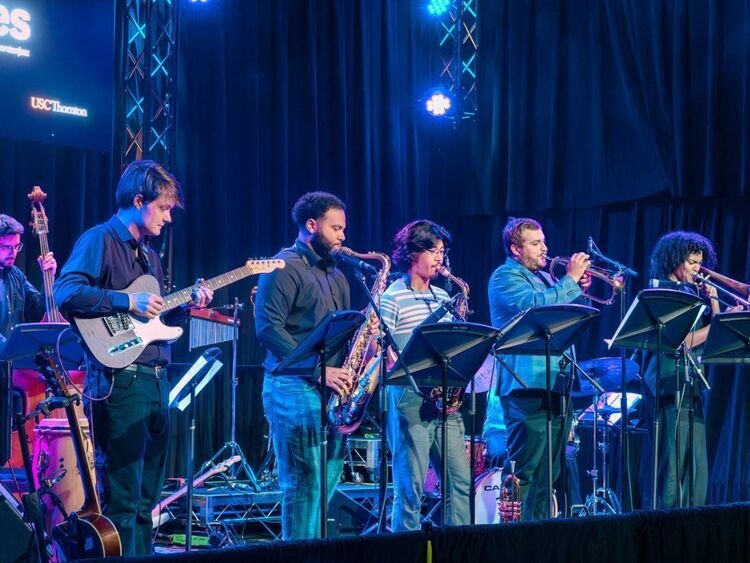
Thornton Winds

-
Date
Friday, 11/6 -
Time
7:00 pm -
Location
Bovard Auditorium (ADM)
Thornton Winds
Friday, November 6th at 7:00pm
Bovard Auditorium
Frank Ticheli, Conductor
Sophia Thompson, Soprano Soloist
The Thornton Wind ensemble presents a special evening featuring guest conductor Frank Ticheli. The program features works by Omar Thomas, David Maslanka, as well as Maestro Ticheli himself.
Program
Frank Ticheli, Angels in the Architecture
(b. 1958)
Omar Thomas, Come Sunday
(b. 1982)
1. Testimony
2. Shout!
Intermission
David Maslanka, Symphony No. 4
Program Notes
Frank Ticheli, Angels in the Architecture
2008
Angels in the Architecture was commissioned by Kingsway International, and received its premiere performance at the Sydney Opera House on July 6th, 2008 by a massed band of young musicians from Australia and the United States, conducted by Matthew George. The work unfolds as a dramatic conflict between the two extremes of human existence – one divine, the other evil.
The work’s title is inspired by the Sydney Opera House itself, with its halo-shaped acoustical ornaments hanging discreetly above the performance stage.
Angels in the Architecture begins with a single voice singing a 19th-century Shaker song:
I am an angel of Light
I have soared from above
I am cloth’d with Mother’s love.
I have come, I have come,
To protect my chosen band
And lead them to the promised land.
This “angel” – represented by the singer – frames the work, surrounding it with a protective wall of light and establishing the divine. Other representations of light – played by instruments rather than sung – include a traditional Hebrew song of peace (“Hevenu Shalom Aleichem”) and the well-known 16th-century Genevan Psalter, “Old Hundredth.” These three borrowed songs, despite their varied religious origins, are meant to transcend any one religion, representing the more universal human ideals of peace, hope, and love. An original chorale, appearing twice in the work, represents my own personal expression of these aspirations.
In opposition, turbulent, fast-paced music appears as a symbol of darkness, death, and spiritual doubt. Twice during the musical drama, these shadows sneak in almost unnoticeably, slowly obscuring, and eventually obliterating the light altogether. The darkness prevails for long stretches of time, but the light always returns, inextinguishable, more powerful than before. The alternation of these opposing forces creates, in effect, a kind of five-part rondo form (light – darkness – light — darkness – light).
Just as Charles Ives did more than a century ago, Angels in the Architecture poses the unanswered question of existence. It ends as it began: the angel reappears singing the same comforting words. But deep below, a final shadow reappears – distantly, ominously.
-Note from the composer
Omar Thomas, Come Sunday
(2018)
I played trombone in wind ensembles from the 4th grade through college. This experience has contributed significantly to the life I lead now. I had the pleasure of being exposed to sounds, colors, moods, rhythms, and melodies from all over the world. Curiously absent, however, was music told authentically from the African-American experience. In particular, I couldn’t understand how it was that no composer ever thought to tell the story of a black worship experience through the lens of a wind ensemble. I realize now that a big part of this was an issue of representation. One of the joys and honors of writing music for wind ensemble is that I get to write music that I wish had existed when I was playing in these groups — music that told the story of the black experience via black composers. I am so grateful to Dr. Tony Marinello and the Illinois State University Wind Symphony for leading an incredible consortium that brought this piece to life. I can’t tell you how much I’m looking forward to hanging with Tony and the group for a week in about a month’s time!
Come Sunday is a two-movement tribute to the Hammond organ’s central role in black worship services. The first movement, Testimony, follows the Hammond organ as it readies the congregation's hearts, minds, and spirits to receive The Word via a magical union of Bach, blues, jazz, and R&B. The second movement, Shout!, is a virtuosic celebration — the frenzied and joyous climactic moment(s) when The Spirit has taken over the service. The title is a direct nod to Duke Ellington, who held an inspired love for classical music and allowed it to influence his own work in a multitude of ways. To all the black musicians in wind ensemble who were given opportunity after opportunity to celebrate everyone else’s music but our own — I see you and I am you. This one’s for the culture!
-Note from the composer
David Maslanka, Symphony No. 4
(1993)
The sources that give rise to a piece of music are many and deep. It is possible to describe the technical aspects of a work – its construction principles, its orchestration – but nearly impossible to write of its soul-nature except through hints and suggestions.
The roots of Symphony No. 4 are many. The central driving force is the spontaneous rise of the impulse to shout for the joy of life. I feel it is the powerful voice of the Earth that comes to me from my adopted western Montana, and the high plains and mountains of central Idaho. My personal experience of the voice is one of being helpless and torn open by the power of the thing that wants to be expressed – the welling-up shout that cannot be denied. I am set aquiver and am forced to shout and sing. The response in the voice of the Earth is the answering shout of thanksgiving, and the shout of praise.
Out of this, the hymn tune “Old Hundred,” several other hymn tunes (the Bach chorales “Only Trust in God to Guide You” and “Christ Who Makes Us Holy”), and original melodies which are hymn-like in nature, form the backbone of Symphony No. 4.
To explain the presence of these hymns, at least in part, and to hint at the life of the Symphony, I must say something about my long-time fascination with Abraham Lincoln. Carl Sandburg’s monumental Abraham Lincoln offers a picture of Lincoln in death. Lincoln’s close friend, David R. Locke saw him in his coffin. According to Locke, his face had an expression of absolute content, of relief at having thrown off an unimaginable burden. The same expression had crossed Lincoln’s face only a few times in life; when after a great calamity, he had come to a great victory. Sandburg goes on to describe a scene from Lincoln’s journey to final rest at Springfield, Illinois. On April 28th, 1865, the coffin lay on a mound of green moss and white flowers in the rotunda of the capitol building in Columbus, Ohio. Thousands of people passed by each hour to view the body. At four in the afternoon, in the red-gold of a prairie sunset, accompanied by the boom of minute guns and a brass band playing “Old Hundred,” the coffin was removed to the waiting funeral train.
For me, Lincoln’s life and death are as critical today as they were more than a century ago. He remains a model for this age. Lincoln maintained in his person the tremendous struggle of opposites raging in the country in this time. He was inwardly open to the boiling chaos, out of which he forged the framework of a new unifying idea. It wore him down and killed him, as it wore and killed the hundreds of thousands of soldiers in the Civil War, as it has continued to wear and kill by the millions up to the present day. Confirmed in the world by Lincoln was the unshakable idea of the unity of all the human race, and by extension the unity of all life, and by further extension, the unity of all life with all matter, with all energy, and with the silent and seemingly empty and unfathomable mystery of our origins.
Out of chaos and fierce joining of opposite comes new life and hope. From this impulse I used “Old Hundred,” known as the Doxology – a hymn of praise to God; Praise God from Whom all Blessings Flow; Gloria in exclesis Deo – the mid-sixteenth century setting of Psalm 100. Psalm 100 reads in part:
Make a joyful noise unto the Lord, all ye lands. Serve the Lord
with gladness; come before his presence with singing… Enter into
his gates with thanksgiving and into his courts with praise: be
thankful unto him, and bless his name.
I have used Christian symbols because they are my cultural heritage, but I have tried to move through them to a depth of universal humanness, to an awareness that is not defined by religious label. My impulse through this music is to speak to the fundamental human issues of transformation and re-birth in this chaotic time.
-Note from the composer
ABOUT FRANK TICHELI
Frank Ticheli’s music has been described as being “optimistic and thoughtful” (Los Angeles Times), “lean and muscular” (New York Times), “brilliantly effective” (Miami Herald) and “powerful, deeply felt crafted with impressive flair and an ear for striking instrumental colors” (South Florida Sun-Sentinel). Ticheli (b. 1958) joined the faculty of the University of Southern California’s Thornton School of Music in 1991, where he is Professor of Composition. From 1991 to 1998, Ticheli was Composer in Residence of the Pacific Symphony.
Frank Ticheli’s orchestral works have received considerable recognition in the U.S. and Europe. Orchestral performances have come from the Philadelphia Orchestra, Atlanta Symphony, Detroit Symphony, Dallas Symphony, American Composers Orchestra, the radio orchestras of Stuttgart, Frankfurt, Saarbruecken, and Austria, and the orchestras of Austin, Bridgeport, Charlotte, Colorado, Haddonfield, Harrisburg, Hong Kong, Jacksonville, Lansing, Long Island, Louisville, Lubbock, Memphis, Nashville, Omaha, Phoenix, Portland, Richmond, San Antonio, San Jose, Wichita Falls, and others.
Ticheli is well known for his works for concert band, many of which have become standards in the repertoire. In addition to composing, he has appeared as guest conductor of his music at Carnegie Hall, at many American universities and music festivals, and in cities throughout the world, including Schladming (Austria), Beijing and Shanghai, London and Manchester, Singapore, Rome, Sydney, and numerous cities in Japan.
Frank Ticheli is the recipient of a 2012 “Arts and Letters Award” from the American Academy of Arts and Letters, his third award from that prestigious organization. He is a two-time winner of the NBA/William D. Revelli Memorial Band Composition Contest (Symphony no. 2 in 2006, and Lux Perpetua in 2021). Other awards include the Walter Beeler Memorial Prize and First Prize awards in the Texas Sesquicentennial Orchestral Composition Competition, Britten-on-the-Bay Choral Composition Contest, and Virginia CBDNA Symposium for New Band Music.
In 2018, Ticheli received the University of Michigan Alumni Society’s highest honor, the Hall of Fame Award, in recognition for his career as a composer. He was also awarded national honorary membership to Phi Mu Alpha Sinfonia, “bestowed to individuals who have significantly contributed to the cause of music in America,” and the A. Austin Harding Award by the American School Band Directors Association, “given to individuals who have made exceptional contributions to the school band movement in America.” At USC, he has received the Dean’s Award for Professional Achievement, and the Virginia Ramo Award “in recognition of outstanding contribution to music and education, to the USC Thornton School of Music and University of Southern California, and to Humanity.”
Frank Ticheli’s works are published by Manhattan Beach, Southern, Hinshaw, and Encore Music, and are recorded on the labels of Albany, Chandos, Clarion, Equilibrium, Klavier, Koch International, Mark, Naxos, and Reference.
-Bio from the Boston University College of Fine Arts
Roster
* denotes principal on Ticheli
^ denotes principal on Thomas
+ denotes principal on Maslanka
Flute
Aarushi Kumar
Dennis Papazyan+
Emilie Yoo
Emma Park^
Hannelle Yang
Kimberly Tsou
Seungbeom Oh
Tony Lin*
Oboe
Connor Freyen
Jingming Zhao
Noel Takaya*^+
Clarinet
Alexander Erlich-Herzog*
Andrei Bancos+
Ashrey Shah^
Caroline Weiss
Harrison Chiang
Heesoo Kim
Jane Pankhurst
Leo Tellefsen
Mauricio Castillo
Siyuan Yin
Bassoon
Callahan Lieungh^+
Jorge Cruz-Hernandez*
Mio Yamauchi
Saxophone
Cameron Matutina^
Isaac Ko
Julianna Townley+
Micah Rachal
Xavier Michel*
Horn
Alan Schlessinger
Amelia Caruk
Engleberth Mejia-Gonzalez
Neven Basener*
Steven Phan*+
Thomas Wilhelm
Trumpet
Alex Drozd
Derek Gong*
Dylan Johnson+
EJ Miranda
Jerry Mak^
Remy Ohara
Trombone
Alicia Miller
David Nguyen
Harrison Chian
Jason Bernhard
Joseph Chilopoulos^
Lenzario Johnson
Luca Loftus+
Shijin Chen
Spencer mar*
Euphonium
Logan Westerviller*^+
Sean Cooney
Tuba
Jasper Kugler
Rolen De Jesus*^+
String Bass
Josia Sulaiman
Piano/Celeste
Chloe Gwak
Organ
Elizabeth Chou
Harp
Zoe O’Shaughnessy
Timpani
Xavier Zwick
Percussion
Luciano Valdes*^+
Marcos Salgado
Cash Langi
Sabrina Lai
Matthew Tashima