Concert Programs
Thornton Symphony: New Music for Orchestra
New Music for Orchestra
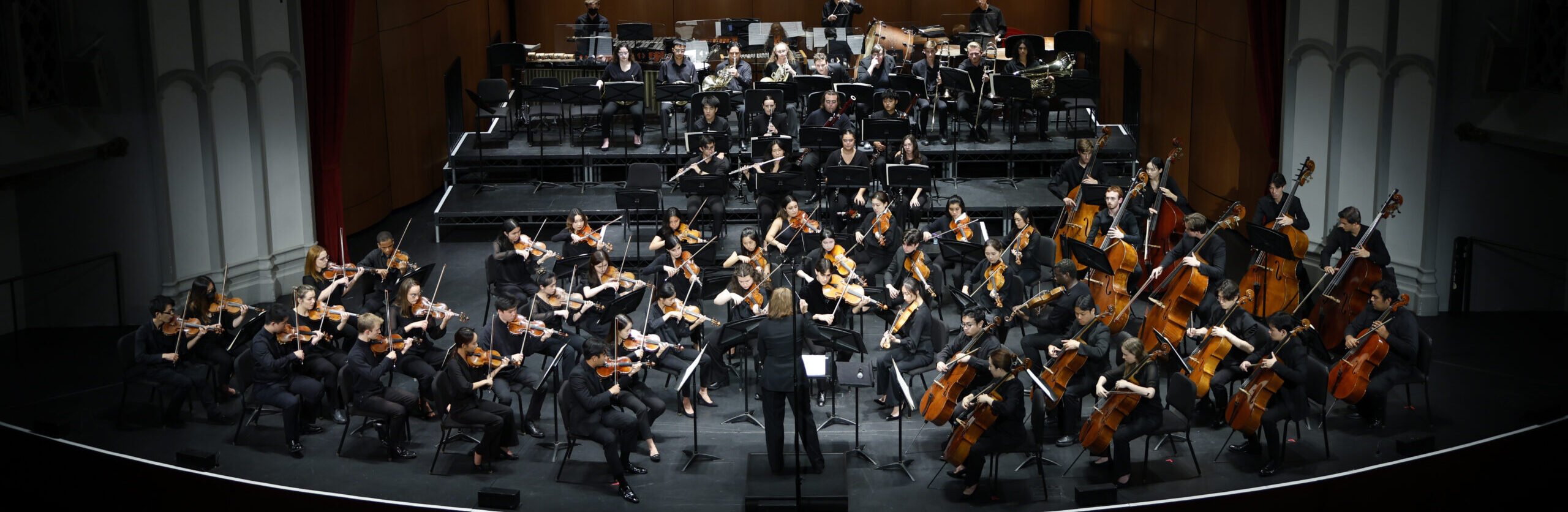
Donald Crockett, chair of the Composition program, leads the USC Thornton Symphony in this annual concert of colorful new works by outstanding Thornton student composers.

Program
Magisterium
Samuel Guevara
Honneger’s Wife
Linda Dallimore
The Green Knight
-
-
-
- Olivia Marckx, cello
-
-
Olivia Marckx
~Intermission~
Composition No. 0136
Trevor Zavac
Ripple Infinity
Ben Beckman
Program Notes
Magisterium
Samuel Guevara
This piece grows from a deeply personal place, shaped by both fear and hope — by the challenge of remaining faithful to what one believes, even when doing so carries uncertainty or cost.
The piece takes its name from the teaching authority of the Catholic Church and traces a journey shaped by both awe and unease, by moments of great elevation and profound vulnerability. Its origins lie in an early visit to the Vatican, standing inside St. Peter’s Basilica, where I felt an unexpected mixture of familiarity and apprehension. The familiarity came from encountering beauty and meaning so clearly embodied in the architecture and symbolism; the apprehension arose from an awareness that throughout history, committing oneself fully to deeply held convictions has often required sacrifice.
The work draws inspiration from Saint Peter, the namesake of the Basilica, whose life reflects the cost and courage of holding to one’s convictions. Across time, belief of any kind has carried risk — the risk of misunderstanding, isolation, or self-doubt. There are moments when expressing what one holds deeply can feel precarious, and silence may seem safer than honesty. Yet the greater danger often lies in retreating from what gives meaning in the first place.
This tension lies at the heart of the music. It opens with a sense of confidence and light, suggesting joy rooted in clarity and purpose. That assurance gradually gives way to longing — a quiet desire for reassurance, for things to settle and make sense. The music begins to fracture: strings press forward with urgency, winds take on a sharper, more unsettled character, and the texture eventually collapses into stillness, as if the motion of life itself has been momentarily suspended. In this silence, uncertainty is allowed to exist without resolution.
The final section unfolds slowly, almost cautiously, as though rebuilding step by step. Harmonies widen, textures open, and what once felt strained is reshaped into something expansive. In its closing moments, the music reaches toward transcendence — not as certainty imposed, but as an invitation: a sense of arrival at something larger, where doubt gives way to openness and awe.
-Samuel Guevara
Honegger’s Wife
Linda Dallimore
Honegger’s Wife is named after the wife of the Swiss French composer Arthur Honegger, who is known to us through reference in various music literature as both Honegger’s wife and Pierre Boulez’s counterpoint teacher.
Andrée Vaurabourg (1894 – 1980) was a formidable pianist, composer and teacher at the Paris Conservatoire. She also supported her husband’s career, premiering several of his pieces and completing arrangements of some of his music. Honegger and Vaurabourg lived apart, in order that he have the solitude he required to compose. Pierre Boulez studied counterpoint in frequent private lessons with Mme. Vaurabourg, during two of his formative musical years.
As far as we know, all that remains of her music is a counterpoint exercise in Vaurabourg’s hand, in the manuscript of Charles Koechlin’s Précis des Règles du Contrepoint (1923, Heugel & Cie, Paris). We also know that a composition of Vaurabourg’s was performed in a Verley Prize concert in 1921 in Paris. Unfortunately, Pascale Honegger (Vaurabourg-Honegger’s daughter) was unable to find this work. Vaurabourg did not win the prize (Honegger did) and then decided to stop composing. No music of hers is included in the Honegger archives held by the Paul Sacher Foundation. We are left to imagine what might have happened musically under different circumstances.
Vaurabourg’s counterpoint is embedded as a musical object in a new work inspired by this history. Honegger’s Wife channels a slow-burning kind of feminist rage, in response to both the glacial rate of social change women have experienced and the (predominantly female) juggle of a modern life, balancing career, family and household obligations, coupled with the cognitive load of doing so.
With gratitude to Susanne Gärtner for sharing her research about Andrée Vaurabourg and correspondence with Pascale Honegger.
-Linda Dallimore
The Green Knight
Olivia Marckx
The Green Knight takes its title from “Sir Gawain and the Green Knight”, a 14th-century chivalric romance that functions equally well as a hero’s journey and as a David Lynch-esque psychodrama. I am fascinated by the relationship between the soloist and the orchestra in the existing concerto canon—sometimes, the soloist must assert their individuality and expressivity in the face of an orderly, unified orchestra, and yet in other works, the orchestra is a force of chaos that the soloist must in some way tame. In The Green Knight, neither the soloist nor the orchestra tames the other, and the material they trade back and forth continually fluctuates between expressing order and disorder. I was particularly influenced by my background in Scottish folk music (the poem’s Gawain hails from the Orkney Islands, just off the coast of Scotland), and the concerto draws on rhythmic and ornamentation techniques intrinsic to that tradition.
-Olivia Marckx
Composition No. 0136
Trevor Zavac
What’s in a name? According to Shakespeare, not much. We can certainly agree that the connotation of a rose is pretty strong. We can even all agree that it smells sweet. However, if you ask five people very specific questions about the roses in their minds, you would receive 5 specific, but different answers. I think about this every time I name a piece of music. If something as real as a rose has not much in its name, then how could something as abstract as music have anything concrete to say at all? To me, the beauty of music is this abstraction. As the 1830 edition of the Encyclopedia Americana puts it, music “is that art alone which strives to affect the soul by tones.” I wonder then, why should the name of a piece of music muddy the interpretation by postulating character or narrative?
So what’s in the name? Composition No. 0136 is named for the use of the (0136) tetrachord, which is a common feature throughout the piece, but certainly not the only such collection utilized. Instead of burdening you with my own interpretation, a title alluding to some grand narrative, or a lengthy description of its banal inspiration; I would like you just to listen and let your mind come up with its own explanation for the purpose of this piece. Whether you find humor or horror, I hope it disgusts or delights you (whatever that means). The beauty, as with all music, is that your perception is different, unique, and precious. All that I ask is that you consider looking inward, where you might ponder how your own soul is affected by these tones.
-Trevor Zavac
Ripple Infinity
Benjamin Beckman
Much of my recent music has been interested in slowing rhythmic processes that don’t easily conform to the standard metric system used in most classical notation. After extensive experimentation, and a good deal of math, this interest led to Ripple Study I (for a quartet of two pianists and two percussionists). The title reflects my experience of the music’s rhythmic onsets and gradual decelerations, paired with descending pitch patterns, which abstractly evoked the image of ripples dissipating on the surface of a pond. I wasn’t finished exploring the idea, and soon after I wrote Ripple Study II, translating the same principles into a short orchestral work while maintaining the mathematical rigor of the first piece.
Ripple Infinity grew from a desire to take these “ripples” further, loosening the mathematical constraints of the earlier studies. I set three guiding axioms. First, the piece functions as a single large “ripple”: it unfurls across seven sections, each with a descending key center (alternating major and minor thirds), and each expanding in duration. Second, I sought to generate as much material as possible purely from the core ripple idea. Third, each section was designed to be as distinct as possible from the others, like seven contrasting character studies, or variations on a theme.
The resulting construction became symphonic in nature: despite the freedom I allowed myself, nearly every note in the piece can be traced back to the ripple idea, much as Beethoven or Brahms might take a single thread of musical material and weave it through an entire movement. As I continued working with this material, however, I came to realize just how expansive the ripple concept could be. Even in the seventh and final section of the piece, where I set aside the ripple’s expanding rhythmic processes, the harmonic possibilities of the pitch sequence alone continued to feel inexhaustible. The ripple idea permeates the work at every level, from large-scale structure down to microscopic detail. But if there is an infinity of ripples, it lies not in this piece, but in the still-unexplored possibilities for musical experimentation and play that still remain.
-Benjamin Beckman
About the Artists
Samuel Guevara
Cellist and composer Samuel L.D. Guevara is renowned for his exceptional musical mastery in both his virtuosic performances and his evocative compositions. Samuel is currently a third year at the University of Southern California Thornton School of Music, where he is pursuing a Bachelor’s Degree in both Cello Performance and Composition with a Presidential Scholarship. Samuel’s performance style is deeply influenced by his experiences in masterclasses and mentorships with world-renowned cellists, including Andrew Shulman, Ron Leonard, Clive Greensmith, Ko Iwasaki, and Joon Sung Jun.
Being no stranger to Chamber music, Samuel has performed with the award winning Evie Quartet all around the nation. His quartet has won prizes from many local competitions including the Voce Competition and ENKOR competition, as well as multiple national and international top prizes from both the Coltman Chamber Music Competition in Austin, Texas and the Fischoff Chamber Competition in South Bend Indiana, eventually leading them to make their debut in New York City at the Lincoln Center through The Lincoln Center Chamber Music Society.
Composition is as much of a part of Samuel’s life as the cello. He is currently studying under Donald Crockett at The University of Southern California, and has written multiple chamber works and orchestral works including 2 Symphonies, many of them being performed. Samuel’s influences derive from composers such as Sibelius, Strauss and Mahler, giving his music a timeless quality that captivates audiences nationwide. He just completed a collaboration piece with the Kaufman School of Dance at the University of Southern California, where he is exploring the realms of Electronic music and its integration with acoustic instruments. His goal is to eventually help the worlds of electronic music and traditional classical music live in harmony.
Linda Dallimore
New Zealand-native, Los Angeles-based composer Linda Dallimore writes music for orchestras, chamber ensembles and films.
Her work features jagged melodies, colorful timbres, groove-driven rhythms, repetitive structures and assemblage, weaving narratives rooted in psychological processes as well as sociological, cultural, and environmental concerns.
Linda’s music emerges from introspection and empathy, drawing on an awareness of cognition and psychology as catalysts for musical ideas. Linda’s compositions have been played by the New Zealand Symphony Orchestra, Rhode Island Philharmonic, Auckland Philharmonia Orchestra, Ensemble Klangrauschen, Stroma, the New Zealand Trio and the Aspen Contemporary Ensemble. Linda has participated in festivals across Europe and the US, including the Aspen Music Festival, SICPP (USA), Etchings Festival (France), UPBEAT (Croatia) and VIPA Festival (Spain). She is a member of the Composers Association of New Zealand and represented by SOUNZ centre for New Zealand Music and APRA AMCOS.
Linda is completing a Doctor of Musical Arts at the University of Southern California, Los Angeles. She holds a Master of Musical Arts in composition at Yale School of Music, degrees from the University of Auckland, New Zealand, and she is an alumna of Berklee College of Music. Her mentors and teachers include Andrew Norman, Donald Crockett, Christopher Theofanidis, Martin Bresnick, Eve de Castro-Robinson, Jonathan Bailey Holland, Marti Epstein and Ben Cadwallader.
Linda serves on the music theory faculty at the Colburn school and faculty for the LA Phil’s Composer Fellowship Program for young composers.
Outside of music, Linda enjoys spending time with her two young children Charlie and Stella, whilst trying to speak French with her husband Arnaud.
Olivia Marckx
Los Angeles and Seattle-based composer and cellist Olivia Marckx writes music that is colorful, inventive and athletic. As a teenager, Olivia spent time busking at Seattle’s Pike Place Market. Through her music, she aims to channel the high octane atmosphere and immediacy of audience connection in that space. Further inspiration comes from old Hollywood dance movies, Scottish fiddling, and early Modernism.
Olivia received honors at the 2024 NACUSA-LA National Composition Competition. Her works, recognized as “Gorgeous…swirling yet measured beauty,” (Bandcamp) have been commissioned/and or performed by violinists Simone Porter, Blake Pouliot and Aubree Oliverson, Tony Arnold, The Lyris String Quartet, and the Pacific, South Coast and San Fernando Valley Symphonies. Her compositions and arrangements have been featured at the Aspen Music Festival, Orcas Island Chamber Music Festival, Carnegie Hall (Weill Hall), and on the Violin Channel, and her piece, Night Terrace, will be premiered by the Seattle Festival Orchestra this March.
As a cellist, Olivia has soloed with the Seattle Symphony, Pacific Symphony, Colburn Orchestra, and USC Thornton Symphony, among others, and performed at the Orcas Island Chamber Music Festival, and the Colburn and Seattle Chamber Music Societies. She has attended Yellow Barn, New Music on the Point, the Aspen Music Festival, the Perlman Music Program and the Heifetz Chamber Music Seminar and has collaborated on stage with artists such as Itzhak Perlman, Jon Kimura Parker, Demarre McGill, Time for Three and Mark O’Connor. She was a semifinalist at the 2025 Washington International Competition and will participate in the 2026 Queen Elisabeth Competition in Brussels this spring. Olivia received BM and MM degrees from the Colburn Conservatory, where she worked with Clive Greensmith and Robert Lipsett. Olivia is currently pursuing a double degree (DMA and MM) at USC’s Thornton School studying cello with Ralph Kirshbaum and composition with Dr. Donald Crockett.
Trevor Zavac
Trevor Zavac (he/him, b. 2000 Hinsdale, IL) is a composer, hornist, and wordist whose works experiment with perception and abstraction to explore the complexity, beauty, and humor of the illogical. Zavac’s music has been performed by the San Francisco Contemporary Music Players, USC Thornton Edge, the Brevard Music Center Orchestra, Brevard New Music Ensemble, and the Butler University Composer’s Orchestra. His music for ballet has been choreographed and performed by the Indianapolis Ballet and the Jacobs School of Music Ballet Department. A 2024 ASCAP Morton Gould Award winner, Zavac’s compositions have received awards from the ARTZenter Institute, the Brevard Music Center, and the International Horn Society. He holds a B.M. in Composition and a B.M. in Horn Performance from the Indiana University Jacobs School of Music and is currently pursuing a M.M. in Composition at the University of Southern California Thornton School of Music.
Benjamin Beckman
Benjamin Beckman is a Los Angeles-based composer, conductor, and pianist. His music searches for meaning through the manipulation of sonic materials to reflect natural, textual, spiritual, sociological, metaphysical, and abstract processes. Heralded as a composer with a “strong compositional voice” (The Guardian), “uncommon maturity” and one who “stands his own alongside master orchestrators” (bachtrack), Beckman is at home creating an hour-long solo piano piece that an audience “felt as though the experience had been a musical hallucinogenic” (Yale Herald), composing orchestral work showcasing “kaleidoscopic fractals” and “fragmented fanfares” (Opera Today), and writing chamber opera that is “timeless and clear” concerned with “emotive beauty that is both accessible and engaging” (Yale Daily News).
Beckman’s orchestral music has been performed by the Los Angeles Philharmonic, the National Youth Orchestra of the United States of America, the Yale Symphony Orchestra and the Yale Undergraduate Chamber Orchestra, the Kaleidoscope Chamber Orchestra, and the Boston University Tanglewood Institute Young Artists Orchestra, led by conductors such as Antonio Pappano, Ken-David Masur, Ruth Reinhardt, and William Boughton. Other collaborations include those with the Long Beach Opera, Opera Elect, Salastina, Frost School of Music Ensemble Ibis, Triton Brass, the Lyris Quartet, and the Thornton Edge. His music has been presented on the BBC Proms, the Tanglewood Music Festival, Concertgebouw Presents: Summer Concerts, Festival Napa Valley, the HearNow Festival, the Hot Air Festival, NPR’s From the Top, YoungArts Los Angeles, and Yale College New Music. His 2023 opera Passage, with librettist Adam Haliburton, was the first-ever evening-length opera to be premiered by the Opera Theatre of Yale College and was awarded Yale’s Beekman Cannon Friends of Music Prize for most outstanding senior thesis in the music major.
His compositions have been recognized by both the ASCAP Foundation Morton Gould and Herb Alpert Awards, the New York Youth Symphony’s First Music commissioning program, the American Composers Forum Nextnotes Awards, the National YoungArts Foundation, and composition competitions sponsored by the Philadelphia Organ Festival, the University of Miami, the University of Kentucky, the Metropolitan Youth Symphony Orchestra, Opera Elect, and the Boston New Music Initiative.
Beckman is currently pursuing a master’s degree in composition at the USC Thornton School of Music, where he studies with Donald Crockett, Andrew Norman, and Veronika Krausas, and holds a teaching assistantship managing and playing in the university’s contemporary music ensemble, Thornton Edge. He holds an undergraduate degree in music from Yale, where he studied with Konrad Kaczmarek, Kathryn Alexander, and Richard Lalli, conducted the Yale Undergraduate Chamber Orchestra and the Opera Theatre of Yale College, and was awarded the Abraham Beekman Cox Prize, Joseph Selden Memorial Award, and the R.J.R. Cohen Fellowship.
Also active as a conductor and répetiteur, in the 2025-2026 season, he makes his company debut at The Atlanta Opera as assistant conductor (to Ryan McAdams) on Glass’s La Belle et la Bête, returns to Pacific Opera Project as rehearsal pianist and chorusmaster for Fra Diavolo, Zorro, The Abduction from the Seraglio, and Turandot, and USC Thornton Opera for The Cunning Little Vixen and The Turn of the Screw. As Artistic Director and a co-founder of Park City Opera, he conducts David Conte’s The Gift of the Magi in December 2025, and both Aaron Copland’s The Tender Land and Gounod’s Roméo et Juliette in Summer 2026.
Ensemble
Violin I
Juchao Zhao, Concertmaster
Maia Law
Hyojeong Kim
Ariana O’Connell
Dahae Shin
Maya Masaoka
Eric Cheng
Isaiah Iny-Woods
Diana Dawydchak
Ashlee Sung
Violin II
Andrew Choi, Principal
Yifei Mo
Ayman Amerin
Anna Renton
Sara Yamada
Nathan Nguyen
Abigail Park
Dominic Guevara
Maya Lambright
Viola
Cecille McNeill, Principal
Matthew Pakola
Solomon Leonard
Jay Madonado
Poppy Yu
Lilien Foldhazi
Gloria Choi
Cello
Amy Jong, Principal
Jaemin Lee
Dylan Tyree
Cole Leonard
Miles Reed
Siena Rosborough
Mingchen Ma
Elaina Spiro
Isabelle Fromme
Nathan Choe
Bass
Logan Nelson, Principal
Jai Ahuja
Josia Sulaiman
Micah Sommons
Nathaniel De La Cruz Daga
Harp
Carter Williams
Angel Kim
Daya Asokan
Piano/Celeste
Chloe Gwak
*=Principal Player
Flute
Kiana Kawahara*
Dennis Papazyan*
Tony Lin*
Ellen Cheng*
Piccolo
Kiana Kawahara*
Dennis Papazyan*
Tony Lin*
Ellen Cheng*
Oboe
Ricky Arellano*
Karen Hernandez
Chase Klein*
Connor Feyen*
English Horn
Chase Klein
Connor Feyen
Clarinet
Alex Varvne*
Jane Pankhurst
Siyuan Yin*
Andrei Bancos
Simon Bakos
Bass Clarinet
Simon Bakos
Contrabass Clarinet
Joshua Tang
Bassoon
Chris Lee*
Anjali Pilla*
Contrabassoon
Ethan Ault
Horn
Engelberth Meija*
Grace Kim*
Alan Schlesinger*
Joe Oberholzer*
Evelyn Webber*
Trumpet
Hugo Tomas*
EJ Miranda*
Alex Drozd
Jerry Mak*
Trombone
Joseph Chilopoulos*
Alicia Miller*
Terry Cowley*
Sean Cooney*
Bass Trombone
Harrison Chiang
Tuba
Logan Westerviller
Timpani
David Lee*
Percussion
Marcos Salgado*
Chanhui Lim
Xavier Zwick