Concert Programs
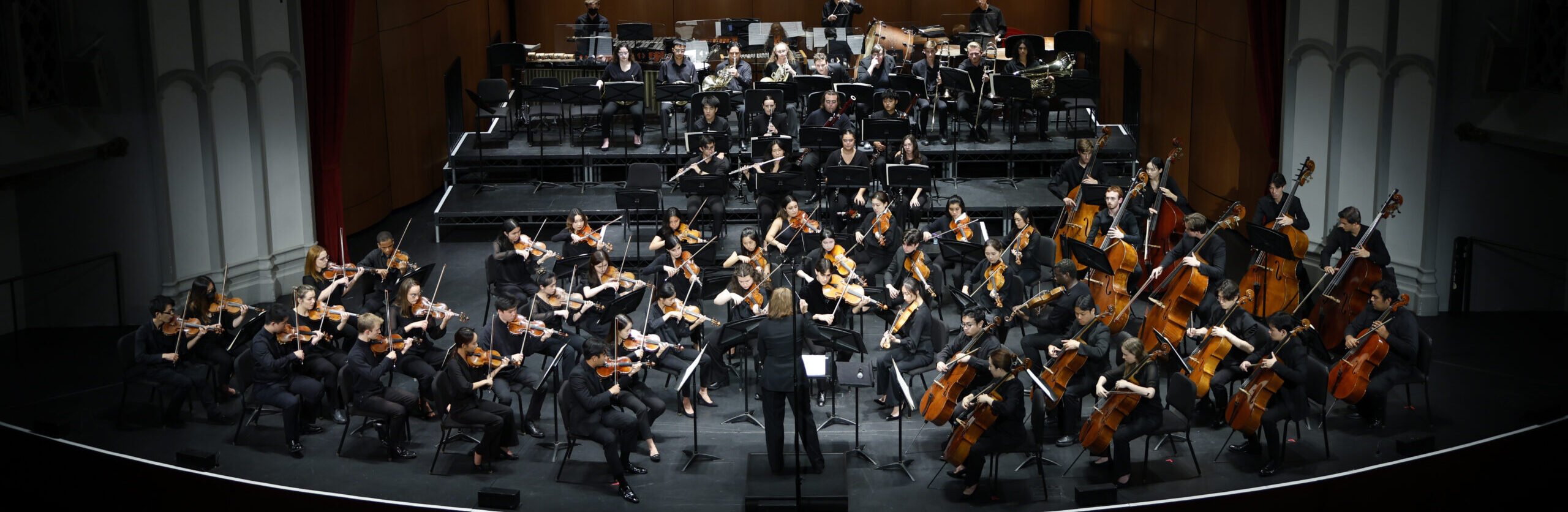
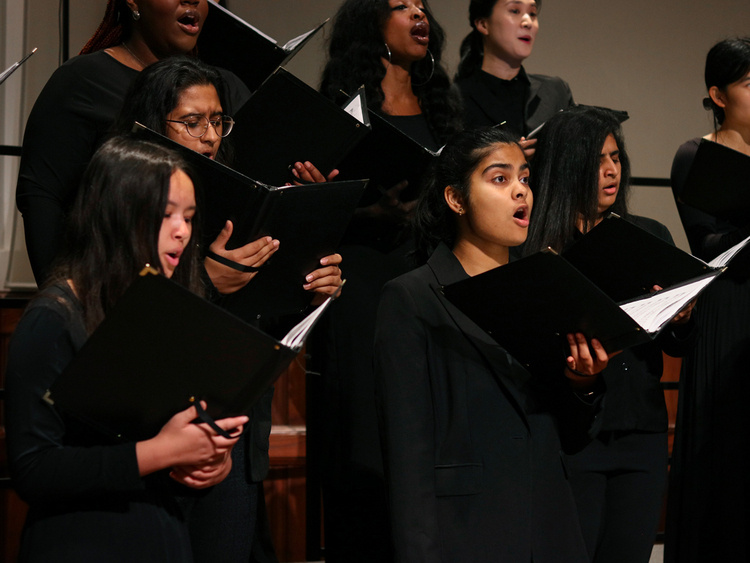
USC Thornton Oriana Choir & USC Gospel Choir
One Spirit, One Voice: USC Thornton Oriana Choir & Gospel Choir
USC Thornton Oriana Choir
Dr. Emily Sung, conductor
Kayla Kim, associate conductor
Yuyoung Jeong, collaborative pianist
USC Gospel Choir
Antun Foster, conductor
Phoebe Rosquist, associate conductor
Gospel Band
Keyboardists: Ami Burton & Jahi Watson
Drums: Josh Smith
Drums/Percussion: Richard Sledge
Bass: Arthur Sutton
Program
USC Thornton Oriana Choir
Hej, Igazítsad!
Kayla Kim, conductor
Lajos Bárdos (1899-1986)
Tundra
Kayla Kim, conductor
Soloists:
Gemma Gibeault and Eloise Pedersen
Ola Gjeilo (b.1978)
Nāru dziesma
Sophie O’Shea, conductor
Emīls Dārziņš (1875-1910)
Koki
Jēkabs Jančevskis (b.1992)
Bachuri Le’an Tisa
Eloise Pedersen, soprano
Sophia Thompson, soprano
Sophie O’Shea, mezzo soprano
Victoria Rhee, mezzo soprano
Leah Taylor, mezzo soprano
Amy Cruz, mezzo soprano
Gideon Klein (1919-1945)
Dusk in June
Sophia Thompson, soprano
Sophie O’Shea, soprano
Leah Taylor, mezzo soprano
Amy Cruz, mezzo soprano
Amy Beach (1867-1944)
September Song
Kurt Weill (1900-1950) and
Maxwell Anderson (1888-1959)
arr. Matt Falker
Will the Circle Be Unbroken
Soloists:
Chelsea Ackman, Sophie O’Shea,
Ella Pedersen, Eloise Pedersen,
Claire Schulze, Leah Taylor,
Sophia Thompson
traditional Appalachian
arr. J. David Moore (b. 1962)
The Parting Glass
Sophia Thompson, conductor
traditional
arr. The Wailin’ Jennys
— INTERMISSION —
USC Gospel Choir
For the Rest of my Life
Vincent Bohanan
Great God, Great Vision
Rickey Payton, Sr. (b. 1959)
He’s Been Good
Charles Jenkins, Rodney Jones, Ay Ron Ronell Lewis
I Need You
Tye Tribbett
Who Will Go
Freddy Washington, Jr.
Text & Translations
Hej, Igazítsad! by Lajos Bárdos (1899-1986)
Lajos Bárdos was one of the most influential figures in twentieth-century Hungarian music. Bárdos composed nearly 800 works, spanning sacred music, folk song arrangements, and secular choral pieces, and he was a passionate advocate for music education. A composer, conductor, educator, and musicologist, he studied composition with Zoltán Kodály at the Liszt Academy in Budapest. He co-founded the Magyar Kórus (Hungarian Choir) publishing house and led the Singing Youth movement, encouraging thousands of young people to engage in choral singing. Through his compositions, teaching, and leadership, Bárdos created a lasting legacy that combined Hungary’s folk traditions with a modern choral aesthetic.
Hej, Igazítsad is a lively arrangement of a Hungarian folk song, collected in 1939, that captures the playful spirit of a village festival. The text depicts young men and women dancing and flirting, with nonsensical syllables like danadom adding rhythmic energy and excitement. Written for three vocal parts, the piece mirrors the swapping of dance partners, creating a sense of movement and communal joy. The quick tempo and playful character reflect his gift for writing music that is enjoyable to sing while preserving the authenticity of Hungarian folk traditions.
Hungarian
Hej, igazítsad jól a lábod,
tíz farsangja, hogy már járod,
haj dana dana dana danajdom…
Hej, ez a kislány atyám fíja,
szereti az apám fíja,
haj dana dana dana danajdom…
Hej a szívemnek nagy a búja,
te légy rózsám orvoslója,
haj dana dana dana danajdom…
Hej, nem aludtam csak egy szikrát,
eltáncoltam az éjszakát,
haj dana dana dana danajdom…
English
Hey, get your feet good and ready!
You’ve now been through ten carnivals!
Hey, my brothers, this young girl
loves my father’s son.
Hey, my heart has grown sorrowful;
be the healing of my heart’s sorrow.
Hey, I didn’t sleep a wink,
I danced away the night.
Tundra by Ola Gjeilo (b.1978)
Ola Gjeilo is a Norwegian-born composer and pianist whose works have become central to contemporary choral repertoire. After studying composition at the Juilliard School in New York City and the Royal College of Music in London, Gjeilo established himself as a sought-after composer and improvisational pianist. His music is often described as cinematic, lush, and evocative, drawing inspiration from jazz, film scores, and visual arts. Based in the United States, he has collaborated with leading ensembles such as Tenebrae, Voces8, and the Choir of Royal Holloway, and his recordings have earned international acclaim.
Tundra sets a poem by Charles Anthony Silvestri inspired by the vast, rugged landscapes of the Hardangervidda mountain plateau in Gjeilo’s native Norway. His music reflects the grandeur and quiet majesty of the Scandinavian wilderness through expansive harmonies and flowing melodic lines, creating a soundscape that is both cinematic and meditative. The piece captures the stillness and power of nature, highlighting Gjeilo’s ability to combine poetry, place, and music in a deeply atmospheric and emotionally resonant work.
Wide, worn and weathered,
Sacred expanse
Of green and white and granite grey;
Snowy patches strewn,
Anchored to the craggy earth,
Unmoving;
While clouds dance
Across the vast, eternal sky.
Nāru dziesma by Emīls Dārziņš (1875-1910)
Nāru dziesma, or “Song of the Mermaid,” is one of the most well-known choral works by the late Romantic Latvian composer Emīls Dārziņš. Dārziņš studied composition with Nikolai Rimsky-Korsakov at the St. Petersburg Conservatory, then moved to Riga, where he spent the rest of his adult life before his premature death at the age of 35. Although he only wrote seventeen choral works, Dārziņš’s music is deeply embedded in Latvian choral culture. Many of his compositions are settings of texts by contemporary Latvian writers and poets. Nāru dziesma sets a short, simple text by Jānis Jaunsudrabin̦š (1877-1962), in which a chorus of mermaids calls from the deeps. Traditionally, the melody is repeated three times: at first soft, then louder, and finally very soft, as though receding into the watery depths. The music is scored for four-part a cappella treble choir.
Latvian
Nav jūras bez dziļuma,
nāc, ak, nāc!
Mirtes un lilijas,
nāc, ak, nāc!
English
There is no sea without depth,
come, oh come!
Myrtle and lilies,
come, oh come!
Koki by Jēkabs Jančevskis (b.1992)
Koki, or “Trees,” is a recent choral work by Latvian composer Jēkabs Jančevskis, who is known for his cinematic style. Jančevskis studied with Ēriks Ešenvalds during his years at the Riga Cathedral Choir School, where he now serves on the composition faculty. Many of his most well-known works were inspired by historical or contemporary events in Latvia, such as Ar zvaigžņu kluso gaismu, a piece written in tribute to the 54 lives lost after the collapse of a supermarket roof in Rīga in 2013.
Koki was premiered by a massed choir of about 16,500 singers at the 2023 Latvian Song and Dance Festival, one of the largest music festivals in the world. Originally written for mixed choir, this version is scored for four-part treble choir with piano accompaniment. The text, by Latvian poet Inese Zandere (b.1958), describes the miraculous gifts of nature––sun, wind, trees that grow into vast forests, and seasons that bring change and renewal. The last line is repeated six times in an inspiring finale: “The rest we can do for ourselves.”
Latvian
Zeme, izaudzē mūs par kokiem,
lai saknes sastopas dziļi un neredzami,
debess izaudzē mūs par kokiem,
lai zari aizsniedzas tālāk par stumbru rētām,
vēji, audzējiet kokus par mežu,
kurā katris ir patvērums katram,
saule, atslēdz mums acis,
dzen mūs salapot, pārziemot, atkal lapot––
pārējo spēsim paši,
visu pārējo spēsim paši.
English
The earth grows us into trees,
the roots meet deep and invisible,
the sky grows us into trees,
the branches reach beyond the scars of the trunks,
winds grow the trees into a forest,
In which each is a shelter for everyone,
the sun opens our eyes,
drives us to shed leaves, hibernate, shed leaves again––
we can do the rest ourselves,
we can do everything else ourselves.
Bachuri Le’an Tisa by Gideon Klein (1919-1945)
Gideon Klein was a Czech Jewish composer and pianist who is remembered today for his role as an educator, arranger, composer, performer, and musical organizer as a prisoner at the Terezín concentration camp, also known as Theresienstadt. Before the Holocaust, Klein was known as a brilliant pianist and one of the rising stars of his generation. During the time leading up to his deportation, Klein performed under the pseudonym Karel Vranek before it became too dangerous to perform publicly at all. In 1941, Klein was deported to Terezín, where he stayed until he was transported to Auschwitz in 1944. He died a year later at the age of 25 in the Fürstengrube concentration camp.
“Bachuri Le’an Tisa” is a three-part treble choir composition that Klein completed on December 3, 1942 while interned at Terezín. He wrote the piece for the girls in block L-410 of the camp, and it was likely meant to be performed by one of the choirs conducted by his colleague Rafael Schaechter. The one-page manuscript of “Bachuri Le’an Tisa” contains only one enigmatic line of text, which translated into English means, “My boy, where will you go? My sweetheart, it’s all over.” Klein only wrote out the text in the first four bars of music, leaving open the question of whether the text is meant to be repeated throughout the piece, or whether other, missing lines of text were meant to complete the song. While the origins of the text and melody are not known, its structure––three verse-like repetitions of the same eight-bar phrase––suggest that it could be an arrangement of a preexisting folk song. According to Klein’s sister, Eliska Kleinova, Klein arranged many folk songs for the choruses of Terezín, records of which mostly did not survive the war.
Hebrew
Bachuri le’an tisa?
Chamudah, kvar pasa
English
My boy, where will you go?
My sweetheart, it’s all over.
Dusk in June by Amy Beach (1867-1944)
Amy Beach was an American pianist and composer who was widely recognized during her life as one of the most significant American composers of the time. She began composing at the age of four and gave her debut performance with the Boston Symphony Orchestra at age 18. Her most well-known works include her Mass, Symphony, Violin Sonata, Piano Quintet, and numerous songs and choral works. After marrying her husband Henry Beach in 1885, she limited her piano performances to annual charity recitals according to his wishes. After his death in 1910, Amy Beach’s musical career took on new life. Through concert tours in Europe and the United States, Beach reestablished her professional reputation as a pianist and composer. Dusk in June is one of a small number of secular choral works dating from this period.
Scored for four-part treble choir, Dusk in June is an a cappella setting of a poem by Sara Teasdale (1884-1933). The piece has many hallmarks of Beach’s mature style: long lines, highly chromatic harmony, modulation by thirds and common tones, augmented sixth chords, and avoidance of the dominant. Beach’s sensitive approach to text-setting and color are also on full display throughout Dusk in June. The text, which describes the first sweet moments of dusk in the summer sky, comes to life through delicately shifting harmonies in a gently lilting 6/8 meter.
Evening, and all the birds
In a chorus of shimmering sound
Are easing their hearts of joy
For miles around.
The air is blue and sweet,
The few first stars are white,—
Oh let me like the birds
Sing before night.
September Song by Kurt Weill (1900-1950) and Maxwell Anderson (1888-1959), arr. Matt Falker
Kurt Weill was one of many German Jewish composers who fled Germany under the Nazi regime and eventually forged a new life in the United States. Primarily known for his contributions to musical theater, Weill built a career in the United States through his work for Hollywood and Broadway. His most well-known song, “Mack the Knife,” has become a popular standard with famous covers by Louis Armstrong, Ella Fitzgerald, and Bobby Darin. Though less well known than his popular songs, Weill’s classical works also include a few important contributions to Jewish repertoire, most notably Kiddush, a Sabbath piece for SATB choir and tenor soloist commissioned by Park Avenue Synagogue in New York. Weill was the son of a cantor and the descendant of an old family of rabbis and rabbinical scholars.
“September Song,” Kurt Weill’s first American hit, was written for a satirical musical called Knickerbocker Holiday with lyrics by Maxwell Anderson. The work has become an American jazz standard with recordings by Ella Fitzgerald, James Brown, Frank Sinatra, and countless other artists. The song was also famously recorded by Kurt Weill’s wife, Lotte Lenya, after her husband’s death. This a cappella version by Matt Falker is scored for three-part treble choir.
Will the Circle Be Unbroken, traditional Appalachian, arr. J. David Moore (b. 1962)
J. David Moore (b. 1962) is an American composer and arranger. He has written arrangements of vocal jazz, spirituals, barbershop quartet, Celtic mouth music, Civil Rights marching songs, early American hymn tunes, sixteenth-century madrigals, and European folk music, and he has been commissioned by the Arizona Master Chorale, the Choral Arts Ensemble of Rochester, the Minnesota Opera, MUSE Women’s Choir of Cincinnati, Shawn Womack Dance Projects, the Venere Lute Quartet, and the Cheng-Gong High School Choir in Taiwan. Moore has won grants, awards, and residencies from ASCAP, the Jerome Foundation, and the American Composers Forum. He was the recipient of the 2001 McKnight Fellowship for Performing Musicians.
The hymn “Will the Circle Be Unbroken” first appeared in the 1908 volume, Alexander’s Gospel Songs, with words by Ada Ruth Habershon and music by Charles H. Gabriel. The updated lyrics in this arrangement were written by folk singers Betsy Rose, Cathy Winter, and Marcia Taylor, and printed in the folk song resource Rise Up Singing (ed. Peter Blood, 1998). Moore’s arrangement makes use of two traditional vocal ensemble styles: the bluegrass trio (inspired by Dolly Parton’s rendition of “Seven Bridges Road”) and the gospel quartet. Scored for four-part a cappella treble choir in E major, Will the Circle Be Unbroken features bright triadic harmonies, bluegrass-style improvisational ornaments, and uptempo gospel-style call and response between the melody and harmony parts.
Will the circle be unbroken
By and by, Lord, by and by?
There’s a better home awaitin’
If we try, Lord, if we try
I was singing with my sisters
I was singing with my friends
And we all can sing together
‘Cause the circle never ends
I was born down in the valley
Where the sun refused to shine
But I’m climbing up to the highland
Gonna make that mountain mine!
The Parting Glass, traditional arranged by The Wailin’ Jennys
The Wailin’ Jennys are a Canadian folk trio composed of founding members Nicky Mehta and Ruth Moody and Taos-based Heather Masse. Founded in 2002, the group has released five critically acclaimed albums. Their signature sound is rooted in folk and bluegrass while also expanding occasionally to include alt-country, pop, and rock. “The Parting Glass” is the final track on their 2004 debut album, 40 Days. The song is a treble arrangement of a Scottish-Irish folk song dating back to the 1600s. Traditionally sung at the end of a gathering of friends, “The Parting Glass” was purported to be the most popular farewell song before “Auld Lang Syne” was published at the end of the 1700s. This version by The Wailin’ Jennys is a simple three-voice setting of the first two verses of the song.
Oh all the money that e’er I spent
I spent it in good company
And all the harm that e’er I’ve done
Alas, it was to none but me
And all I’ve done for want of wit
To memory now I can’t recall
So fill to me the parting glass
Good night and joy be with you all
Oh all the comrades that e’er I’ve had
Are sorry for my going away
And all the sweethearts that e’er I’ve had
Would wish me one more day to stay
But since it falls unto my lot
That I should rise and you should not
I’ll gently rise and I’ll softly call
Good night and joy be with you all
Good night and joy be with you all
Gospel Choir Program Notes
“For the Rest of My Life” Vincent Bohanan
Vincent Bohanan is a New York-based gospel songwriter, choir director, and pastor. He founded the ensemble Sound of Victory Fellowship Choir (SOV) in January 2014 to provide a platform for young gospel singers to develop their talents. He also holds a bachelor’s degree in music business and audio from Five Towns College. In recent years, Bohanan and his choir have been featured in academic and musical-cultural venues, such as the Yale Institute of Sacred Music’s “Celebration of Gospel” event in 2022. Bohanan’s music merges classic gospel roots with contemporary production sensibilities, making his work accessible to younger generations while anchored in church tradition.
“For the Rest of My Life” expresses a vow to lifelong service and praise. The text looks forward (“For the rest of my life”), embodying both present commitment and future hope—we use it tonight to set the tone for our other musical offerings, with optimism that each song in our program serves the greater good and uplifts you all. Musically, you will hear many classic congregational devices come into play: call and response, passing the focus from soloist to choir, and within the choir from one part to another. The song’s rhythmic drive underscores the active, ongoing nature of service rather than passive observance. As in all our offerings tonight, let the spirit move you, inside and out. If you hear something that affects you, feel free to move your body and call out with your voice!
“Great God, Great Vision, Great Accomplishments” Composer/Lyricist: Rickey Payton, Sr.
Rickey Payton was born June 16, 1959 in Washington, D.C. He started taking piano lessons in kindergarten. Inspired by Rance Allen, Al Green and Stevie Wonder, Payton excelled in music from a young age. At the of 13 in 1972, he composed music for NBC’s The Sunshine Store. While still high school, Payton scored the Emmy Award winning documentary New Cotton Club Review. As a student at Howard University, Payton majored in music, business administration, and studied entertainment law. Payton also attended music conservatories in Paris and in Switzerland.
He has toured the world, given commanding performances at the White House and the Vatican, and performed for President Mitterrand of France, Queen Elizabeth and the British Royal Family, and Mikhail Gorbachev of the former Soviet Union. In 1994, Payton’s project, City at Peace, a diverse youth theatrical group promoting ethnic understanding, was featured by Ted Koppel on ABC’s Nightline in 1995. Payton’s song “Let’s Build a Bridge All Across America” was featured at President Clinton’s second inauguration in 1996. In 1997, Payton co-founded Urban Nation, Inc. with Sheila Crump and serves as its president and CEO. In 1998 Payton was featured in the documentary film City at Peace directed by Susan Koch and with Barbara Streisand as executive producer. Payton is an official voting member of the Grammy Awards.
Sung under the auspices of the Church of God in Christ (COGIC) International Choir, “Great God, Great Vision…” is rooted in the Pentecostal gospel tradition and often used in national COGIC gatherings. One can hear both simple congregational anthem motifs along with gospel harmonic language—extended tertian chords, suspensions and resolutions, and rhythmic drive reminiscent of anthems from the mid-20th century onward. The text centers on God’s reign, vision, and creations, themes resonant with Pentecostal worship emphases on divine sovereignty and prophetic expectation.
“He’s Been Good” Charles Jenkins, Rodney Jones, and Ay Ron Ronell Lewis
Charles Jenkins is a pastor, worship leader, and gospel songwriter who leads Fellowship Chicago and has guided the choir into a contemporary evangelical powerhouse. His musical vision blends traditional gospel roots into modern day worship.
Rodney “Lil Rod” Jones Jr. is a Chicago-based producer, instrumentalist, and arranger with deep ties to the city’s gospel scene. Known for his versatile keyboard, drum programming, and arranging skills, Lil Rod brings a blend of church tradition and urban contemporary flair to his collaborations. Ay’Ron Lewis is a gospel producer, instrumentalist, and songwriter who crafts percussive and rhythmic frameworks (drum programming and synth textures) that complement collaborators’ vocals and harmonic structure.
This song was popularized by One Voice, a gospel ensemble formed by Kenny Lewis in 1999. Lewis’ background in choir direction and praise team teaching is foundational to his approach, merging congregational vitality with studio polish. His work embodies the continuity of Black church gospel traditions while engaging with contemporary music production and worship sensibilities.
“He’s Been Good” continues the testimonial tradition in contemporary gospel. The song is built around gratitude and remembrance of God’s faithfulness to God’s people. It employs modern gospel idioms: groove-based accompaniment, alternating ensemble/solo textures, and lyrical repetition. In the wake of post-war gospel choirs and urban gospel ensembles that increasingly embraced rhythm & blues idioms, jazz-influenced harmony, and band accompaniment, this song reflects how Black worship music continuously evolves, drawing from secular idioms while holding steady to its spiritual purpose.
“I Need You” Recording artist/composer: Tye Tribbett
In his career, Grammy-winning gospel artist Tye Tribbett has had over 317 million global streams with over 1.3 million albums sold. On YouTube, he has eclipsed 60 million views. And he’s rocked national TV performances such as The Tonight Show with Jimmy Fallon, The BET Awards, and the STELLAR Awards. He is known for his high energy, genre-blending creativity, and deep religious roots. Born in Camden, New Jersey into a pastoral family, Tribbett began playing keyboards at age five and soon became active in community choirs. In 1996 he founded Greater Anointing (G.A.), a choir of family and friends that quickly gained national attention, appearing on the Prince of Egypt soundtrack and releasing acclaimed albums such as Life (2004) and Victory Live! (2006). After disbanding G.A., Tribbett launched a successful solo career with albums like Greater Than (2013), which earned two Grammy Awards, and All Things New (2022). His music fuses gospel with elements of funk, hip-hop, and R&B while remaining deeply devotional.
“I Need You” by Tye Tribbett exemplifies the contemporary gospel-pop hybrid—a genre forged in the late 20th and early 21st centuries within African American worship settings. Blending gospel, R&B, and contemporary Christian worship, the song testifies to a personal dependence on God. This blending is historically significant: Black worship music has long absorbed secular musical trends (jazz, soul, hip-hop, pop) while reinterpreting them in a spiritual context. Tribbett’s work offers modern gospel lovers a musical style that feels current, personal, and expressive while rooted in gospel’s theological and spiritual lineage.
“Who Will Go” Lyricist/Composer: Freddy Washington & Carol Cymbala
Carol Joy Cymbala (b. 1947) is the longtime choir director of the Grammy-winning Brooklyn Tabernacle Choir. Daughter of Rev. Clair Hutchins, she began leading small worship groups in her youth, eventually founding what grew into the Tabernacle choir in the 1970s. Under her leadership the choir has released dozens of albums and garnered multiple Grammy and Dove Awards. As a composer, arranger, and director, she has written and arranged many of the choir’s signature anthems.
Freddy Washington is a gospel composer, producer, and worship leader whose music bridges traditional church roots with contemporary gospel innovation. Raised in a musical household, Washington began on drums before mastering piano, organ, and guitar. By age 18 he was already directing choirs and arranging music for services, experiences that laid the foundation for his later career. A graduate of The University of the Arts in Philadelphia, he has also shared gospel traditions internationally, teaching American gospel repertoire to students in Europe. Washington’s songwriting and production work have earned Grammy, Dove, and Stellar Award nominations, including collaborations with Da’Truth and Melinda Watts. His debut solo project, The Jesus Record (2012), established him as a recording artist in his own right. Soon after, he began working with Carol Cymbala and the Brooklyn Tabernacle Choir, co-writing the title track for their Grammy-winning album Pray from which we drew tonight’s selection.
“Who Will Go” belongs to the tradition of polished gospel choir anthems designed for worship with an emphasis on mission. Musically, it shares traits of modern gospel: strong harmonic design, modulations, dynamic contrast, and recognizable song structure (verses, chorus, bridge). Yet its heritage lies in the 20th-century gospel-choir movement, which sought to craft worship music that served both liturgical function and as outreach with concert impact.
Ensemble
Oriana Choir Roster
Soprano
Chelsea Ackman
Masters of Accounting, B.S. Accounting | Denver, CO
Naomi Cowan
B.A Psychology, B.A. Anthropology (Visual) | Glendale, AZ
Xiaozhu Fu
B.S. Accounting | Bellevue, WA
Gemma Gibeault
B.A Dramatic Arts | Half Moon Bay, CA
Debora Hutajulu
Master of Communication Management | Jakarta, Indonesia
Cameron Kiley
B.A. Sociology, B.A. Philosophy, Politics, and Law | Redlands, CA
Kayla Kim
D.M.A. Choral Music | Seoul, South Korea
Sofia Leimer
B.A. Psychology | Zurich, Switzerland
Eloise Pedersen
Ph.D. Evolutionary Biology | Bishops Stanford, UK
Claire Schulze
B.S. Biomedical Engineering | Newport Beach, CA
Sophia Thompson*
B.M. Choral Music| Pasadena, CA
Amy Yao
B.S. Biological Science | Tianjin, China
Grace Zhang
Ph.D. Computer Science | Sunnyvale, CA
Alto
Charlize Avila
B.S. Business Administration | Chino Hills, CA
Xindi Chen
B.S. Computer Science; Business Administration | Guangzhou, China
Amy Cruz
Ph.D. English Literature | New Brunswick, NJ
Aimee Ge
B.S. Business Administration | Bay Area, CA
Gwendoline Hoch
B.S. Geological Sciences | Manchester, United Kingdom
Ruowen Huang
M.A. Public Relations | Kumming, China
Abigail Kim
B.A. Theatre | Orange County, CA
Sophie O’Shea*
B.M. Choral Music | Palos Verdes, CA
Ella Pedersen
Master of Landscape Architecture and Master of Urban Planning | Hershey, PA
Victoria Rhee
B.A. Health and Human Sciences | La Habra, CA
Clara Richard
B.A. Psychology | Oakland, CA
Leah Taylor*
B.M. Choral Music, B.A. Public Relations and Advertising | Arcadia, California
*denotes section leader
USC Gospel Choir
Natasha Barr*
Faith Buggs
Angel Chisholm*
Vanessa Dickens
Sarah Edem
Alexandria Gee
Autumn Henderson
Xavia Hendrickson
Debora Hutajulu
Clifford James
Manje Jefferson
Madi Miller
Tyler Nevels*
Nathan Rosquist
Phoebe Rosquist
Yasmeena Sharif
Christian Sharp
Izzy Tiamson
Kelley Yearout
Hanwen Zhang
*vocal section leaders