Concert Programs
University Chorus
Still I Rise
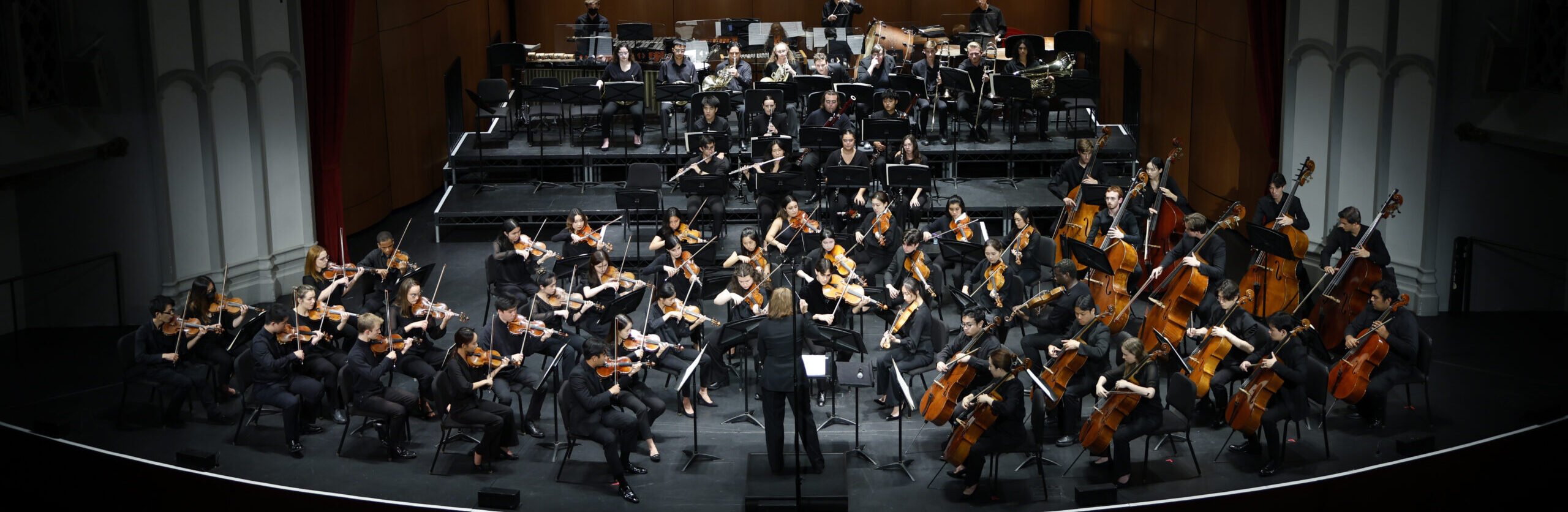
USC University Chorus
Tyler Berg, lead conductor
Christopher Arceo, associate conductor
Nicole Kouwabunpat, collaborative pianist
Program
“JAM!”
Tracy Wong
“Blow, blow, thou winter wind”
John Rutter (b. 1945)
“Hush, Somebody’s Callin’ My Name”
Moyang Song, soloist
Brazeal Dennard (1929-2010)
“Va, pensiero” from Nabucco
Giuseppi Verdi (1813-1901)
“Mantra”
Timothy C. Takach (b. 1978)
“Over the Rainbow” from The Wizard of Oz
Harold Arlen (1905-1986)
— Audience Sing A Long —
“Gloria” from Heiligmesse
Franz Joseph Haydn (1732-1809)
“For Good” from Wicked
Soloists:
Lillian Matthews, Prae Srisuponvanit
Cyrus Payne, Bass
Phia Papouchado, Drums
Stephen Schwartz (b. 1948), arr. Mac Huff
“Still I Rise”
Soloists:
Caleb Perrear, Gemma Gibeault
Cyrus Payne, Bass
Phia Papouchado, Drums
Rosephanye Powell (b. 1962)
Program Notes
“JAM!” by Tracy Wong
Dr. Tracy Wong is a Malaysian choral conductor and composer based in Ontario, Canada, where she splits her time between composing and directing choirs at Western University. She holds a Doctor of Musical Arts and Master in Music Performance (Choral Conducting) from the University of Toronto and is an active clinician throughout the United States and abroad. Her work advocates for what she calls “repertoire-based music education.” Her compositions reflect this mission in their usefulness as teaching tools of language and technique for all ages. Her compositions have been performed throughout the world. (Source: tracywongmusic.com)
Dr. Wong’s “JAM!” (2022) is a play on words in colloquial Malay. The words “jom,” “ayuh,” and “mari” all translate to some version of “Come, let’s go!” The title itself means clock, which suggests the passing of time. Dr. Wong’s inclusion of body percussion is a nod to this aspect of the text. Furthermore, a jam can also refer to a group of musicians coming together to make music. Combining all three of these textual ideas, the translation means, in the composer’s own words, “Come, let’s go make some music together and sing while passing time!” JAM! was originally composed as a treble choir work, commissioned by the Chorus Niagara Children’s Choir. (Notes from the score.)
“Blow, Blow, Thou Winter Wind” by John Rutter (b. 1945)
John Rutter (b. 1945) is one of the most influential living choral musicians in the world. A composer and conductor hailing from London, he graduated from Clare College, Cambridge in the 1960’s and became the music director of the college from 1975-1979. In 1981, he founded the Cambridge Singers, a professional choir made up primarily of former Cambridge students. Already a celebrated composer, the success and adoration of the Cambridge Singers recordings launched Rutter further into international fame in classical music. His work as an editor and compiler of choral music has given visibility to many carols, church anthems, and opera choruses through his anthologies published through Oxford University Press. Even in his eighties, he continues to be an active composer and advocate of choral music. He remains an in-demand conductor and clinician throughout the world. (Source: johnrutter.com)
“Blow, blow, thou winter wind” is the fourth movement of Rutter’s six movement choral cycle When Icicles Hang (1975) for choir and chamber orchestra. Often performed as a standalone piece, “Blow, blow, thou winter wind” has an appropriately chilling piano accompaniment in the reduced version for piano and choir. The text comes from Shakespeare’s As You Like It. The poem is spoken by Lord Amiens in the play, who describes a friendship that has gone sour as more bitter than the winter wind. Rutter captures this bitterness in his F minor setting of the poem, using dissonance and haunting chromaticisms to bring the text to life.
“Hush! Somebody’s Callin’ My Name” – Trad. Spiritual arr. Brazeal Dennard (1929-2010)
Dr. Brazeal Dennard (1929-2010) was a singer, conductor, and gospel music pedagogue whose influence is felt greatly throughout the country. After graduating from Wayne State University, he worked in the Detroit Public School system for decades while also serving as an adjunct professor at Wayne State. In 1972, he founded the Brazeal Dennard Chorale, which through performance, tours, recording, and educational outreach, advocated for the revitalization and preservation of African American music. In 2008, he received the Detroit Urban League’s Distinguished Warrior Award. Dennard received honorary doctorates from Olivet and Marygrove colleges in recognition of his contributions to the art of choral music and dedication to music education. (Obituary: Michigan Chronicle.)
“Hush! Somebody’s Calling my Name” (1986) is an arrangement of a traditional African American spiritual. Listeners will hear a lamenting melody that has existed for hundreds of years and likely was used as a work song during slavery. One of the first appearances of the spiritual in popular culture was on Quincy Jones’s 1977 soundtrack for the television series Roots, in his song titled “What Can I Do?” (The New York Times). The text contains layers of meaning. “Somebody” could refer to a higher power, the devil, or even a slave holder. The sentiment overall, however, is one of perseverance, as the singer is confident that they have found salvation through their religion.
“Va, Pensiero” from Nabucco by Giuseppe Verdi (1813-1901)
Giuseppe Verdi (1813–1901) was an Italian composer and conductor best known as a nineteenth-century master of opera, whose vision for scale and drama advanced the art form. Verdi was widely celebrated for his third opera, Nabucco, in 1842, and went on to compose twenty-six operas (some estimate twenty-eight). His operas that followed, particularly Rigoletto, La Traviata, Aida, Otello, and Falstaff, established him as a national icon of the genre. In addition to his operas, Verdi also composed some choral works, most notably his Messa da Requiem (1874), as well as some smaller works for choir and instrumental compositions. (Source: eno.org.)
Nabucco (Italian for Nebuchadnezzar) dramatizes the Israelites’ struggle for freedom and King Nebuchadnezzar’s conversion to Judaism. The opera’s most famous number, “Coro di Schiavi Ebrei” or “Chorus of the Hebrew slaves,” is colloquially referred to by its opening words: “Va, pensiero.” During the late nineteenth century, this lament based on Psalm 137 (“By the rivers of Babylon”) was one of two contenders to become the Italian national anthem. Although it was ultimately not selected, this chorus enjoyed nearly a decade as an unofficial anthem of Italian independence. Known for its recurring phrases sung in unison, this lament has remained one of the most performed opera choruses in the repertoire. (Source: operaleague.org.)
“Mantra” by Timothy C. Takach (b. 1978)
Timothy C. Takach (b. 1978) is a singer and composer based in the Twin Cities of Minnesota. From a young age, Takach was a prominent bass voice in the midwest. He co-founded the now internationally acclaimed tenor-bass vocal ensemble Cantus while he was a student at St. Olaf College in 1995. Their recordings and commissions throughout his tenure are important resources for tenor-bass ensembles throughout the world. As a composer, Takach has written everything from a capella choral works, choral symphonies, ballets, art songs, and more. He has been commissioned by various GRAMMY Award-winning ensembles, such as the Roomful of Teeth and the St. Paul Chamber Orchestra, as well as many professional, collegiate, and youth ensembles around the globe. (Source: timothyctakach.com)
“Mantra” was first conceived as an art song for mezzo-soprano and piano and premiered at the Source Song Festival in Minneapolis in 2018. The mixed voice and piano arrangement was commissioned by St. Paul-based ensemble VocalPoint for their February 2019 concert benefiting walk-in counseling services in the Twin Cities. The text comes from poet Sierra DeMulder’s Today Means Amen, a collection of her poems published in 2016. The poem serves as a reminder of the importance of taking care of ourselves and the power of self-forgiveness. (Source: score.)
“Gloria” from Missa Sancti Bernardi von Offida (or Heiligmesse) by Franz Joseph Haydn (1732-1809)
Franz Joseph Haydn (1732–1809) was one of the most influential figures of the Classical era. Haydn’s compositional output is one of the largest of his time, composing everything from works for solo piano, string quartets, concertos, oratorios, and most importantly, symphonies. Haydn is often referred to as the “father of the symphony.” He composed 104 of them and helped to define the symphonic form in terms of both structure and instrumentation. His tenure with the Esterházy family of Hungary for nearly thirty years led to a prolific output of compositions for their royal court orchestra, for whom Haydn served as the music director.
In 1776, Prince Esterházy commissioned Haydn to write a solemn mass setting for the birthday of princess Maria Josepha Hermenegild Esterházy, the prince’s wife. The Missa Sancti Bernardi von Offida (Heiligmesse) was the result, and this tradition of composing a birthday mass continued for the next five years, accounting for six of Haydn’s 12 completed mass cycles. The Heiligmesse calls for a full classical orchestra and is about 40 minutes in length. The opening section of the “Gloria” (marked vivace) showcases Haydn’s inclination for dramatic dynamic contrasts and programmatic writing. (Source: catholicchorale.org)
“For Good” from Wicked by Stephen Schwartz (b. 1948), arr. Mac Huff
Stephen Schwartz (b. 1948) is one of the most celebrated composers and lyricists of musical theater in the world. He completed his Bachelor of Fine Arts in Drama at Carnegie Mellon in 1968 and completed graduate studies in composition at the Juilliard School. His most notable musicals include Godspell (1971) and Pippin (1972), both completed while a student at Juilliard, and Children of Eden (1991) and Wicked (2003). He is also hailed for his contributions to the world of film, collaborating with composer Alan Menken to write original lyrics for Pocohantas (1995), The Hunchback of Notre Dame (1996), and The Prince of Egypt (1998). (Source: stephenschwartz.com)
“For Good” comes from the second act of Schwartz’ magnum opus, Wicked. One of only three musicals to surpass one billion dollars in Broadway box office revenue (with Phantom of the Opera and Lion King), Wicked has been a global phenomenon for two decades and is the fourth longest continually running show in the history of Broadway (Newyorktheatreguide.com). “For Good” is the emotional climax of Wicked, in which leads Elphaba and Glinda acknowledge the profound impact their friendship has had on their lives.
“Still I Rise” by Rosephanye Powell (b. 1962), arr. by William and Rosephanye Powell
Dr. Rosephanye Powell (b. 1962) is a renowned composer, conductor, singer, and music educator. She is was one America’s most celebrated living choral musicians and is championed for her contributions to the art form. She earned her Bachelor of Music Education degree from Alabama State University, her Master of Music in Vocal Performance and Pedagogy from Westminster Choir College, and her Doctor of Music in Vocal Performance from Florida State University. She has taught at several universities in the United States and frequently gives lectures throughout the country and the world. Her compositions and research are invaluable resources to choral musicians around the world. (Source: rosephanye.com)
“Still I Rise” speaks to our shared ability to persevere through life’s most difficult moments. The words are by Dr. Powell herself, mirroring the ideas laid out in Maya Angelou’s poem of the same name. Incorporating music elements of gospel style, Powell explores themes of resilience, empowerment, and triumph. “Still I Rise” was commissioned by VOX Femina of Los Angeles as an anthem for treble choir in 2005 and was performed later that year at the American Choral Directors Association national convention where it received an enthusiastic response. The work was later adapted for mixed voices, growing the circle of singers and audiences that get to experience this transformative music. (Source: Voxfemina.org)
Text & Translations
“JAM!” ~ Tracy Wong, text by the composer
Come, let’s go make some music together and sing while passing time! Leave your worries for a while.
“Blow, blow, thou winter wind” ~ John Rutter, text by William Shakespeare from “As You Like It”
Blow, blow, thou winter wind,
Thou art not so unkind
As man’s ingratitude;
Thy tooth is not so keen,
Because thou art not seen,
Although thy breath be rude.
Heigh-ho! sing, heigh-ho! unto the green holly:
Most friendship is feigning, most loving mere folly:
Then, heigh-ho, the holly!
This life is most jolly.
Freeze, freeze, thou bitter sky,
That dost not bite so nigh
As benefits forgot:
Though thou the waters warp,
Thy sting is not so sharp
As friend remembered not.
Heigh-ho! sing, heigh-ho! unto the green holly.
“Hush, Somebody’s Callin’ My Name” ~ Brazeal Dennard, traditional spiritual text
Hush, hush, somebody’s callin’ my name.
O my Lord, O my Lord, what shall I do?
Soon one morning, death come creepin’ in my room.
O my Lord, O my Lord, what shall I do?
I’m so glad, got me religion on time.
O my Lord, O my Lord, what shall I do?
I’m so glad trouble don’t last always.
O my Lord, O my Lord, what shall I do?
“Va, pensiero” from Nabucco ~ Giuseppi Verdi, libretto by Temistocle Solera
Go thought on wings of gold,
go rest on the slopes, on the hills
where the warm, soft breezes of our native land
spread their fragrant aroma.
Greet the banks of the Jordan,
The fallen towers of Zion…
Oh my homeland so beautiful and lost!
Oh remembrance so dear and fatal!
Golden harp of the prophetic bards,
Why do you hang silent from the willow?
Re-kindle memories in our breast.
Speak to us of times past!
Mindful of Jerusalem’s fates
Either give forth a sound of crude lamentation,
Or let the Lord inspire you to a harmony
Which instills in us the virtue to suffer.
“Mantra” ~ Timothy C. Takach, text by Sierra DeMulder’s “Today Means Amen”
Vitamin D. Sunlight.
Go outside.
Get a good night
of sleep. Not too good.
Not shades drawn forever good.
Not like you used to.
Open the windows.
Buy more houseplants.
Breathe. Meditate. (One day,
you will no longer be
afraid of being alone
with your thoughts.)
Exercise. Actually exercise
instead of just Googling it.
Eat well. Cook for yourself.
Organize your closet, the
garage. Drink plenty of
water and repeat after me:
I am not a problem
to be solved. Repeat after me:
I am worthy I am worthy
I am neither mistake nor
the punishment. Forget to take
vitamins. Let the houseplant die.
Eat spoonfuls of peanut butter.
Shave your head. Forget
this poem. It doesn’t matter.
There is no wrong way
to remember the grace of your
own body; no choice
that can unmake itself.
There is only now, here,
look: you are already forgiven.
“Over the Rainbow” from The Wizard of Oz ~ Harold Arlen, text by Yip Harburg
Somewhere over the rainbow, skies are blue,
And the dreams that you dare to dream really do come true.
Someday I’ll wish upon a star and wake up where the clouds are far behind me.
Where troubles melt like lemon drops away above the chimney tops,
That’s where you’ll find me.
Somewhere over the rainbow, bluebirds fly. Birds fly over the rainbow; why, then, oh why can’t I?
“Gloria” from Heiligmesse ~ Franz Joseph Haydn
Glory to God in the highest,
and on earth peace to people of good will.
We praise you,
we bless you,
we adore you,
we glorify you.
“For Good” from Wicked – Stephen Schwartz, arr. Mac Huff, text by Stephen Schwartz
I’ve heard it said
That people come into our lives for a reason
Bringing something we must learn
And we are led
To those who help us most to grow
If we let them
And we help them in return
Well, I don’t know if I believe that’s true
But I know I’m who I am today
Because I knew you…
Like a comet pulled from orbit
As it passes a sun
Like a stream that meets a boulder
Halfway through the wood
Who can say if I’ve been changed for the better?
But because I knew you
I have been changed for good
It well may be
That we will never meet again
In this lifetime
So let me say before we part
So much of me
Is made of what I learned from you
You’ll be with me
Like a handprint on my heart
And now whatever way our stories end
I know you have re-written mine
By being my friend…
Like a ship blown from its mooring
By a wind off the sea
Like a seed dropped by a skybird
In a distant wood
Who can say if I’ve been changed for the better?
But, because I knew you
I have been changed for good
And just to clear the air
I ask forgiveness
For the things I’ve done you blame me for
But then, I guess we know
There’s blame to share
And none of it seems to matter anymore
Like a comet pulled from orbit
As it passes a sun
Like a stream that meets a boulder
Halfway through the wood
Like a ship blown from its mooring
By a wind off the sea
Like a seed dropped by a bird in the wood
Who can say if I’ve been
Changed for the better?
I do believe I have been
Changed for the better
And because I knew…
I have been changed for good.
“Still I Rise” ~ Rosephanye Powell, text by the composer
Though I have been wounded, aching heart full of pain.
Still I rise, yes, still I rise.
Jus’ like a budding rose, my bloom is nourished by rain.
Haven’t time to wonder why, though fearful I strive.
My pray’r and faith uphold me ‘til my courage arrives.
Still I rise as an eagle, soaring above ev’ry fear.
With each day I succeed, I grow strong an’ believe
That it’s all within my reach; I’m reaching for the skies,
Bolstered by courage, yes, still I rise.
Yes, it’s all within my reach; I’m reaching for the skies, yes, still I rise.
As my heart grows heavy and my confidence dies,
Still I rise, yes, still I rise,
Pure strength is in my tears and healing rains in my cries,
Plunging depths of anguish, I determine to strive.
My prayer and faith uphold me ‘til my courage arrives.
Though you see my slump with heart ache,
Heart so heavy that it breaks.
Be not deceived I fly on birds wings
Rising sun, it’s healing rays.
Look at me. I’m getting stronger;
I’m determined to survive.
Tho’ I get tired I get weary,
I won’t give up. I’m still alive.