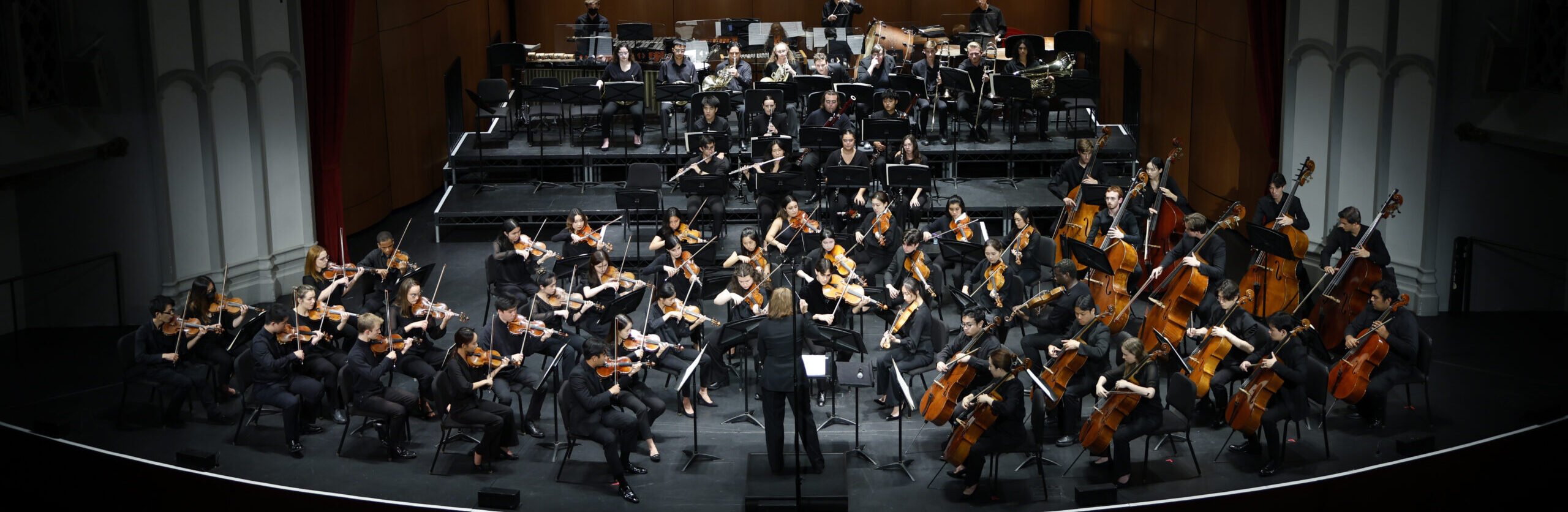
Concert Programs
Oriana Choir
IN BLOOM
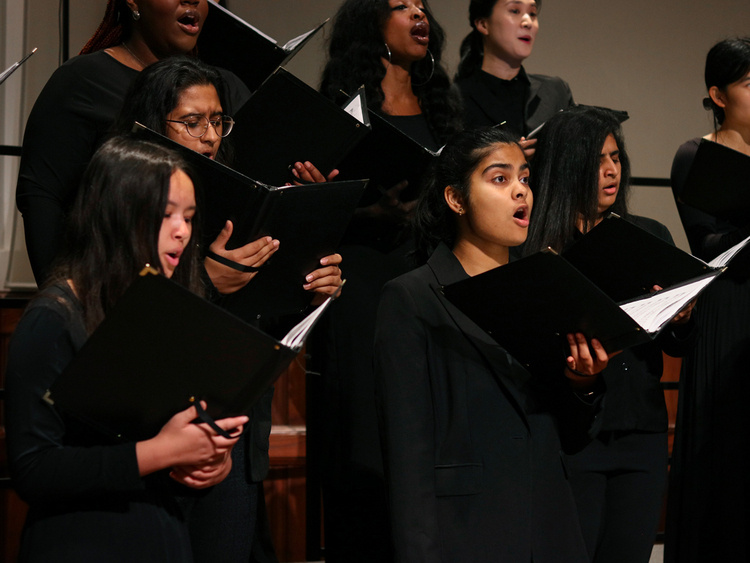
The USC Thornton Oriana Choir, under the direction of faculty member Emily Sung, will be performing a full concert of choral music for treble voices from all periods and genres.
Emily Sung, conductor
Kayla Kim, associate conductor
Elizabeth Chou, collaborative pianist
Sophie O’Shea, Leah Taylor, and Sophia Thompson, section leaders
Guest artists:
Evangeliya Delizonas, piano and harpsichord
Marco Lenzi, bass
Han-Ah Park, synthesizer
Ruthie Prillaman, guitar
ChanHui Lim, spoons
Savannah Tweedt, drums
Program
“Wir eilen mit schwachen, doch emsigen Schritten,”
from Jesu der du meine Seele, BWV 78
J.S. Bach
Elizabeth Chou, piano
“The Bluebell,” from Three Flower Songs
Amy Beach
“Evocation”
Hye Young Cho
Kayla Kim, conductor
Elizabeth Chou, piano
“Nein, Geliebter, setze dich,” from Neue Liebeslieder, Op. 65
Johannes Brahms
Elizabeth Chou & Evangelia Delizonas, piano
Intermezzo in A minor, Op. 76, No. 7
Johannes Brahms
Evangeliya Delizonas, piano
“Erste Begegnung,” from Spanisches Liederspiel, Op. 74
Robert Schumann
Treble chamber ensemble
Evangeliya Delizonas, piano
“Le Tre Grazie à Venere”
Barbara Strozzi
Treble chamber ensemble & Evangeliya Delizonas, harpsichord
Suite No. 1 in D minor, III. Courante from Pièces de Clavecin
Élisabeth Jacquet de la Guerre
Evangeliya Delizonas, harpsichord
“Flower Duet,” from Lakmé
Léo Delibes
Vishaala Wilkinson, soprano
Lauren Bondurant, mezzo-soprano
Elizabeth Chou, piano
Intermission
“Devotee”
Shruthi Rajasekar
Amy Cruz
Sophia O’Shea
Shreya Ramesh
Leah Taylor
Sophia Thompson
“Si verias a la rana”
Moira Smiley
Kayla Kim, conductor
“Vichten”
Arthur and Angèle Arsenault, arr. Hart Rouge
Sophie O’Shea, soloist
ChanHui Lim, spoons
“Light of a clear blue morning”
Dolly Parton, arr. The Wailin’ Jennys
“Bone to Bone”
Small Fools
Ruthie Prillaman, guitar
Elizabeth Chou, piano
“Satellite”
Laila Biali, arr. Will Clements
Eloise Pedersen, soloist
Elizabeth Chou, piano
Marco Lenzi, bass
Savannah Tweedt, drums
“Fix You Up”
The Wild Reeds
Marco Lenzi, bass
Ruthie Prillaman, guitar
Savannah Tweedt, drums
Special thanks to Marisa Bradfield, Ruthie Prillaman, Phoebe Rosquist, and Sean Stanton for their assistance in preparing tonight’s program.
Program Notes
“Wir eilen mit schwachen, doch emsigen Schritten,” from Jesu der du meine Seele, BWV 78 by J.S. Bach
Johann Sebastian Bach (1685–1750) is remembered today as one of the most important composers of the German Baroque era. Born in Eisenach, Bach spent his early adulthood working as a musician in Protestant churches in Weimar, Arnstadt, and Mühlhausen, eventually settling in Leipzig, where he spent most of his career. Bach’s choral oeuvre is defined by his prolific contributions to Lutheran church music. His musical language inherited ideals of counterpoint and harmony embodied by the works of earlier German Baroque composers, such as Heinrich Schütz (1585-1672) and Dieterich Buxtehude (1637-1707), as well as the styles and techniques of composers from across the European continent. Many of his works also deliberately pay homage to the Renaissance through their use of imitative counterpoint and fugue, techniques which Bach developed to the zenith of their complexity.
“Wir eilen mit schwachen, doch emsigen Schritten” is a duet from Cantata BWV 78, Jesu, der du meine Seele. This cantata was first premiered on September 10, 1724 in Bach’s second Leipzig Jahrgang, or his second complete cycle of cantatas for the Lutheran church year. Originally set in Bb major, this duet is presented tonight down a half step in A major. The form of the duet is a da capo aria: it opens in the home key with the soprano leading and the mezzo-soprano line following down a fourth in imitation, followed by a middle section in the relative minor and nearby key areas, before returning to the opening. The text, which describes the speaker’s desire to approach God “with weak but diligent steps,” is beautifully expressed in ever-longer melismas that at first seem to wander but unerringly bring the singers to the height of the phrase (and, perhaps, closer to the joyful presence of God).
| Wir eilen mit schwachen, doch emsigen Schritten, O Jesu, o Meister zu helfen, zu dir. Du suchest die Kranken und Irrenden treulich. Ach höre, wie wir die Stimmen erheben, um Hülfe zu bitten! Es sei uns dein gnädiges Antlitz erfreulich! |
We hasten with weak but diligent steps, Oh Jesus, oh Master of Salvation, to you. You seek the ailing and erring faithfully, Ah, hear, how we Raise our voices to plead for help/salvation. Let your merciful countenance be gladdening to us. |
“The Bluebell,” from Three Flower Songs by Amy Beach
Amy Beach (1867–1944) was a distinguished pianist and one of the most prominent American composers of her generation. A child prodigy, Beach was largely self-taught in composition, mastering the techniques of fugue and orchestration by studying canonical works. Despite her early success as a pianist (she debuted with the Boston Symphony Orchestra as a teenager), after marrying she largely curtailed her performance career to respect her husband’s wishes. After his death in 1910, Beach undertook a European tour that helped relaunch her career as a performer and composer. Beach’s compositional style is characterized by songlike melodies, chromaticism, frequent use of seventh chords and augmented sixth chords, avoidance of the dominant, and modulation by thirds––techniques that show her inheritance from the late Romantics. (Adrienne Fried Block, “Beach [Cheney], Amy Marcy,” Grove Music Online)
“The Bluebell” is the third song from Three Flower Songs, a set of a cappella works for four-voice treble choir. All three pieces are short, largely homophonic settings of texts that playfully describe scenes of unrequited love against a backdrop of blooming flowers. Scored in a lilting 3/4 meter, “The Bluebell” imagines an innocent flower who falls in love with a flighty bumblebee.
| In love she fell, My shy Bluebell, With a strolling Bumble Bee; He whispered low, “I love you so! Sweet, give your heart to me! I love but you, And I’ll be true, O give me your heart, I pray!” She bent her head, “I will!” she said, When lo! he flew away. |
Evocation (못잊어) by Hye-Young ChoHye-Young Cho (b.1969) is a distinguished Korean composer known for her ability to blend traditional Korean musical elements with contemporary classical styles. She has served as composer-in-residence for both the National Chorus of Korea and the Incheon City Chorale and has become an influential voice in South Korean choral music. Her works have gained international recognition through performances at events such as the World Choral Symposium and the American Choral Directors Association (ACDA) National Conference.
Evocation (못잊어) was commissioned by the National Chorus of Korea and is based on a poignant poem by Kim Sowol, one of Korea’s most beloved poets. The poem comes from Kim’s iconic collection The Azaleas (1925) and reflects the enduring memory of a loved one who has been lost. While the text expresses personal grief, it also resonates with broader moments in Korean history when many families experienced painful separations, including the Japanese colonial era, the Korean War, and the continued division of the Korean peninsula.
Cho’s music unfolds with a gentle, reflective atmosphere that mirrors the emotional depth of the poem. In this SSA version, the delicate vocal textures highlight the sense of longing and remembrance found in the text. Through expressive melodic lines and subtle harmonic colors, Cho creates a musical landscape that conveys both sorrow and tenderness, allowing the memory of the beloved to remain present even as time passes.
| 못잊어 못잊어 못잊어 생각이 나겠지요
그런대로 세월만 가라시구려 그러나 또한 긋 이렇지요 못잊어 |
I cannot forget, I cannot forget — I will think of you
Just let time pass as it will Yet, perhaps it is also like this I cannot forget |
“Nein, Geliebter, setze dich,” from Neue Liebeslieder Walzer, Op. 65 by Johannes Brahms
Johannes Brahms (1833-1897) was one of the most influential composers of the German Romantic period. A prolific composer of chamber music, orchestral repertoire, piano and organ works, lieder, and secular and sacred choral music of all forms, Brahms contributed masterpieces in every major compositional form of his time except opera. His choral music is characterized by a devotion to Renaissance and Baroque polyphonic techniques intermingled with contemporary innovations in harmony and style. His secular writing, which encompasses the Neue Liebeslieder, was heavily inspired by German folk music and poetry.
“Nein, Geliebter, setze dich,” is a treble duet from Brahms’s Neue Liebeslieder Walzer (1875-77), a set of fifteen love-waltzes that set poetry from Friedrich Daumer’s two-volume Polydora, a collection of poems from a cornucopia of cultures including Spain, Serbia, Turkey, and Malaysia. Like their “prequel,” the Liebeslieder Walzer, the Neue Liebeslieder rank among the most popular and enduring of Brahms’s considerable output of “hausmusik” (home-music) chamber pieces that were meant to be performed in intimate settings like homes and salons. Both sets of the Liebeslieder are scored for SATB solo quartet and four-hands piano and are frequently performed by mixed-voice choirs today. In “Nein, Geliebter, setze dich,” the speaker implores her lover not to sit so near or gaze so passionately into her eyes, lest people realize they are in love (perhaps foreshadowing “People Will Say We’re in Love” from the hit Broadway musical Oklahoma!). In a sleight of hand, Brahms wrote a piano accompaniment that requires the two pianists to sit very close indeed: their hands must be crossed to play their parts.
| Nein, Geliebter, setze dich mir so nahe nicht! Starre nicht so brünstiglich mir ins Angesicht!Wie es auch im Busen brennt, dämpfe deinen Trieb, daß es nicht die Welt erkennt, wie wir uns so lieb. |
No, my love, do not sit so close to me! Do not gaze so fervently into my eyes.However much your heart might burn, subdue your desire, that the world might not see how we love each other! |
Intermezzo in A minor, Op. 76, No. 7 by Johannes Brahms
The Intermezzo in A minor is part of a set of eight Klavierstücke (piano pieces) that were written mostly in 1878, about the same time as the Neue Liebeslieder and at the height of Brahms’s career as a pianist, composer, and conductor. The set is a combination of short piano works that Brahms named “capriccio” or “intermezzo,” with the former characterized by faster tempi and the latter characterized by a more lyrical, introspective style. The Intermezzo in A minor opens and closes with a simple chorale melody, with the interior of the work featuring insistent, almost anxious motion and a brooding reiteration of the most unstable note in the key: the leading tone G#.
“Erste Begegnung,” from Spanisches Liederspiel, Op. 74 by Robert Schumann
Robert Schumann (1810-1856) was a German Romantic composer remembered for his prolific contributions to piano repertoire, lieder, chamber music, orchestral music, and choral works in nearly all the major forms of his time. Many of his best choral works are partsongs inspired by folk melodies and German love poetry, intended for one-on-a-part chamber performances in intimate settings. When Johannes Brahms was only twenty years old, he met Schumann, who immediately christened the younger composer a genius. Schumann remained a close friend and mentor to Brahms until the older composer’s tragic descent into mental illness and early death.
“Erste Begegnung,” or “First Encounter,” is the opening number in the Spanisches Liederspiel, a song cycle of nine works scored for solo vocal quartet and piano. Written in a matter of days, the whole cycle was premiered at the Schumann family residence on April 29, 1849. The texts are from a volume of Spanish poems translated into German by Emanuel Geibel. As in the Brahms Neue Liebeslieder Walzer, each song in the Spanisches Liederspiel features different voicings, with “Erste Begegnung” scored as a soprano and mezzo-soprano duet. Schumann’s lieder tend to feature the piano and voice parts as equal partners—a reflection of his own prowess as a pianist. In “Erste Begegnung,” breathlessly short phrases in the vocal lines, punctuated by passionate flourishes in the piano, communicate a young woman’s haste and excitement as she tells her mother what she has encountered in the rose bushes: a slender and sighing young man.
| Von dem Rosenbusch, o Mutter, Von den Rosen komm ich;An den Ufern jenes Wassers Sah ich Rosen stehn und Knospen; Von den Rosen komm ich.An den Ufern jenes Flusses Sah ich Rosen stehn in Blüte; Von den Rosen komm ich,Sah ich Rosen stehn in Blüte, Brach mit Seufzen mir die Rosen Von dem Rosenbusch, o Mutter; Von den Rosen komm ich. Und am Rosenbusch, o Mutter, An den Ufern jenes Wassers An den Ufern jenes Flusses Und mit Lächeln brach die schönste er, |
I come from the rose-bush, O mother, I come from the roses;On the banks of those waters I saw roses and buds; I come from the roses.On the banks of that river I saw roses in blossom; I come from the roses,I saw roses in blossom, Sighing I picked the roses From the rose-bush, O mother; I come from the roses. And by the rose-bush, O mother, On the banks of those waters On the banks of that river And smiling he picked the loveliest, |
Le Tre Grazie à Venere Barbara Strozzi
Barbara Strozzi (1619-1677) was a leading composer of the Italian Baroque. She was well-known as a singer and composer during a time in which few women were able to have careers as professional musicians. As a young woman, Strozzi was a frequent performer at her father’s Accademia degli Unisoni, a branch of the literary Accademia degli Incogniti. Her father also arranged for her to study music with the leading Venetian composer Francesco Cavalli (1602-1676), whose influence is evident in her mastery of seconda pratica techniques and styles. By the end of her life, Strozzi had published eight volumes of music – more than any other composer in seventeenth-century Venice. Aside from her madrigals and motets, Strozzi’s oeuvre includes a vast quantity of secular arias, ariettas, and cantatas for solo voice and continuo. Her style is defined by her use of vocal melismas, metric shifts, and above all, her sensitivity to text setting. (Ellen Rosand and Beth L. Glixon, “Strozzi, Barbara,” Grove Music Online).
Le Tre Grazieà Venere is a madrigal for three treble voices and continuo from Barbara Strozzi’s first book of madrigals (1644). The text is a poem by her father, Giulio Strozzi, in which the Three Graces, handmaidens to Venus, ask the goddess of love why she hides her beauty from the eyes of her admirers. The music is through-composed, with each new line of text introduced with a new tempo, rhythm, and melody. Strozzi’s vocal writing is virtuosically expressive, featuring long, florid lines, colorful suspensions and dissonances, and dramatic cadences at the end of each phrase.
| Bella madre d’Amore, anco non ti ramembra che nuda avesti di bellezze il grido, in sul Troiano lido dal giudice Pastore?Onde se nuda piaci in sin à gl’occhi de bifolchi idei, vanarella che sei, perché vuoi tu con tanti adobbi e tanti ricoprirti a gl’amanti?O vesti le tue Grazie e i nudi Amori o getta ancor tu fuori gl’arnesi I manti e i veli: di quelle care membra nulla si celi.Tu ridi e non rispondi? Ah, tu le copri, si, tu le nascondi, che sai ch’invoglia più che più s’apprezza la negata bellezza. |
Beautiful mother of love, have you forgotten that you were nude when you carried away the prize for beauty on the Trojan shore, in the shepherd’s judgement?So if nude you pleased the eyes of the herdsmen of Mount Ida, vain that you are, why do you conceal yourself from lovers with so many ornaments?Either clothe your graces and the naked cupids, or you too cast away the attires, robes and veils: Let nothing be hidden of those dear limbs.You laugh and don’t answer? Ah, you cover them, you conceal them, for you know that more enticing, more valued is beauty that is withheld. |
Suite No. 1 in D minor, III. Courante from Pièces de Clavecin by Élisabeth Jacquet de la Guerre
Élisabeth Jacquet de la Guerre (1665-1729) was a renowned harpsichordist and composer of the French Baroque. She served as a court musician under Louis XIV from the age of five until her marriage in 1684. Her first publication was the Pièces de Clavecin (1687). The work consists of six harpsichord suites, each in a different key, with the form following a French Baroque dance suite. Each suite includes the four canonical dances––allemande, courante, sarabande, and gigue––as well as additional dances like the menuet or rondeau, or opening movements like the prelude or toccata.
“Flower Duet,” from Lakmé by Léo Delibes
Léo Delibes (1836-1891) was a French composer and organist known for contributions to opera and ballet. His primary composition teacher was Adolph Adam, and his writing style was strongly influenced by his contemporary Georges Bizet. As a chorus master, Delibes worked first at the Théâtre Lyrique and later at the Opéra, the premiere opera house in Paris during the 19th century. His ballet La fille aux yeux d’émail was first premiered at the Opéra in 1870 and remains a staple of the ballet repertory. His most well-known opera, Lakmé,
Lakmé is an opera in three acts set in a fictionalized version of British-occupied India. The story recounts a doomed romance between Lakmé, the daughter of a Brahmin priest, and Gérald, an English officer. Like many European operas of the 19th century and early 20th century, Lakmé uses religion, lush native flora, and a cross-cultural love story to portray encounters between the West and an exoticized version of another country. The “Flower Duet” is one of the most well-known songs in Lakmé
| Sous le dôme épais Où le blanc jasmin À la rose s’assemble Sur la rive en fleurs, Riant au matin Viens, descendons ensemble. Doucement glissons de son flot charmant Suivons le courant fuyant Dans l’onde frémissante D’une main nonchalante Viens, gagnons le bord, Où la source dort et L’oiseau, l’oiseau chante. Sous le dôme épais Où le blanc jasmin, Ah! Descendons ensemble! |
Under the thick dome where the white jasmine Intermingles with the rose On the river bank covered with flowers laughing in the morning Come, let us descend together. Let us gently glide on the charming stream, Let us follow the river’s current In the shimmering waves, With a nonchalant hand, Come, let us reach the bank, Where the spring sleeps And the bird, the bird sings. Under the thick dome Where the white jasmine (grows) Ah! Let us descend together! |
Devotee by Shruthi Rajasekar
Composer and performer Shruthi Rajasekar is a McKnight Composer Fellow with the American Composers Forum, Jerome Hill Artist Fellow, Associate of the Royal Northern College of Music (ARNCM), winner of the Global Women in Music Award from the United Nations, and recipient of the Marshall Scholarship from the Government of the United Kingdom. Shruthi’s music draws from her deep roots in the Carnatic (South Indian classical) and Western classical traditions. Her work highlights identity, community, and joy. Globally, Shruthi’s compositions have been featured at the Royal Albert Hall (London, UK), the Cannes Film Festival (France), the National Centre for Performing Arts (Mumbai, India), Victoria Hall (Singapore), and the United Nations’ COP 26 (Glasgow, UK). She has been a performing artist and artist-in-residence at Britten Pears Arts, Tusen Takk Foundation, and Norway’s Kampenjazz. Shruthi lives in Minnesota and serves on the Board of Directors of the Anderson Center and of chamber ensemble Zeitgeist. (shruthirajasekar.com/bio)
Inspired by the power of music to bring people together, Devotee sets messages from two different faiths in spiritual dialogue. The vulnerability in the Christian text becomes particularly moving when paired with the divine response from the sacred Hindu Bhagavad Gita. In the last two lines excerpted from the Gita verses, the connection between God and devotee is shown to be strengthened by not only love and worship, but also by cherished friendship. (Note by the composer)
German text: Anonymous, tenor aria from J.S. Bach’s Cantata BWV 6
| Laß uns auf dich sehen, Laß das Licht Deines Worts uns heller scheinen Und dich jederzeit treu meinen |
Let us look upon You, Let the light of Your word shine upon us and continually bring You to mind |
| Sanskrit text: Lines 1-4 (Bhagvad Gita 9.34); lines 5-6 (Bhagavad Gita 18.65); God Krishna is addressing Arjuna | |
| man manā bhava mad-bhaktho mad yājī mām namaskuru mām evaisyasi yuktvaivam ātmānam mat-parāyanah mām evaisyasi satyam te pratijāne priyo ‘si me |
Think of Me, always Offer your obeisance to Me And you will come to Me Being completely absorbed in Me You will come to Me, I promise you this Because you are My very dear friend |
Si verias a la rana by Moira Smiley
Moira Smiley (b.1976) is an American composer, vocalist, and educator whose work draws inspiration from global folk traditions and communal singing practices. Her compositions and arrangements have been commissioned and performed by ensembles such as the LA Master Chorale, Conspirare, and the Santa Fe Desert Chorale. Smiley’s music is especially known for its rhythmic vitality and the use of body percussion, reflecting her interest in the physical and communal aspects of music making.
Si verías a la rana is based on a traditional Sephardic folk song. Sephardic music originates from Jewish communities that were dispersed from Spain in the late fifteenth century and carried their musical traditions throughout the Mediterranean region. These songs reflect a rich blending of cultural influences, combining elements of Spanish, Middle Eastern, and Mediterranean musical traditions.
In this arrangement, Smiley highlights the lively and playful spirit of the original folk tune through energetic rhythms and percussive vocal textures. The interaction between voices and percussion creates a vibrant musical atmosphere that invites both singers and listeners to experience the music in a rhythmic and physical way. This setting captures the joyful energy of folk music while presenting it through Smiley’s distinctive contemporary choral style.
| Si verias a la rana astentada en al ornaya, Friendo sus buenas fritas Espartiendo a sus ermanikas. Ben seni severim, chok seni severim. Si verias al gameyo astentado en al tablero, Mudando sus buenas filas, mas delgadas de sus caveyos. Ben seni severim, chok seni severim |
If you could only see the frog seated on the oven, frying her lovely potatoes and sharing with her sisters. I love you, I love you so much! If you could only see the camel seated on the table, rolling out the phyllo dough that is thinner than a hair. I love you, I love you so much! |
“Vichten” by Arthur and Angèle Arsenault, arr. Hart Rouge
The Acadians are a vibrant and distinct French culture in the Canadian mosaic, descended from settlers mainly from Northern France who first arrived in 1604 to the area known today as southwest Nova Scotia. After building communities throughout Canada’s east coast provinces, the Acadians were expulsed from their lands by the British colonial authorities from 1755 to 1763, and their homes and crops burned. Over 10,000 Acadians were deported to various parts of the world, some of whom settled in Louisiana where, over time, the word ‘Acadian’––as spoken in the Acadian patois––was understood by English-language speakers as ‘Cajun.’ Today, Acadian culture is thriving, and music is a huge part of everyday life. It is not uncommon for everyone in a traditional Acadian family to play an instrument and sing!
Many people in Canada mistake “Vichten” as a traditional Acadian folk song. It is not. It is a newly composed folk song that was written by Arthur Arsenault for his children and made popular by his daughter Angéle Arsenault. Angéle was the eighth of fourteen children, born on Prince Edward Island in 1943, and she recorded and performed “Vichten” throughout her long career as an Acadian folk singer and TV host. The words of “Vichten” are made up of nonsense syllables, similar to Scottish “mouth music” where the voices are intended to mimic instruments. (Notes from the score)
“Light of a clear blue morning” by Dolly Parton, arr. The Wailin’ Jennys
The Wailin’ Jennys are a Canadian folk trio composed of founding members Nicky Mehta and Ruth Moody and Taos-based Heather Masse. Founded in 2002, the group has released five critically acclaimed albums. Their signature sound is rooted in folk and bluegrass while also expanding occasionally to include alt-country, pop, and rock. Their cover of Dolly Parton’s “Light of a clear blue morning” was released on their sixth album, Fifteen, in 2017. The song is a three-part a cappella treble arrangement featuring the bluegrass-inflected harmonies and flexible voice-crossings that are part of their signature style.
“Bone to Bone” by Small Fools
Small Fools is the cosmic classically-inflected folk collaboration of sibling songwriting duo Nathan and Ruthie Prillaman. Inspired by the whimsical intersections between antiquity and futurism, their musical world draws from an eclectic well of folk, bluegrass, choral music, and medieval polyphony, interwoven with ecstatic synthesizers and dreamy electronics. They experiment with unusual and historical instruments ranging from a hand-built medieval string drum to modular synthesizers. (https://www.smallfools.com)
This song draws its inspiration from the second Merseberg Charm, written down in a manuscript in central Germany around 900 AD. This charm appears to be of great antiquity and invokes old deities to heal a horse’s broken bone. Scholars debate the origin and intention of this charm. Does it reflect an older, pre-Christian belief system? Was it an invention at the time of its writing? Why would a Christian monk write it in the margin of a theological manuscript? The text of the charm has demonstrated remarkable staying power. Analogues appear in spells across Scandinavian, Gaelic, Latvian and Finnish folklore. We came across this charm in the dead of winter and were moved by the incantatory repetitions. We decided to adapt it into a winter hymn, reimagining the healing of bones to the healing and rebuilding of the natural world. (Note by Ruthie Prillaman)
“Satellite” by Laila Biali, arr. Will Clements
Laila Biali is a Canadian singer-songwriter and pianist known for her work as a jazz artist, and Will Clements is a Vancouver-based arranger. “Satellite” is a song from Biali’s 2018 album, Laila Biali. Clements’ arrangement preserves Biali’s signature cross-genre sound, blending elements of jazz and pop in a new adaptation for vocal jazz ensemble. Originally written to express the struggle of missing family and loved ones while living life on the road as a professional musician, the lyrics of “Satellite” took on new meaning to Biali’s fans during the COVID-19 pandemic. (anchormusic.com)
“Fix You Up” by The Wild Reeds
The Wild Reeds are an American indie band based in Los Angeles. The group is fronted by three singer-songwriters and multi-instrumentalists: Kinsey Lee, Sharon Silva, and Mackenzie Howell, backed by drummer Nick Jones and bass player Nick Phakpiseth. “Fix You Up” is a song on their 2017 album, The World We Built.The song features three-part treble harmony atop a folk-rock rhythm section.
Ensemble
ORIANA CHOIR
Soprano
Autumn Blackford|BS + MS Industrial & Systems Engineering ’27 // West Hills,CA
Naomi Cowan | BA Psychology & BA Anthropology (Visual) ’26 // Glendale, AZ
Debora Hutajulu | Master in Communication Management ’26 // Jakarta, Indonesia
Vanessa Jabbour | MS Stem Cell Biology & Regenerative Medicine,
MS Clinical Research ’26 // Batroun, Lebanon & North Attleboro, MA
Linette Karimian | Master of Social Work
Kayla Kim | DMA Choral Music // Seoul, Korea
Catherine Lee | BS Human Biology ’27 // San Dimas, CA
Sofia Leimer | BA Psychology ’26 // Zurich, Switzerland
Selina Ou | Art ’27 // Arcadia, CA
Eloise Pedersen | PhD Integrative & Evolutionary Biology ’26 // Bishops Stortford, UK
Hadassah Rodriguez | BA Law, History, & Culture; Minor in Classical Voice // Los Angeles, CA
Phoebe Rosquist | DMA Choral Music // Hanover, Germany
Hope Songer | BA Dramatic Arts (Acting) ’29 // Golden, CO
Sophia Thompson | BM Choral Music ’28 // Pasadena, CA
Kimberly Topete | BA History; Minor in Legal Studies ’28 // San Jose, CA
Alto
Sobaata Chaudhry // Lawrenceville, NJ
Xindi Chen | BS Computer Science/Business Administration ’27 // Guangzhou, China
Hyewon Han | Master of Management Studies ’28 // Seoul, Korea
Edna Karimian | ME Educational Counseling ‘26
Ivy Liu | BFA Design & BS Business Administration ’28 // Beijing, China
Ana Negrete | BA Political Science (Pre-Law) ’29 // Colorado Springs, CO
Sophie O’Shea | BM Choral Music ’28 // Palos Verdes, CA
Shruti Pai | BS Biological Sciences (Ecology, Evolution, Environment) ’26 // San Ramon, CA
Ella Pedersen | MLA/MUP (Landscape Architecture & Urban Planning) ’28 // Hershey, PA
Shreya Ramesh | PhD Earth Sciences // Vienna, VA
Brianna Raygoza | BM Vocal Arts ’28 // Chino, CA
Clara Richard | BS Business Administration ’29 // Oakland, CA
Monique Marie Rivera | BA Psychology, Minor in Songwriting ’29 // Glendora, CA
Kaelyn Saldanha | BS Business Administration ’29 // Mumbai, India
Leah Taylor | BM Choral Music ’28, BA Public Relations & Advertising ’28 // Arcadia, CA
Katie VanArnam | BA Journalism, Entrepreneurship ’27 // Haddonfield, NJ
TREBLE CHAMBER ENSEMBLE
Lauren Bondurant | BM Vocal Arts & Opera // Glendale, CA
Natalie Bradley | BM Choral Music // San Diego, CA
Amy Cruz | PhD English Literature // New Brunswick, NJ
Emily Feldon | BM Choral Music // Redmond, WA
Kayla Kim | DMA Choral Music // Seoul, Korea
Olivia Knowles| BM Choral Music & BM Vocal Arts and Opera // Newport Beach, CA
Sophie O’Shea | BM Choral Music // Palos Verdes, CA
Julianna Othmer | BM Choral Music // West Covina, CA
Eloise Pedersen | PhD Integrative and Evolutionary Biology // Bishops Stortford, UK
Brianna Raygoza | BM Vocal Arts // Chino, CA
Phoebe Rosquist | DMA Choral Music // Hanover, Germany
Cheyenne Simon | BM Choral Music // Houston, TX
Cass Sobota | BM Choral Music // Madison, WI
Leah Taylor | BM Choral Music, BA Public Relations and Advertising//Arcadia,CA
Sophia Thompson | BM Choral Music // Pasadena, CA
Vishaala Wilkinson | BS Human Biology, Minor in Musical Studies (Voice) // San Diego, CA