Concert Programs
Concert Choir
2026 Spring Concert
Dr. Tram Sparks, Conductor
Marisa Rawlins-Bradfield, Associate Conductor
Timothy Wong, Collaborative Pianist
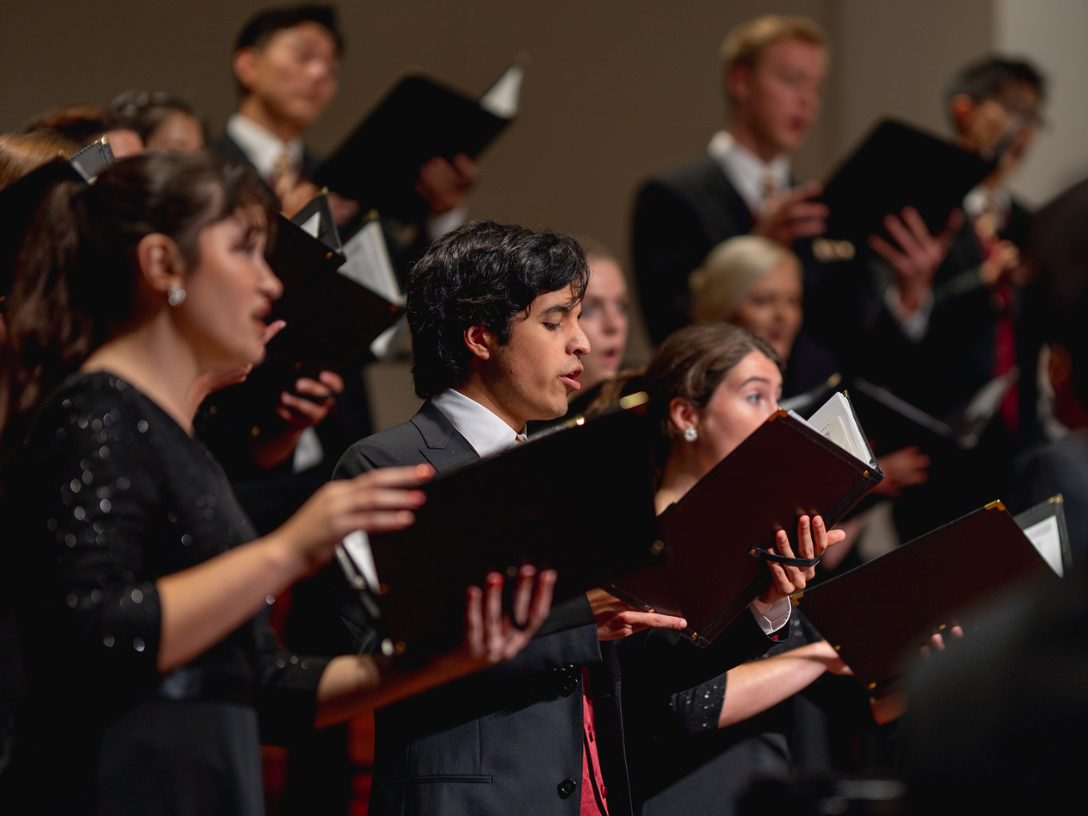
The USC Thornton Concert Choir presents an evening of choral music led by faculty member Tram Sparks.
Program
Vesperae Solennes de Confessore, K. 339
i. Dixit Dominus
-
- Soloists
Brook Lebron, soprano
Brianna Raygoza, alto
John Fayad, tenor
Hanwen Zhang, bass
- Soloists
v. Laudate Dominum
-
- Soloist
Phoebe J. Rosquist, soprano
- Soloist
Wolfgang Amadeus Mozart (1756–1791)
Veni, Sancte Spiritus
Zanaida Stewart Robles (b. 1980)
Even When He Is Silent
Marisa Rawlins-Bradfield, conductor
Kim André Arnesen (b. 1980)
Samo moru virujen
Phoebe J. Rosquist, conductor
-
- Soloists
Lauren Bondurant, soprano
Brianna Raygoza, alto
- Soloists
Krste Juras & Zdenko Runjić, arr. Tambača
“Choose Something Like a Star” from Frostiana
Randall Thompson (1899-1984)
Let My Love Be Heard
Jake Runestad (b. 1986)
I Can’t Make You Love Me
Marisa Rawlins-Bradfield, conductor
-
- Soloists
Chris Chang, tenor
Milana Gallette-Arledge, alto
Brianna Raygoza, alto
Abigail Wissot, soprano
Nick Amenta-Shin, tenor
Maxwell Banashek, bass
- Soloists
Allen Shamblin & Mike Reid, arr. Rob Dietz
“You Will Be Found” from Dear Evan Hansen
-
- Soloists
Marisa Rawlins-Bradfield, alto
Brook Lebron, soprano
Emily Feldon, soprano
- Soloists
Benj Pasek & Justin Paul, arr. Mac Huff
TEXT & TRANSLATIONS
Dixit Dominus
Dixit Dominus Domino meo:
Sede a dextris meis,
donec ponam inimicos tuos
scabellum pedum tuorum.
Virgam virtutis tuae emittet Dominus ex Sion:
dominare in medio inimicorum tuorum.
Tecum principium in die virtutis tuae,
in splendoribus sanctorum:
ex utero ante
luciferum genui te.
Juravit Dominus,
et non poenitebit eum:
Tu es sacerdos in aeternum
secundum ordinem Melchisedech.
Dominus a dextris tuis,
confregit in die irae suae reges.
Judicabit in nationibus,
implebit ruinas;
conquassabit capita in terra multorum.
De torrente in via bibet;
propterea exaltabit caput.
Gloria Patri, et Filio,
et Spiritui Sancto,
sicut erat in principio, et nunc, et semper,
et in saecula saeculorum. Amen.
The Lord said to my Lord:
Sit at my right hand
until I make your enemies a footstool for your feet.
The scepter of your power
The Lord shall send forth from Zion:
rule in the midst of your enemies.
The power to rule is with you
In the splendor of the holy ones:
I have begotten you from the womb before
the rising of the day-star
The Lord has sworn an oath,
And will not repent of it:
You are a priest forever,
according to the order of Melchisedech.
The Lord at your right hand
destroys kings on the day of his wrath.
He shall judge among the heathens,
he shall pile up ruins
and scatter skulls on many lands.
He shall drink of the torrent in his way;
therefore, he shall lift up his head.
Glory be to the Father, and to the Son,
and to the Holy Spirit,
as it was in the beginning,
is now and ever shall be,
world without end. Amen.
Laudate Dominum
Laudate Dominum, omnes gentes;
laudate eum, omnes populi.
Quoniam confirmata est super nos
misericordia eius,
et veritas Domini manet in aeternum.
Gloria Patri, et Filio, et Spiritui Sancto,
sicut erat in principio, et nunc, et semper,
et in saecula saeculorum. Amen.
O praise the Lord, all ye nations;
praise him, all ye peoples.
For his loving kindness
Has been bestowed upon us,
and the truth of the Lord endures forever.
Glory be to the Father, the Son, and the Holy Spirit, As it was in the beginning, is now, and ever shall be, world without end. Amen.
Veni, Sancte Spiritus Zanaida Stewart Robles (b.1980)
Veni, Sancte Spiritus,
et emitte caelitus
lucis tuae radium.
Veni, pater pauperum,
veni, dator munerum,
veni, lumen cordium.
Consolator optime,
dulcis hospes animae,
dulce refrigerium.
In labore requies,
in aestu temperies,
in fletu solacium.
O lux beatissima,
reple cordis intima
tuorum fidelium.
Sine tuo numine,
nihil est in homine,
nihil est innoxium.
Lava quod est sordidum,
riga quod est aridum,
sana quod est saucium.
Flecte quod est rigidum,
fove quod est frigidum,
rege quod est devium.
Da tuis fidelibus,
in te confidentibus,
sacrum septenarium.
Da virtutis meritum,
da salutis exitum,
da perenne gaudium.
Amen. Alleluia.
Come, Holy Spirit,
and send from heaven
the radiance of your light.
Come, Father of the poor,
come, giver of gifts,
come, light of hearts.
Best of consolers,
sweet guest of the soul,
gentle refreshment.
In labor, rest;
in heat, tempering;
in tears, solace.
O most blessed light,
fill the inmost hearts
of your faithful.
Without your presence,
there is nothing in humanity,
nothing that is harmless.
Cleanse what is unclean,
water what is dry,
heal what is wounded.
Bend what is rigid,
warm what is cold,
guide what has gone astray.
Grant to your faithful,
who trust in you,
the sevenfold gift.
Grant the reward of virtue,
grant the end of salvation,
grant everlasting joy.
Amen. Alleluia.
Samo moru virujen – Krste Juras & Zdenko Runjić, arr. Tambača
1. Samo moru virujen
More sluša, ja mu pričam priče
Samo moru virujen
Ono šumi, pušta me da vičen
Samo moru virujen
More lići, more rane vida
Samo moru kažem sve
More sluša, pa me ispovida
2. Samo moru virujen
Samo valu, oseki i plimi
I kad svi me ostave
More širi ruke da me primi
3. Samo moru virujen
More sluša pa me osokoli
Samo moru virujen
Samo more znade da te volim Krste Juras
1. Only the sea is faithful
The sea listens, I tell it stories.
My only faith is in the sea
It sighs; it lets me shout
Chorus: Only the sea is faithful
The sea is beautiful, the sea heals all wounds
Only the sea tells all—
The sea listens, so it is my confessor.
2. Only the sea is faithful
Only the waves, the ebbs and flows.
And when everyone else leaves me
The sea spreads its arms to receive me.
3. Only the sea is faithful
The sea listens and encourages me
Only the sea is faithful
Only the sea knows that I love you.
Program Notes
“Dixit Dominus” & “Laudate Dominum,” from Vesperae Solennes de Confessore, K. 339 – Wolfgang Amadeus Mozart (1756–1791)
Wolfgang Amadeus Mozart (1756-1791) is remembered today as one of the most prominent composers of the classical era. Mozart’s catalog of music exceeds 800 works, spanning many genres and styles of the time, including symphonies, concertos, operas, chamber works, and choral-symphonic works. Born in Salzburg, Mozart was a musical prodigy who demonstrated proficiency on the keyboard and violin at an early age and composed his first works at age five. He toured Europe extensively, and the great majority of his time working as a professional musician was spent in Salzburg and Vienna, where he wrote much of his works. Among his most highly regarded compositions are the operas Don Giovanni, The Magic Flute, Così fan tutte, and The Marriage of Figaro. Mozart died at age 35 under unclear circumstances while composing his last work, Requiem in D minor, K.626 (1791). His output represents some of the most enduring masterworks in Western music, combining elegance, emotional impact, and extraordinary artistry.
Mozart composed Vesperae Solennes de Confessore in 1780 while serving as the court organist to the Archbishop of Salzburg. This work represented his final contribution to church music in Salzburg. Vesperae Solennes de Confessore reflects the Enlightenment reforms of the Salzburg court, which emphasized clarity, conciseness, and restraint in sacred music, restrictions that often frustrated Mozart. The work is scored for four-part choir, four vocal soloists, and a modest orchestra, with no movement lasting longer than five minutes. It was written for the evening, the Vespers service within the Roman Catholic Church, consisting of five psalm settings, followed by a Magnificat for an unnamed saint’s day; the movements are commonly performed individually in concert settings. “Dixit Dominus” (Psalm 110) and the best-known movement, “Laudate Dominum” (Psalm 117), demonstrate both Mozart’s mastery of integrating conservative (stile antico) choral counterpoint with lyrical clarity and expressive operatic writing.
–Marisa Rawlins-Bradfield
Veni, Sancte Spiritus – Zanaida Stewart Robles (b.1980)
Zanaida Stewart Robles is an accomplished composer, vocalist, and educator whose work has earned national recognition. Her original compositions are performed by a wide range of ensembles and musicians, including professional organizations, community and school choirs, faith-based groups, and individual performers worldwide. Robles earned her Doctor of Musical Arts degree from the USC Thornton School of Music, following graduate study at California State University, Northridge, and undergraduate study at California State University, Long Beach. She is also an alumna of the Los Angeles County High School for the Arts.
Veni, Sancte Spiritus (“Come, Holy Spirit”) was composed in 2012 under the guidance of Robles’s composition teacher, Dr. Morten Lauridsen, while attending the University of Southern California. This arrangement offers a modern interpretation of the “Golden Sequence,” a Latin text that honors God the Holy Spirit during the Masses of Pentecost Sunday. Her setting captures both the mystery and urgency of invoking the Holy Spirit, with luminous harmonies and rhythmic vitality. Waves of sound rise and fall to mirror the text’s breathing imagery, creating a work that is both meditative and expansive. “Veni, Sancte Spiritus” combines the harmonic language and syncopation of popular genres such as rock and pop with the structure of compound meter, intricate piano writing, and expressive choral textures. The result is a work that bridges contemporary and classical choral traditions.
–Marisa Rawlins-Bradfield
Even When He Is Silent – Kim André Arnesen (b. 1980)
Kim André Arnesen (b. 1980) is one of today’s most frequently performed contemporary choral composers. A native of Trondheim, Norway, Arnesen was trained as a classical pianist, sang as a chorister in the Nidaros Cathedral Boys’ Choir, and studied at the Trondheim Music Conservatory. Drawing on influences ranging from Baroque and contemporary classical music to popular styles, he has developed a distinctive and deeply expressive choral voice. His works, including Even When He Is Silent, Cradle Hymn, and Flight Song are performed worldwide and praised for their warmth, lyricism, and emotional depth. Arnesen’s music has been performed in over thirty countries, including a performance of Cradle Hymn at the White House in 2016. His music is published by Boosey & Hawkes.
Even When He Is Silent was commissioned in 2011 by the St. Olaf festival in Trondheim, Norway. The assignment was to write a work in two separate versions – one for SATB choir and one for SSAA choir, unaccompanied. The text was found written on a wall at a concentration camp after World War II. Imagining what that person went through makes the words so powerful. As I read them, it was a Credo – when everything is dark and difficult in life you might wonder where God is, or if God is there at all. This is about keeping faith in God, love, and hope. I think of the sun as a metaphor for hope. Even without thinking of metaphors, the text has a deep meaning. Even if people take away your freedom, your friends, the people you love – they cannot take God away from you. The SSAA version of Even When He Is Silent was premiered just a few days after the terrorist attacks in Oslo and Utøya. It was one of the works being performed at a Conversation in the Nidaros Cathedral with bishop Tor Singsaas and actor Liv Ullmann on July 30, 2011. It was premiered by the Nidaros Cathedral Girls’ Choir and conductor Anita Brevik. The SATB version was premiered on November 26, 2011, by the Nidaros Cathedral Boys’ Choir and conductor Bjørn Moe. The composition begins in stillness, reflecting the profound depth of the words. It gradually builds to a dramatic climax on the phrase “I believe in love,” embodying the intense and conflicting emotions of holding onto it in difficult times. The piece then fades into a more contemplative ending, culminating in a serene acceptance of faith in God, even amidst silence. (Notes from the score.)
“Choose Something Like a Star,” Randall Thompson (1899–1984)
Randall Thompson (1899–1984) is recognized as a central figure in twentieth-century American choral music, best known for his works such as “Alleluia” and Frostiana. Educated at Harvard University and the Curtis Institute of Music, Thompson later returned to both institutions as a teacher and mentor, shaping generations of musicians and scholars, including Samuel Adler and Leonard Bernstein. Thompson had a distinguished career holding leadership positions at the Curtis Institute, the University of Virginia, Princeton, and Harvard, where he became the inaugural Walter Bigelow Rosen Professor of Music. His contributions were recognized with numerous honors, including the award of his doctorate from the Eastman School of Music at the University of Rochester.
Robert Frost (1874–1963) is acknowledged as one of America’s most celebrated poets, winning four Pulitzer Prizes for his poetic works, best known for “The Road Not Taken” and “Stopping by Woods on a Snowy Evening.” His literary output often includes simple, nature-centered themes and deep philosophical reflections. Frost taught at institutions including Amherst College, Harvard, Dartmouth, and the University of Michigan, and became the first poet to read at a U.S. presidential inauguration, reciting The Gift Outright at John F. Kennedy’s swearing-in. Frost’s works continue to be studied and celebrated.
“Choose Something Like a Star,” the closing movement of Thompson’s Frostiana: Seven Country Songs, reflects Frost’s meditation on constancy, truth, and the search for guidance in an uncertain world. Commissioned for the bicentennial of Amherst, Massachusetts, Frostiana premiered in 1959 and has since become a cornerstone of American choral literature. Thompson’s transparent textures and gentle harmonies allow Frost’s poetry to speak with clarity and warmth, resulting in a quietly luminous work that continues to resonate deeply with performers and audiences across generations.
–Marisa Rawlins-Bradfield
Samo moru virujen – Krste Juras & Zdenko Runjić, arr. Tambača
Klapa is a singing tradition of the southern Croatian regions of Dalmatia. Multipart singing, a cappella homophony, oral tradition and simplicity are its main features. The word klapa itself means “group of friends.” Typically performed in unmixed ensembles, the leader of each group is the top voice, whether tenor or soprano. During performances, the singers stand in a tight semicircle, sometimes draping their arms around each other. Practitioners are skilled amateurs who inherit the repertory as an oral tradition. Klapa has been recognized on a list of Intangible Cultural Heritage of Humanity by UNESCO (The United Nations Educational, Scientific and Cultural Organization).
Topics of klapa songs usually deal with love, wine, and the (mostly coastal) environment in which they live. That is certainly true in Samo moru virujen: The sea is addressed as a confidante, the only one to whom the singer can bring their feelings about life and love.
-Phoebe J. Rosquist
Let My Love Be Heard – Jake Runestad (b. 1986)
Jake Runestad (b.1986) is an EMMY®-winning and GRAMMY®-nominated American composer and conductor. Steeped in a belief that music has the power to initiate positive change, Runestad creates musical works that are socially conscious and explore authentic human emotions and experiences. Conductors, performers, and audiences continue to praise his music for its ability to connect with the head and the heart. His music has been performed and commissioned by leading ensembles and organizations such as VOCES8, Washington National Opera, the Los Angeles Master Chorale, the Munich Radio Orchestra, the Dallas Symphony Orchestra & Chorus, the Pacific Symphony & Chorale, True Concord Voices & Orchestra, the National Chorus of Korea, the Bavarian Radio Choir, the Netherlands Radio Choir, the Philippine Madrigal Singers, Seraphic Fire, the Santa Fe Desert Chorale, and many more. Along with Jake’s commissions and residencies, he leads workshops and conducting masterclasses nationally and internationally. Runestad earned his master’s degree in composition from the Peabody Conservatory of Johns Hopkins University, where he studied with Pulitzer Prize-winning composer Kevin Puts. In addition to these achievements, Jake Runestad is one of the youngest composers ever awarded the prestigious Raymond C. Brock commission by the American Choral Directors Association (JakeRunestad.com).
Let My Love Be Heard is a deeply expressive plea for comfort and compassion, written in response to personal and collective loss. Built on ascending melodic gestures and richly textured harmonies, the piece moves from quiet reflection to a powerful, cathartic climax. Its message of love rising above sorrow has resonated with choirs around the world. Though originally written for Choral Arts Northwest, this work has taken on a new life in light of the atrocities in Paris and Beirut. Jonathan Talberg, the conductor of the choir at Cal State Long Beach, led his singers in a performance during the memorial vigil for Nohemi Gonzalez, a Long Beach student who was killed in the Paris attacks. The day after the vigil, the choir was supposed to begin rehearsing holiday music; however, Jonathan felt that was not appropriate and wanted time for the singers to grieve this loss. So, at the beginning of rehearsal, he passed out a brand-new piece of music (Let My Love Be Heard), rehearsed it, and then recorded it. It was posted on SoundCloud and shared in memory of Nohemi and as a plea for peace. Their musical offering is a powerful outpouring of grief but also a glimmer of light. I am honored that this piece, Let My Love Be Heard, has helped to provide hope in the darkness of our world. (JakeRunestad.com)
I Can’t Make You Love Me – Allen Shamblin & Mike Reid, arr. Rob Dietz
Allen Shamblin and Mike Reid are acclaimed American songwriters known for crafting songs recorded by major artists across numerous genres. Their 1991 hit, “I Can’t Make You Love Me,” is considered one of the greatest modern love songs recorded by country singer Bonnie Raitt on her eleventh studio album, Luck of the Draw. It was originally an up-tempo bluegrass song, inspired by a 1989 story in a Tennessean newspaper about a divorced man and his estranged wife that stated, “You can’t make a woman love you if she don’t.”.
Arranger Rob Dietz brings this iconic song into the contemporary a cappella world with rich vocal textures, expressive dynamics, and close-harmonic writing. Dietz is known as an award-winning arranger, composer, conductor, and educator. He is the co-director for the Los Angeles-based A Cappella Academy program with Ben Bram and Avi Kaplan from the vocal group, Pentatonix. His work has been featured on The Sing-Off (NBC), America’s Got Talent (NBC), Glee (FOX), To All the Boys: P.S. I Still Love You (Netflix), and Pitch Perfect 3 (Universal). His arrangement of “I Can’t Make You Love Me” highlights the emotional weight of the text while creating a lush harmonic environment for the soloist. The result preserves the original’s intimacy while adding new depth through vocal ensemble color.
–Marisa Rawlins-Bradfield
“You Will Be Found,” Benj Pasek & Justin Paul
Benj Pasek and Justin Paul are a recognized songwriting duo for film, television, and the musical theatre landscape. The two met at the University of Michigan while studying musical theatre, and there, they established a collaborative partnership. They achieved widespread recognition with their Tony Award-winning score for Dear Evan Hansen, and further international success through their work on films such as La La Land, which earned them an Academy Award for Best Original Song, and The Greatest Showman. Their music often explores themes of identity, connection, and resilience, resonating strongly with audiences across generations and performance settings.
“You Will Be Found” is the Act I finale of the musical Dear Evan Hansen and has become an anthem of hope, connection, and mental health awareness. Written by Pasek and Paul, the song addresses the pain of loneliness, anxiety, and depression while affirming the power of community and human connection. The arrangement begins with quiet introspection of a single voice and gradually builds into a powerful choral texture of unity. Through powerful melodic lines and layered harmonies, the piece conveys the message that no one is alone and that, even in moments of fear and isolation, we are supported by those around us.
–Marisa Rawlins-Bradfield
Ensemble
ROSTER
Soprano
Hyeongju An
Lauren Bondurant
Natalie Bradley
Cassidy Clark
Emily Hope Feldon
Brook Lebron
Fionna Lee
Mandy Leung
Janaya Palmer
Phoebe J. Rosquist
Vivienne Ruemler
Abigail Wissot
Alto
Milana Gallette-Arledge
Marisa Rawlins-Bradfield
Shreeya Chand
Lauren Chen
Angelina Diaz
Indy Faulkner
Cindy Zhaoyuan Jin
Minh Ngoc Nguyen
Brianna Gabriela Raygoza
Cassandra Sobota
Maya Nisperos Wong
Manjing Zhang
Tenor
Chris Chang
Emory Cotter
John Fayad
David Junchen Qu
Zarif Ikram
Nick Amenta-Shin
Brady Travers
Peter Dian Yu
William Chuxia Zhang
Bass
Maxwell Banashek
Padraic Carr
David Cerna
Max Davis
Theo Lopez
Gordon Lu
Lucca Salazar
Alexander Haoxiong Tang
William Sillers
Hanwen Zhang