Concert Programs
USC Thornton Symphony featuring Leonard Slatkin
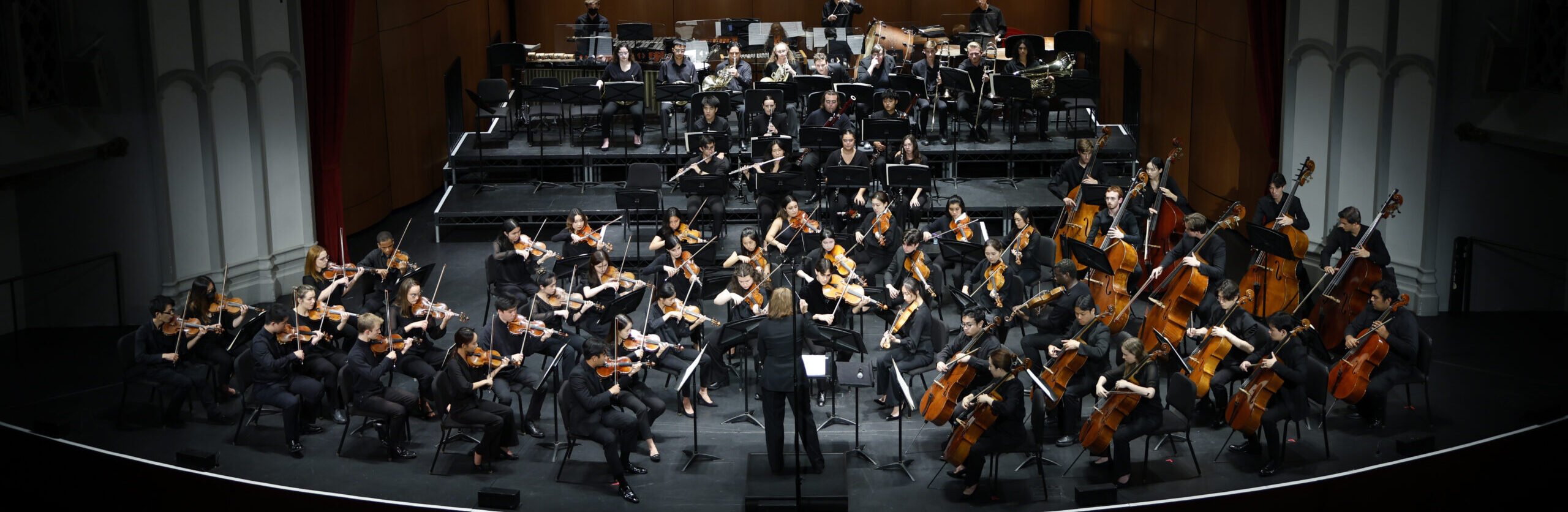
USC Thornton Symphony Orchestra
Friday October 24th, 7:30 PM, Bovard Auditorium
Leonard Slatkin, Conductor

Program
Schubertiade: An Orchestral Fantasy
Leonard Slatkin
(1944 – )
Symphony No.7, op.60, C major “Leningrad”
Dmitry Shostakovich
(1906 – 1975)
Composer Notes
Leonard Slatkin, Schubertiade: An Orchestral Fantasy (2025)
In April of 2022, when we were all starting to come out of hiding from the global pandemic, I had the privilege of conducting the Hiroshima Symphony Orchestra in a concert honoring the 50th anniversary of their becoming a professional orchestra. When we had concluded the Sixth Symphony by Gustav Mahler, I sat, somewhat exhausted, in the dressing room.
Several administrators of the orchestra came to greet me, and during the course of our chat, they asked my wife, composer Cindy McTee, if she would be interested in writing a work to honor Franz Schubert. She was flattered but declined. However, I became quite intrigued by the idea and suggested that the piece be written by me. Our concert is actually on his birthday, January 31.
Almost immediately, ideas started swirling around in my head. Should it be a totally original composition, with no musical reference to the Austrian master? Or might it be a hybrid, where various strains of Schubert fragments are heard alongside new material? I decided on the latter and used the composer’s final composition, the Symphony in B minor, as a starting point.
Schubert himself was rather poor for most of his brief life. To get his music heard, he would organize soirées at his apartment, where friends would gather to play and sing his works. These events were known as Schubertiaden. The composer was usually at the piano. When I began to write this piece, I wondered what it might be like if this tradition could be extended well past the composer’s lifetime.
The work is basically in three parts, with descriptive moments placed before each. It begins with Schubert, not seen, at the piano playing the opening of his monumental Bb Sonata. This is rudely interrupted by the orchestra, representing the guests, who arrive rather vociferously with a series of fanfares and flourishes by the trumpets, horns and flutes.
The initial section is taken from the first six bars of Schubert’s “Unfinished” Symphony and is cast as a passacaglia. This is a set of variations over the bass line which opens the symphony. Other elements of the first movement are introduced, but those become more and more distorted as the guests indulge in some glühwein.
Schubert is playing one of his impromptus when several more friends arrive, and they are introduced by the same instruments who greeted the earlier visitors. When they settle down, some more recent composers, perhaps Phillip Glass or Steve Reich, proceed to take Schubert’s main themes from the slow movement of his final work and alter them into a mash-up of harmonic and rhythmic glee. This becomes the second part of Schubertiade.
The guests are anxious to get home, and the music becomes more and more deafening as well as fast, with dancing turned into a frenzy. The music stops and once more, the flourishes are played, but this time, they are done more quietly. It is a signal for everyone to leave. But they do not make their way to the door until several have honored their host by performing fragments of some of his other compositions. This becomes the third and final section of the piece, a quodlibet, if you will. Sometimes these are not played exactly as the composer wrote them, but we are in a 21st-century version of a Schubertiade.
It is raining as the guests depart into the evening. A final reference to the fanfares is heard, but this time the notes are played in reverse. The composer is left at his piano, trying to complete the sonata melody that began the evening. And which, at least in this version, will remain “Unfinished.”
—Leonard Slatkin
Program Notes
Dmitry Shostakovich, Symphony No.7, op.60, C major “Leningrad” (1941)
With his 15 symphonies, many chamber works, and numerous concerti all written under the pressures of the Soviet government, Dmitri Shostakovich made a name for himself as a virtuosic composer and pianist.
Shostakovich wrote his Symphony No. 7 in 1941 in Leningrad, as well as in Kuybyshev. This work was a huge success for him, so he settled in Moscow to teach composition at the Leningrad Conservatory. This piece is known as a wartime work, written during the time that the Germans invaded Russia and surrounded Leningrad. The siege lasted around 900 days, leaving people to die in rough conditions.
This work consists of four movements, with the first three being composed during the summer of 1941. After writing these movements, Shostakovich’s family was evacuated to the capital of Russia where he finished the piece.
In the first movement, Allegretto, the audience can hear a sweeping theme that is an important part of the symphony, sounding relaxed and warm. Later in the movement, Shostakovich gives us a crescendo within the orchestra on top of a rhythmic pattern. This theme, known as the “invasion theme,” was meant to represent the Germans invading Russia. In addition to this, Shostakovich also had a second meaning to this theme, thinking of the enemies to humanity. This theme begins soft and distant, growing in volume and tension as it goes on. Towards the end of the first movement, this theme combines with the opening theme to create a sense of heroism.
The second movement of the piece, Moderato or also known as Scherzo, is strange and unsettling. It includes long wind solos and odd rhythms in the strings. The middle section has a playful and mocking feeling to it. It involves a lot of violins, violas, oboe, and English Horn.
The third movement, Adagio, opens with a choral-like theme played by the winds. The tone of this movement is tragic. This is showcased through moments such as a flute solo that transforms into a duet and ends up in the violin section. The middle section of this movement is marked as Moderato risoluto to bring back the themes from the first movement.
The finale of this symphony, Allegro non troppo, resembles the first movement themes based on the invasion. Shostakovich begins the movement calmly, building up movement and power as it goes on. Through this build up, the music takes a moment to breathe with a C Major restatement of the opening theme.
— Carter Williams (Harp, BM 2026)
About the Artists
Leonard Slatkin
Internationally acclaimed conductor Leonard Slatkin is Music Director Laureate of the Detroit Symphony Orchestra (DSO), Directeur Musical Honoraire of the Orchestre National de Lyon (ONL), Conductor Laureate of the St. Louis Symphony Orchestra (SLSO), Principal Guest Conductor of the Orquesta Filarmónica de Gran Canaria (OFGC), Artistic Consultant to the Las Vegas Philharmonic (LVP), and Artistic Advisor to the Nashville Symphony. He maintains a rigorous schedule of guest conducting throughout the world and is active as a composer, author, and educator.
The 2025-26 season includes engagements with the National Symphony Orchestra (Ireland), Manhattan School of Music Symphony Orchestra, SLSO, USC Thornton Symphony, LVP, Taiwan Philharmonic, KBS Symphony Orchestra (Seoul), Gunma Symphony Orchestra, NHK Symphony Orchestra (Tokyo), Nashville Symphony, Atlanta Symphony Orchestra, Orchestre Symphonique de Montréal, Warsaw Philharmonic, Franz Schubert Filharmonia (Barcelona), ONL, Prague Symphony Orchestra, Filarmonica George Enescu (Bucharest), OFGC, and Rundfunk-Sinfonieorchester Berlin.
Slatkin has received six Grammy awards and 35 nominations. Naxos recently reissued Vox audiophile editions of his SLSO recordings featuring the works of Gershwin, Rachmaninov, and Prokofiev. Other Naxos recordings include Slatkin Conducts Slatkin—a compilation of pieces written by generations of his family—as well as works by Saint-Saëns, Ravel, Berlioz, Copland, Borzova, McTee, and Williams. In addition, he has recorded the complete Brahms, Beethoven, and Tchaikovsky symphonies with the DSO (available online as digital downloads).
A recipient of the National Medal of Arts, Slatkin also holds the rank of Chevalier in the French Legion of Honor. He has been awarded the Prix Charbonnier from the Federation of Alliances Françaises, Austria’s Decoration of Honor in Silver, and the League of American Orchestras’ Gold Baton. His debut book, Conducting Business (2012), for which he received the ASCAP Deems Taylor Special Recognition Award, was followed by Leading Tones (2017) and Classical Crossroads: The Path Forward for Music in the 21st Century (2021). His latest books are Eight Symphonic Masterworks of the Twentieth Century (spring 2024) and Eight Symphonic Masterworks of the Nineteenth Century (fall 2024), part of an ongoing series of essays that supplement the score-study process, published by Bloomsbury.
He holds honorary doctorates from many institutions, including The Juilliard School, New England Conservatory, Michigan State University, Indiana University, the University of Rochester, the University of Maryland-College Park, George Washington University, the University of Missouri-St. Louis, and Washington University in St. Louis.
Slatkin has held posts as Music Director of the New Orleans Philharmonic-Symphony Orchestra, SLSO, National Symphony Orchestra, DSO, and ONL, and he was Chief Conductor of the BBC Symphony Orchestra in London. He has served as Principal Guest Conductor of London’s Philharmonia and Royal Philharmonic, the Pittsburgh Symphony Orchestra, the Los Angeles Philharmonic at the Hollywood Bowl, and the Minnesota Orchestra in Minneapolis, where he founded their annual Sommerfest. Furthermore, he has held titled conducting positions with the Blossom Music Center and both the Grant Park and Great Woods music festivals.
He has conducted virtually all the leading orchestras in the world. Among those in America are the New York Philharmonic, Chicago Symphony Orchestra, Philadelphia Orchestra, Boston Symphony Orchestra, San Francisco Symphony, and Los Angeles Philharmonic. Elsewhere he has worked with all five London orchestras, the Berlin Philharmonic, Munich’s Bayerischer Rundfunk, the Royal Stockholm Philharmonic Orchestra, Amsterdam’s Royal Concertgebouw Orchestra, the Orchestre de Paris, the Oslo Philharmonic Orchestra, and the Israel Philharmonic Orchestra.
Slatkin’s opera conducting has taken him to the Metropolitan Opera, Lyric Opera of Chicago, Washington National Opera, Opera Theatre of St. Louis, Santa Fe Opera, Vienna State Opera, Stuttgart Opera, and Opéra Bastille in Paris.
Founder and former director of the St. Louis Symphony Youth Orchestra and National Conducting Institute in Washington, DC, Slatkin remains a passionate music educator. He has conducted and taught at such institutions as the Manhattan School of Music, The Juilliard School, the Aspen Music School, the Jacobs School at Indiana University, the National Orchestral Institute, the Music Academy of the West, and the New World Symphony.
Born in Los Angeles to a distinguished musical family, he is the son of violinist-conductor Felix Slatkin and cellist Eleanor Aller, founding members of the famed Hollywood String Quartet. He began his musical training on the violin and first studied conducting with his father, followed by Walter Susskind at Aspen and Jean Morel at Juilliard. He is the father of one son, Daniel, and makes his home in St. Louis with his wife, composer Cindy McTee.
He is represented by Stefana Atlas at Arabella Arts (manager responsible for the Americas, Europe, Australia, and New Zealand) and Hiromi Oe at Kajimoto (manager responsible for Asia).
Ensemble
Roster
Violin I
Yifei Mo, Concertmaster
Maia Ruiz Law
Dahae Shin
Ayman Amerin
Maya Masaoka
Abigail Park
Hyojeong Kim
Isaiah Iny-Woods
Andrew Choi
Ethan Chen
Chloe Hong
Ashlee Sung
Yiran Yao
Alice Dring
Violin II
Marena Miki, Principal
Anna Renton
Juchao Zhao
Ariana O’Connell
Maya Irizarry Lambright
Nathan Nguyen
Sarah Yoo
Agatha Blevin
Diana Dawydchak
Dominic Guevara
Sara Yamada
Junha Park
Viola
Gloria Choi, Principal
Solomon Leonard
John Czekanski
Poppy Yu
Jay Maldonado
Matthew Pakola
Cecille McNeill
Lilien Foldhazi
Kate Brown
Cello
Olivia Cho, Principal
Olivia Marckx
Dylan Tyree
Amy Jong
Madelynn Bolin
Siena Rosborough
Danny O’Connell
Yongjoon Choe
Isabelle Fromme
Elaina Spiro
Bass
Josia Sulaiman, Principal
Logan Nelson
Anders Ruiter-Feenstra
Julien Henry
Abigail Koehler
Jai Ahuja
Piano/Celeste
Chloe Gwak
Harp
Zoe O’Shaughnessy
Daya Asokan
Angel Kim
*=Principal on Slatkin
+=Principal on Shostakivich
Flute
Dennis Papazyan*
Luke Blancas
Aarushi Kumar
Kiana Kawahara
Celine Chen*
Ellen Cheng
Alto Flute
Ellen Cheng
Piccolo
Kiana Kawahara
Oboe
Ricky Arellano*
Karen Hernandez
Chase Klein+
English Horn
Connor Feyen
Clarinet
Yoomin Sung*
Mauricio Castillo+
Jesus Milano Melgarejo
Louis Milne
Eb Clarinet
Louis Milne
Bass Clarinet
Simon Bakos
Bassoon
Anjali PIllai*
Chris Lee
Callahan Lieungh+
Mio Yamauchi
Contrabassoon
Ethan Ault
Horn
Lauren Goff+
Xinrae Cardozo
Jean Smith
Alan Schlesinger
Evelyn Webber*
Joe Oberholzer
Neven Basener
Engelberth Meija
Daniel Halstead
Trumpet
Dylan Johnson+
Derek Gong
Alex Drozd
Remy Ohara
Jorge Araujo Felix
Jerry Mak*
Trombone
Jason Bernhard+
Terry Cowley
Harrison Chiang
Alicia Miller
Avery Robinson
Sean Cooney
Joe Chilopolus*
Tuba
Jasper Kugler
Timpani
Preston Spisak*+
Percussion
Luciano Valdes
Sabrina Lai+
Cash Langhi
Marcos Salgado
Xavier Zwick
Chanhui Lim
Tyler Brown
Marcos Rivera