Concert Programs
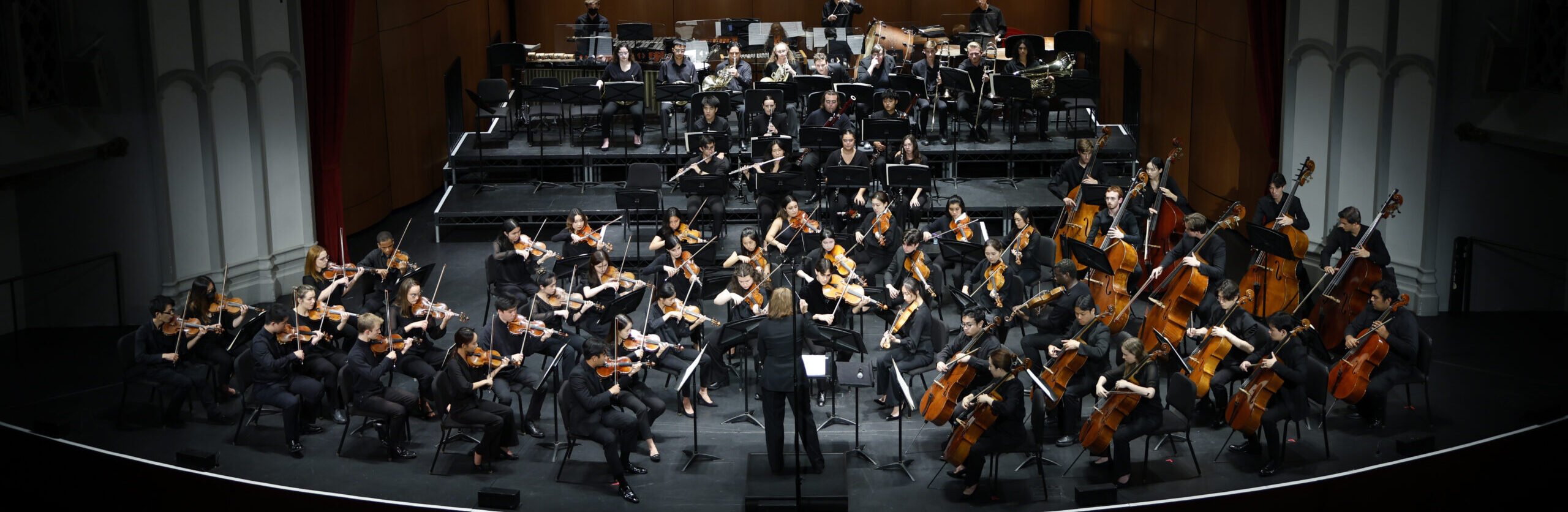
Thornton Symphony Orchestra
Carl St.Clair, Conductor
Cristian Grases, Choral Conductor

Program
Puer natus in Bethlehem
Nunc Dimittis
Rivers of Light
Os Justi
- Thornton Chamber Singers
Cristian Grases, Conductor
Levente Gyöngyösi (b. 1975)
Arvo Pärt (b.1935)
Ēriks Ešenvalds (b. 1977)
Anton Bruckner (1824-1896)
~Intermission~
Symphony No. 7 in E Major
- I. Allegro moderato
- II. Adagio: Sehr feierlich und sehr langsam
- III. Scherzo: Sehr schnell
- IV. Finale: Bewegt, doch nicht schnell
Anton Bruckner(1824-1896)
Program Notes
Puer natus in Bethlehem
Levente Gyöngyösi (b. 1975)
Hungarian composer Levente Gyöngyösi writes choral music that blends the clarity of traditional sacred song with the rhythmic vitality and harmonic richness of modern expression. His works often balance transparency with weight, allowing ancient texts to resonate with a contemporary voice.
Puer natus in Bethlehem (“A child is born in Bethlehem”) is the first of two sacred songs (2 Cantiones Sacrae) composed in 2011. The text comes from a medieval Latin Christmas hymn that celebrates the birth of Christ. For centuries such hymns were sung in monasteries and churches, their verses designed for both worship and teaching. The words begin with joy at the birth of a child in Bethlehem, the city of David, and move quickly to the central Christian message of incarnation, the belief that God is present in human form.
Gyöngyösi’s setting for SATB choir lasts just under four minutes. It opens with chant-like simplicity, as if echoing the sound of monastic voices centuries ago. Gradually the music grows in warmth and color, with richer harmonies and freer rhythms. At important words such as Bethlehem and natus (“born”), Gyöngyösi highlights the text with fuller dynamics and brighter harmonic shifts. The result is a piece that feels both reverent and fresh, rooted in tradition but alive with new energy.
Nunc Dimittis
Arvo Pärt (b. 1935)
Arvo Pärt is one of the most influential Estonian composers of the late twentieth and early twenty-first centuries. His signature style, called tintinnabuli (from the Latin for “little bells”), creates music of luminous simplicity. Silence, pure harmony, and carefully measured pacing are central to his sound, which listeners often describe as prayerful and timeless.
Nunc dimittis (2001) was written for St. Mary’s Cathedral in Edinburgh and sets the biblical canticle known as the Song of Simeon. The text comes from the Gospel of Luke, where the elderly Simeon, having seen the infant Christ in the temple, declares that he is ready to die in peace. The Latin words Nunc dimittis servum tuum, Domine mean “Now, Lord, you let your servant depart in peace.” For centuries this passage has been sung at evening prayer, marking the end of the day with a sense of calm release.
Pärt’s setting for unaccompanied choir unfolds slowly, almost like a single breath. At first the lines are quiet and restrained, carrying the weight of Simeon’s age and longing. Gradually the music swells toward the phrase lumen ad revelationem (“a light to reveal”), where the harmony blossoms into radiant major chords, musically portraying light breaking into darkness. After this brief climax the music recedes once more into stillness. The closing effect is not dramatic resolution but gentle release, a musical evocation of peace, acceptance, and transcendence.
Rivers of Light
Eriks Ešenvalds (b. 1977)
Latvian composer Ēriks Ešenvalds has become one of the most widely performed choral voices of his generation. A graduate of the Latvian Academy of Music and later a student at the Royal Conservatoire of The Hague, he is admired for weaving together folk traditions, vivid imagery from nature, and sacred or literary texts into works that shimmer with light and atmosphere. His sound world often includes extended techniques, such as overtone clusters, solo lines floating above the ensemble, and unusual timbres like the jaw harp, creating textures that feel both mystical and expansive.
Rivers of Light (2014), written for the Swedbank Choir of Riga and conductor Artūrs Ancāns, is a meditation on the Northern Lights. The score calls for two soloists, a mixed choir divided into eight parts, and the distinctive twang of a jaw harp. Ešenvalds layers excerpts from Sámi folk songs with words of explorers and writers including Fridtjof Nansen, Charles Francis Hall, Kari Kaila, Candace Savage, and William Reed. The piece begins in the Sámi language, grounding the listener in northern heritage, before the choir expands into rich, chorale-like textures. Over its five and a half minutes, the music shifts between intimate solos and expansive full choir passages, flickering and transforming like the Aurora Borealis itself: at times hushed and mysterious, at other times radiant and awe inspiring.
Os Justi
Anton Bruckner (1824-1896)
Anton Bruckner is remembered today for his monumental symphonies, yet he was equally at home in the world of sacred choral music. A lifelong church musician shaped by the traditions of St. Florian Abbey and Austrian cathedral culture, Bruckner absorbed the values of the nineteenth-century Caecilian Movement, which sought to restore the purity and clarity of early church music. His motets reflect this influence through their modal harmony, restrained beauty, and attention to liturgical function, while still carrying the spaciousness and sincerity characteristic of his musical voice.
Composed on 18 July 1879, Os Justi sets verses from Psalm 37 in the Latin Vulgate. Bruckner chose the Lydian mode for this text and wrote the entire motet without a single accidental, creating a sound that feels both ancient and luminous. The music begins in simple homophony, clear and chant-inspired, before moving into a more active polyphonic section where each voice line enters independently in gentle imitation. At two points the choir divides into eight parts, producing a glowing sonority that remains pure rather than chromatic.
The final “Alleluia” returns to a chant-like simplicity. It is sung in unison, quiet and unadorned, as if echoing the earliest forms of sacred singing. Os Justi lasts only a few minutes, yet it demonstrates Bruckner’s remarkable ability to unite the clarity of medieval modality with the expressive breath and contemplative stillness of the nineteenth century. The result is music that feels humble, spacious, and deeply devotional.
Symphony No. 7 in E Major, WAB 107
Anton Bruckner
Anton Bruckner’s Symphony No 7 in E Major was written between 1881 and 1883 and became the piece that finally brought him real success. For years, Bruckner had struggled to be taken seriously as a symphonic composer, even though he was a highly respected organist. When this symphony premiered in 1884, audiences responded warmly, and it helped establish his reputation. The first movement begins quietly, with a noble cello theme rising out of a shimmering string background. The music moves at its own pace. It does not rush toward drama. Instead, Bruckner builds the movement in broad waves, letting the sound expand gradually. The feeling is spacious and calm, but never empty.
The second movement is often considered the emotional center of the symphony. Bruckner wrote it while Richard Wagner, the composer he deeply admired, was near the end of his life. The Adagio has a serious and reflective character from the start, especially with the rich, darker sound of the Wagner tubas. As the movement grows, it builds to a powerful climax that includes a cymbal crash and triangle, a moment many people connect to Wagner’s memory. It is striking, but it does not feel exaggerated. Afterward, the music slowly settles, ending in a way that feels peaceful and accepting rather than tragic.
The Scherzo brings a sudden shift in energy. Its strong rhythms and bold brass give it a sense of drive and momentum, almost earthy in character. The middle section softens briefly before the opening returns. In the final movement, Bruckner brings everything together with music that feels confident and bright without trying to overwhelm the listener. The symphony ends in a full and glowing E major. Even though the work is large in scale, what stands out most is its sincerity. It feels less like a display of power and more like a deeply personal statement.
-Marcos Salgado (BM Percussion 2027)
Text & Translations
Puer natus in Bethlehem
Levente Gyöngyösi (b. 1975)
Latin Text (Luke 2, 29-32)
Puer natus in Bethlehem, Unde gaudet Ierusalem.
Hic iacet in præsepio, Qui regnat sine termino. Alleluia.
De matre natus virgine,
Sine virili femine;
Sine serpentis vulnere,
De nostro venit sanguine. Alleluia.
Cognovit bos et asinus, Quod puer erat Dominus. Intrantes domum invicem, Novum salutant principem.
In carne nobis similis, Peccato sed dissimilis;
Ut redderet nos homines,
Deo et sibi similes. Alleluia.
In hoc natali gaudio,
Benedicamus Domino:
Laudetur sancta Trinitas,
Deo dicamus gratias. Alleluia.
Translation
A Child is born in Bethlehem;
Exult for joy, Jerusalem!
Lo, He who reigns above the skies There, in a manger lowly, lies. Alleluia.
He comes, a maiden mother’s Son,
Yet earthly father hath He none; And, from the serpent’s poison free, He owned our blood and pedigree. Alleluia.
The ox and ass in neighbouring stall
See in that Child the Lord of all.
And enter with their offerings, To hail the new-born King of Kings.
Our feeble flesh and His the same, Our sinless kinsman He became,
That we, from deadly thrall set free,
Like Him, and so like God, should be. Alleluia.
Come then, and on this natal day, Rejoice before the Lord and pray.
And to the Holy One in Three
Give praise and thanks eternally. Alleluia.
Nunc Dimittis
Arvo Pärt (b. 1935)
Latin Text (Luke 2, 29-32)
Nunc dimittis servum tuum, Domine, secundum verbum tuum in pace:
Quia viderunt oculi mei salutare tuum,
Quod parasti ante faciem omnium populorum:
Lumen ad revelationem gentium,
et gloriam plebis tuae Israel.
Translation
Lord, now lettest thou thy servant depart in peace, according to thy word:
For mine eyes have seen thy salvation,
Which thou hast prepared before the face of all people;
A light to lighten the Gentiles,
and the glory of thy people Israel.
Rivers of Light
Eriks Ešenvalds (b. 1977)
Kuovsakasah reukarih tåkko teki, sira ria
Tåkko teki Sira ria, sira siraa ria Guovssat, guovssat radni go,
libai libai libaida
Ruoná gákti, nu nu nu
Sounds of the northern lights, flowing movement, shimmering color, traditional Sámi imagery and motion, rhythmic vocables expressing energy and nature.
Winter night, the sky is filled with symphony of light, the sky is flooded with rivers of light.
The doors of heaven have been opened tonight.
From horizon to horizon misty dragons swim through the sky, green curtains billow and swirl,
fast-moving, sky-filling, the tissues of gossamer. Nothing can be heard.
Light shakes over the vault of heaven, its veil of glittering silver changing now to yellow, now to green, now to red.
It spreads in restless change, into waving, into many-folded bands of silver.
It shimmers in tongues of flame,
over the very zenith it shoots a bright ray up until the whole melts away
as a sigh of departing soul in the moonlight,
leaving a glow in the sky like the dying embers of a great fire.
Os Justi
Anton Bruckner (1824-1896)
Text (Psalm 37:30-31)
Os justi medita bitur sapientiam,
et lingua ejus loquetur judicium.
Lex Dei ejus in corde ipsius:
et non supplantabuntur gressus ejus.
Alleluia.
Translation
The mouth of the righteous utters wisdom,
and his tongue speaks what is just.
The law of his God is in his heart,
and his steps shall not falter.
Alleluia.
Ensemble
Chamber Singers Roster
Soprano
Ayanda Fuzane
Kaitlyn Son
Kayla Kim
Sophie O’Shea
Amelia Pietropaolo
Nicole Smith
Sophia Thompson
Vishaala Wilkinson
Alto
Cassandra Sobota
Cheyenne Simon
Leah Taylor
Zoe Powell
Han-Ah Park
Julianna Othmer
Nnenna Onwe
Olivia Knowles
Tenor
Gabriel Kronson
Tyler Berg
Benjamin Thai
Christopher Renfro
Diego Delgado
Josh Feldman
Bass
Brandon DiNoto
Daniel Mangiaracino
Leo Mermelstein
Parker Goodwin
Tyler Milliren
Chris Arceo
Jason Torres
Jason Yang
Symphony Roster
Violin I
Dahae Shin, Concertmaster
Juchao Zhao
Yifei Mo
Anna Renton
Andrew Choi
Abigail Park
Nathan Nguyen
Eric Cheng
Sara Yamada
Dominic Guevara
Violin II
Ariana O’Connell, Principal
Hyojeong Kim
Ashlee Sung
Chloe Hong
Maya Masaoka
Sarah Yoo
Isaiah Iny-Woods
Diana Dawydchak
Ayman Amerin
Viola
Gloria Choi, Principal
Matthew Pakola
Solomon Leonard
John Czekanski
Cecille McNeill
Jay Maldonado
Poppy Yu
Lilien Foldhazi
Cello
Joseph Kim, Principal
Isabelle Fromme
Danny O’Connell
Samuel Guevara
Amy Jong
Taewon Park
Ernie Carbajal
Siena Rosborough
Cole Leonard
Bass
Logan Nelson, Principal
Nathaniel De La Cruz Daga
Julien Henry
Jai Ahuja
Micah Sommons
Josia Sulaiman
Abigail Koehler
*=Principal Player
Flute
Kiana Kawahara*
Celina Chen
Oboe
Ricky Arellano*
Jingming Zhao
Clarinet
Louis Milne*
Andrei Bancos
Bassoon
Callahan Lieungh*
Henry Mock
Horn
Steven Phan
Neven Bassener
Lauren Goff
Engelberth Meija
Alan Schlesinger
Wagner Tuben
Xinrae Cardozo
Evelyn Webber
Grace Kim
Joe Oberholzer
Trumpet
EJ Miranda*
Dylan Johnson
Hugo Tomas
Trombone
Jason Bernhard*
Avery Robinson
Bass Trombone
Kevin Truong
Tuba
Logan Westerviller
Timpani
Marcos Salgado*
Percussion
Sabrina Lai*
Preston Spisak