Concert Programs
Love and Leadership
The University Chorus
Tyler Berg, conductor
Christopher Arceo, associate conductor
Nicole Kouwabunpat, collaborative keyboard artist
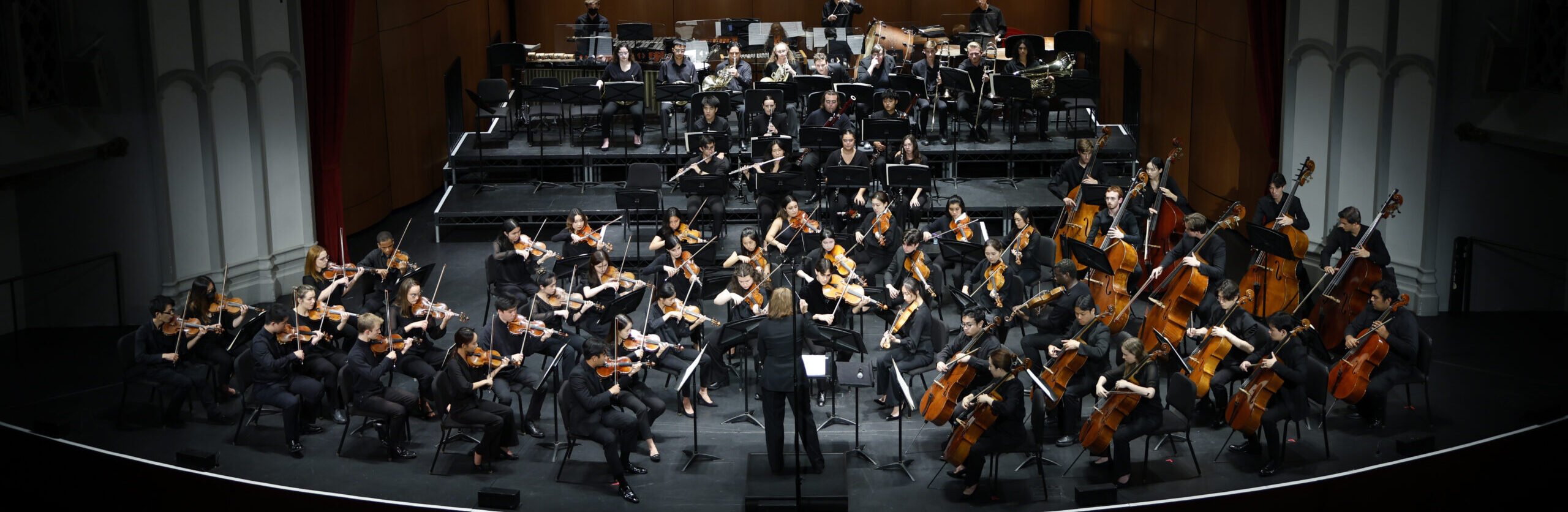
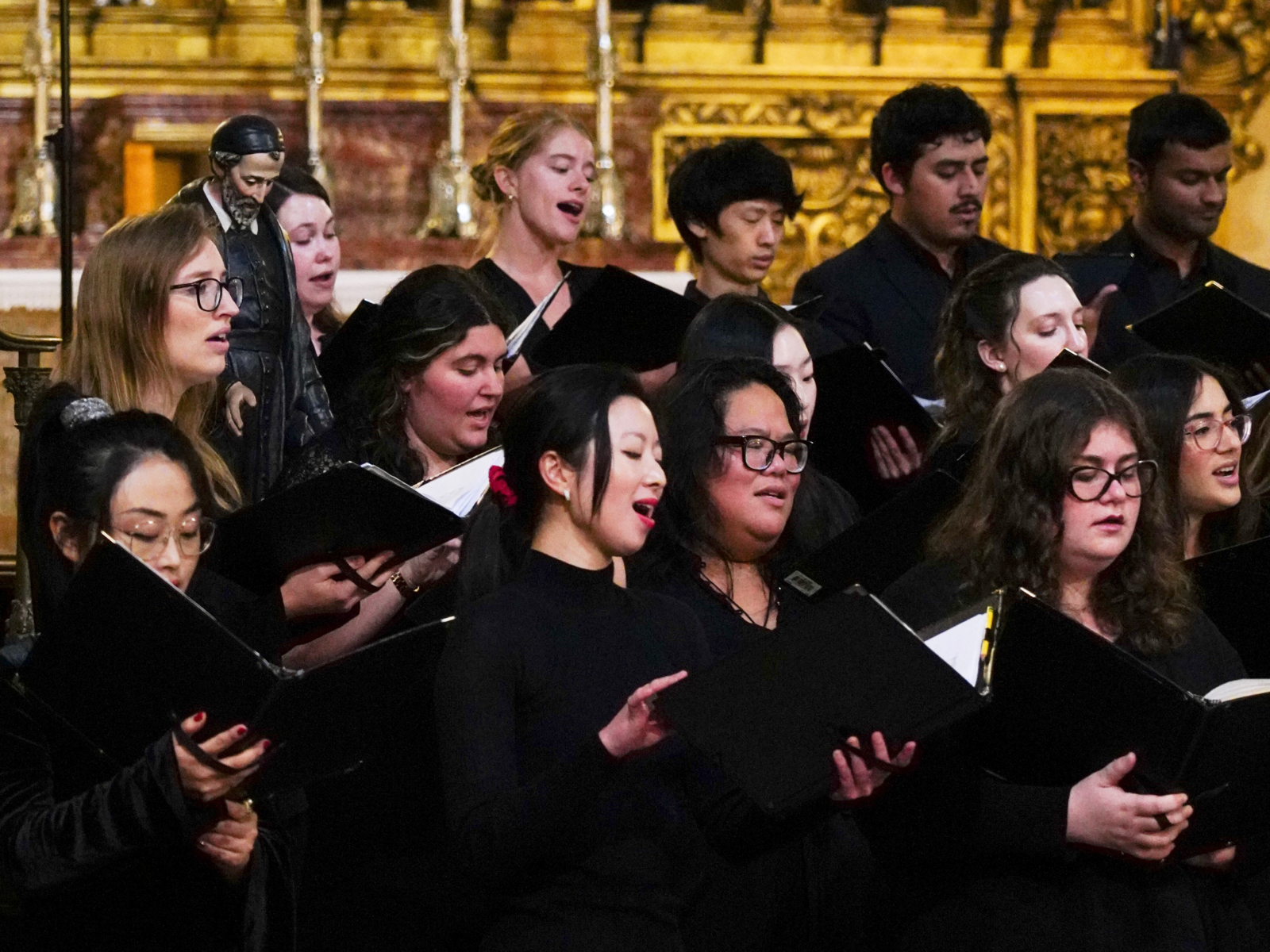
The University Chorus, an ensemble of USC students, alumni, staff and faculty, presents a choral music program in Newman Recital Hall.
Program
“The Last Words of David”
Randall Thompson (1899-1984)
Zigeunerlieder, op. 103
-
4. “Lieber Gott, du weißt”
5. “Brauner, Bursche führt zum Tanze”
Johannes Brahms (1833-1897)
“Lead With Love”
-
Jordan Davis-Wiley, Shania Evans, Roxie Sparling, soloists
Melanie DeMore (b. 1954)
“Opening Chorus” from The Bartered Bride
Bedřich Smetana (1824-1884) arr. Emily Ellsworth
“The Times They Are A-Changin”
-
Jordan Davis-Wiley, soloist
Bob Dylan (b. 1941) arr. Adam Podd
“Kyrie”
-
Ella Donahue, Hershy Karthikeyan, Lillian Matthews, soloists
Cyrus Payne, bass
Savannah Tweedt, drumset
Mr. Mister arr. Kirby Shaw
“I Sing Because I’m Happy”
-
Conducted by Cheyenne Simon
Cyrus Payne, bass
Savannah Tweedt, drumset
Charles Gabriel (1856-1932) arr. Kenneth Paden, adapted by Rollo Dilworth
“One Day More” from Les Misérables
-
Sarah Philo, Moyang Song, soloists
Cyrus Payne, bass
Claude-Michel Schönberg (b. 1944) arr. Mark Brymer
Program Notes
“The Last Words of David” ~ Randall Thompson (1899-1984)
Randall Thompson (1899-1984) remains one of the most celebrated American composer-educators in our history. After completing his studies in composition at Harvard in the early twentieth century, Thompson went on to hold academic positions at The Curtis Institute, Princeton, and Harvard, where he would retire professor emeritus in 1965. Among his most notable students are Leonard Bernstein and Samuel Adler. Thompson’s writing style is neoclassical, and conservative compared to many of his contemporaries, who were experimenting with serialism and electronics, which Thompson never did. Thompson is most regarded for his choral works, including “Alleluia” (1940), Frostiana (1959), and The Testament of Freedom (1942). He also wrote three symphonies. (Britannica)
Randall Thompson’s “The Last Words of David” (1949) is perhaps only surpassed by his “Alleluia” in popularity. It was commissioned in 1949 by the Boston Symphony Orchestra on the occasion of Serge Koussevitsky’s 25th year of directorship of the organization. Originally scored for orchestra and chorus, the arrangement for piano and chorus by Thompson himself has endured lasting popularity. The text from II Samuel depicts King David’s final words before his death: a charge for all who rule to be just. (Notes from the score.)
Zigeunerlieder, op. 103 ~ Johannes Brahms (1833-1897)
German composer Johannes Brahms (1833-1897) is one of the towering figures of the Romantic era. His compositions pushed the boundaries of expression while paying homage to the forms and structures of the classical masters before him. He composed everything from symphonies and concertos to choral works, chamber works, piano works, organ works, and more. Furthermore, he was a virtuosic pianist who refined his skills at a young age playing social gatherings in Hamburg’s living rooms and saloons. It is in this spirit of the “at-home” performance that Brahms composed his Zigeunerlieder, op. 103 in 1887. (Britannica)
The texts of Zigeunerlieder (Gypsy Songs) come from Hungarian folk songs that were translated into German by Hugo Conrat (1845-1906), a businessman, poet, and member of Brahms social circle in Vienna. Brahms sets the all the poems in 2/4 meter, with little material from the original “folk-songs” making it into the score. In fact, the only real nod to Hungarian folk music is the use of uneven phrase lengths throughout the song cycle. Originally conceived as a work for four solo voices and piano, Zigeunerlieder is often performed by larger ensembles in modern contexts. There are eleven movements in Brahms’ first set of Zigeunerlieder. The University Chorus will present movements four “Lieber Gott, du weißt” and five “Brauner, Bursche führt zum Tanzen,” which are both love poems. (Brahms’s Vocal Duets and Quartets with Piano: A Guide with Full Texts and Translations)
“Lead With Love” ~ Melanie DeMore (b. 1954)
Melanie DeMore (b. 1954) is a 3-time Grammy nominated vocal artist, singer, composer, choral director, and activist based in Oakland, California. DeMore is in demand as a choral clinician around the United States and the world, known for her ability to bring diverse groups of people together through song, and “stick-pounding workshops.” DeMore conducts song circles that emphasize the power of the voice to heal from within, and in her own words: “A song can hold you up when there seems to be no ground beneath you.” (belonging.berkeley.edu)
“Lead With Love” was first composed for a choir in Edina, Minnesota for whom DeMore was acting as a clinician. The choir was so moved by the music that one of the members asked her to post a video of the song to YouTube, and its popularity grew from there. In 2016, it was included in The Justice Choir Song Book, a free collection of songs for protest and community singing. “Lead With Love” is emblematic of DeMore’s signature call and response style. Her inspiration came from the great community organizers in history, including Martin Luther King Jr. (A Breath of Song Podcast)
“Opening Chorus” from The Bartered Bride ~ Bedřich Smetana (1824-1884) arr. Emily Ellsworth
Bedřich Smetana (1824-1884) was a Bohemian composer primarily known for his symphonic poems and operas and celebrated for his nationalistic style. Following success in his childhood in Prague, Smetana struggled to establish himself in his early adult years. He finally found success in the 1850’s teaching in Gothenburg, Sweden, which would also be where many of his early orchestral compositions were written. Smetana returned to Prague in 1863 amid an improving political climate, and immediately found success in the Bohemian musical scene. After advocating for the construction of an opera house in Prague, he was appointed director of the newly founded Czech National Opera House in 1866. Smetana’s music found great favor in his homeland. Now, he is internationally recognized as “the father of Czech music.” (Britannica, The Kennedy Center)
The Bartered Bride (1870) was Smetana’s second opera, and his most lasting contribution to the art form. It is a comic opera in three acts depicting a countryside village where a young couple, Marenka and Jenik, are in love. However, Marenka’s parents would rather see her marry for wealth than love, so they enlist a marriage broker and a string of misunderstandings ensue. The light-hearted story captured the Bohemian spirit, and is perfectly encapsulated in the opening chorus, which paints a picture of a beautiful spring day in a Bohemian village where a feast is about to begin.
“The Times They Are A-Changin” ~ Bob Dylan (b. 1941) arr. Adam Podd
Bob Dylan, born Robert Zimmerman in 1941, is widely regarded as one of the most influential musicians and lyricists of the last 70 years. An aspiring folksinger and songwriter raised in Duluth, MN by a family in the furniture business, he acquired his first guitar at fourteen years old and played in a variety of local rock bands during high school. He enrolled at the University of Minnesota, but a fascination with a folk singer named Woody Guthrie (1912-1967) on the east coast became his obsession, eventually leading him to move there in 1961 just to meet him. Dylan quickly found success in the folk music and beat poetry landscape of New York City. After playing the Newport Folk Festival in 1963, he was hailed as the “King of Folk.” (Britannica)
“The Times They Are A-Changin’” is the title track from Dylan’s 1964 album of the same name. The song is one of Dylan’s most covered in his oeuvre, however, rarely performed by Dylan himself at his live shows. Written during the Civil Rights Movement, the song details the inevitable nature of societal and political change, and calls for the next generation to forge their own future. Dylan famously opened a concert with this song on November 23rd, 1963; the day after President John F. Kennedy was assassinated. (americansongwriter.com)
“Kyrie” ~ Mr. Mister arr. Kirby Shaw
American new wave band Mr. Mister claimed the top spot on the Billboard Hot 100 chart twice in 1986. Once with “Broken Wings” which finished fifth on the year end chart, and again with “Kyrie”, which finished ninth on the year end chart. The band was made up of four members: Richard Page on vocals and bass, Steve George on keyboard, Pat Mastelotto on drums, and Steve Farris on guitar. They gained their early rock musician experience as studio musicians in the session scene in Los Angeles in the late 1970’s, before joining up to start their own project. (Medium.com)
“Kyrie” falls into the unique category of “ambiguously spiritual rock music” that had become a popular niche in the eighties. (1981’s “Gloria” by U2) The lyrics of Mr. Mister’s “Kyrie” describe a spiritual journey in which one is faced with obstacles that seem too big to overcome. The inclusion of the line “Kyrie eleison” (Lord have mercy) is indicative of our human nature to call upon a higher power. (Medium.com)
“I Sing Because I’m Happy” ~ Charles Gabriel (1856-1932) arr. Kenneth Paden, adapted by Rollo Dilworth
“I Sing Because I’m Happy” is Kenneth Paden’s arrangement of the classic gospel hymn “His Eye is on the Sparrow” (1905) by American hymnist Civilla D. Martin (1866-1948) and American gospel music composer Charles H. Gabriel (1856-1932). Rollo Dilworth further adapted the arrangement to make it more manageable for his own choir, lowering the arrangement by a whole-step, eliminating solo verses, and adding a vocal line for bass voices. (Notes from the score.)
Civilla D. Martin claims that the idea for the lyrics came to her after meeting a couple while on holiday with her husband. The couple were both crippled, yet maintained a positive attitude and brought “inspiration and comfort to all that knew them.” The second half of the refrain was inspired by a quote from her encounter with the couple. Upon asking them the secret to their hopefulness, the wife answered: “His eye is on the sparrow, and I know he watches me.” There are also clear biblical references in the lyrics to the Gospel of Matthew. (A Foot in Two Worlds: A Pastor’s Journey from Grief to Hope)
“One Day More” from Les Misérables ~ Claude-Michel Schönberg (b. 1944) arr. Mark Brymer
Claude-Michel Schönberg’s (b. 1944) hit musical Les Misérables was first performed in French in 1980. The site of this run was the Dome de Paris, an indoor sports arena in Paris that seats about 4,600 people. The run was a great success, with over 100 shows garnering about 500,000 attendees. It wasn’t long before demand for the production outside of France grew, and an English-translated version was first premiered in London’s West End in 1985, and in the United States on Broadway in 1987, where it ran until 2003. The original run secured the musical’s spot as the 6th longest running show in Broadway history. Les Misérables has remained a major musical theater stalwart throughout its existence, has been translated and performed in more than 20 languages, and has been seen by an estimated 130 million people worldwide. (The Complete Book of Les Misérables, Playbill.com)
The musical is based on French author Victor Hugo’s (1802-1885) 1862 novel of the same name, depicting a French society still reeling from the impacts of the French Revolution. The struggle of an impoverished working class banding together against tyrannical leadership is the heart of the story. “One Day More” is the closing number of Act I of Les Misérables. Mark Brymer’s arrangement stays true to Schönberg’s original, save for a portion of the solo lines becoming choral lines.
Text & Translations
“The Last Words of David” ~ Randall Thompson, text from 2 Samuel 23:3 and 2 Samuel 23:4
He that ruleth over men must be just, ruling in the fear of God.
And he shall be as the light of the morning, when the sun riseth, even a morning without clouds; as the tender grass springing out of the earth by clear shining after rain.
Alleluia. Amen.
Zigeunerlieder, op. 103 ~ Johannes Brahms, Hungarian folk texts translated to German by Hugo Conrat
4. “Lieber Gott, du weißt”
Dear God, you know how often I’ve regretted
That little kiss I once gave my dearest.
My heart decreed I had to kiss him,
As long as I live I’ll think of that first kiss.
Dear God, you know how often in silent nights
I’ve thought of my love in joy and pain.
Love is sweet, however bitter the regret,
My poor heart will ever be faithful to him.
5. “Brauner, Bursche führt zum Tanze”
A swarthy lad leads his lovely
Blue-eyed lass to the dance,
Boldly clashes his spurs together,
A csárdás medody begins,
He kisses and hugs his sweet little dove,
Turns her, leads her, exults and leaps;
Throws three shining silver florins
That make the cimbalom ring.
“Lead With Love” ~ Melanie DeMore, text by Melanie DeMore
You gotta put one foot in front of the other
And lead with love
Put one foot in front of the other
And lead with love!
Don’t give up hope
You’re not alone
Don’t you give up
Keep movin’ on (Refrain)
Lift up your eyes
Don’t you despair
Look up ahead
The path is there (Refrain)
I know you’re scared
And I’m scared, too
But here I am
Right next to you! (Refrain)
“Opening Chorus” from The Bartered Bride ~ Bedřich Smetana, libretto by Karel Sabina
Come along, the mood is merry;
See the budding peach and cherry.
Love that hovers in the air
Beckons to the young and fair.
Season full of hope and rapture,
Youth and beauty in their glory,
Days of bliss beyond recapture!
Time unfolds a darker story.
Trials, troubles
Hurdles lie ahead.
Love begins to flicker;
Bored wives boss and bicker;
Husbands turn to liquor.
Watch out!
Now’s the time, sweet lads and lasses!
Live your life before it passes.
Breathe the magic in the air,
Summoning the young and fair.
Now’s the time, sweet lads and lasses,
Green and tender, young and fair,
Live your life before it passes,
Breathe the magic in the air.
*translation by Donald Pippin
“The Times They Are A-Changin” ~ Bob Dylan, text by Bob Dylan, adapted by Adam Podd
Come gather ’round people
Wherever you roam
And admit that the waters
Around you have grown
And accept it that soon
You’ll be drenched to the bone
If your time to you is worth savin’
Then you better start swimmin’ or you’ll sink like a stone
For the times they are a-changin’
Come mothers and fathers
Throughout the land
And don’t criticize
What you can’t understand
Your sons and your daughters
Are beyond your command
Your old road is rapidly agin’
Please get out of the new one if you can’t lend your hand
For the times they are a-changin’
The line it is drawn
The curse it is cast
The slow one now
Will later be fast
As the present now
Will later be past
The order is rapidly fadin’
And the first one now will later be last
For the times they are a-changin’
“Kyrie” ~ Mr. Mister, words by John Long, Richard Page, Steve George
Kyrie Eleison.
The wind blows hard against this mountainside
Across the sea into my soul
It reaches into where I cannot hide
Setting my feet upon the road
My heart is old, it holds my memories
My body burns a gem-like flame
Somewhere between the soul and soft machine
Is where I find myself again
Kyrie eleison down the road that I must travel
Kyrie eleison through the darkness of the night
Kyrie eleison where I’m going, will you follow?
Kyrie eleison on a highway in the night
When I was young, I thought of growing old
Of what my life would mean to me
Would I have followed down my chosen road
Or only wished what I could be?
“I Sing Because I’m Happy” ~ Charles Gabriel, words by Civilla D. Martin
I sing because I’m happy,
I sing because I’m free.
His eye is on the sparrow,
And I know he watches me.
“One Day More” from Les Misérables ~ Claude-Michel Schönberg, French libretto by Alain Boubil and Jean-March Natel, English libretto by Herbert Kretzmer
One day more.
Another day, another destiny.
This never-ending road to Calvary;
These men who seem to know my crime
Will surely come a second time.
One day more!
I did not live until today,
How can I live when we are parted?
Tomorrow you’ll be worlds away,
And yet with you my world has started.
One more day all on my own,
Will we ever meet again?
One more day more with him not caring.
I was born to be with you.
What a life I might have known,
And I swear I will be true.
But he never saw me there.
One more day before the storm
Do I follow where she goes?
At the barricades of freedom.
Shall I join my brothers there?
When our ranks begin to form
Do I stay and do I dare?
Will you take your place with me?
The time is now, the day is here!
One more day to revolution,
We will nip it in the bud.
We’ll be ready for these schoolboys,
They will wet themselves with blood.
Watch ‘em run a-muck.
Catch ‘em as they fall.
Never know your luck when there’s a free-for-all.
Here a little ‘dip’. There a little ‘touch’.
Most of them are goners so they won’t miss much.
One day to a new beginning.
Raise the flag of freedom high,
Every man will be a king!
There’s a new world for the winning.
There’s a new world to be won.
Do you hear the people sing?
My place is here. I fight with you!
I will join these people’s heroes,
I will follow where they go,
We will learn their little secrets,
I will know the things they know.
Tomorrow we’ll be far away, tomorrow is the judgment day.
Tomorrow we’ll discover what our God in heaven has in store,
One more dawn,
One more day,
One day more!