Concert Programs
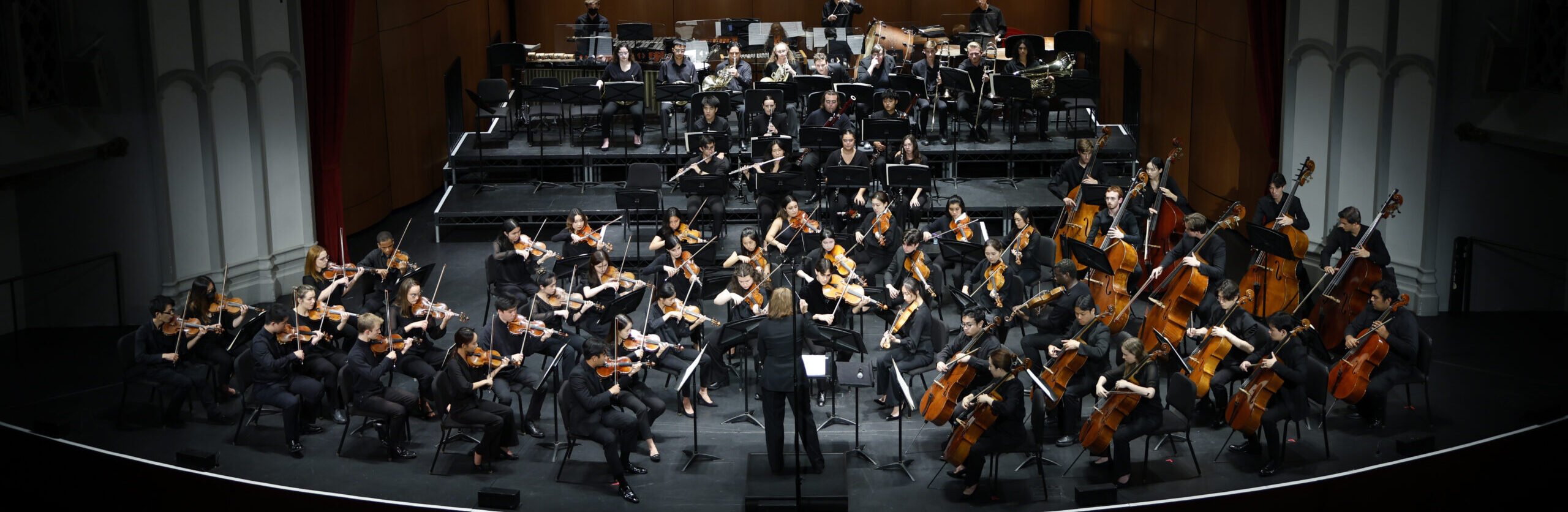
USC Thornton Symphony
Sharon Lavery, Conductor
USC Thornton Symphony
Ellington: Night Creature
Rimsky-Korsakov: Scheherazade
Sharon Lavery, resident conductor of the USC Thornton Orchestra Program, helms a captivating program inspired by the stories we tell at night, featuring Ellington and Rimsky-Korsakov.

Program
Night Creature (1956)
I. Blind Bug
II. Stalking Monster
III. Dazzling Creature
Duke Ellington (arr. David Berger)
(1899–1974)
Scheherazade op. 35 (1888)
1. The Sea and Sinbad’s Ship
2. The Tale of Prince Kalendar
3. The Young Prince and the Princess
4. The Festival at Bagdad; The Sea; The Ship Goes to Pieces on a Rock
Nikolai Rimsky-Korsakov
(1844-1908)
Program Notes
Night Creature (1956)
Duke Ellington
By the mid-20th century, Duke Ellington had already established himself as one of America’s greatest jazz composers, bandleaders, and pianists. Known for transforming popular dance music into sophisticated concert works, Ellington blurred the lines between jazz and classical traditions. Night Creature, written in 1955 for a full symphony orchestra, is a profound example of this vision. It was commissioned by conductor Don Gillis for a Carnegie Hall performance with the Symphony of the Air.
The title Night Creature refers to those who come alive after dark; people who, as Ellington noted, “can only really function at night.” In the composer’s words, “The first movement is about “a blind bug who comes out every night to find that because he is king of the night creatures, he must dance… The second movement is concerned with that imaginary monster we all fear we shall have to meet some midnight, but when we meet him, I’m sure we shall find that he too does the boogie-woogie… They are the restless cool whose exotic or erotic animations, no matter how cool, beg for recognition, mainly from the queen, that dazzling woman who reigns over all night creatures. She is the theme of the third movement, sitting there on her high place and singing, ‘I want to be acknowledged’” (Boston Symphony Orchestra).
At the time, the fusion of jazz and symphony was still unusual, but Ellington greatly succeeded in writing music that can inhabit both the concert hall and the dance floor. What stands out is how vividly Ellington used narrative to capture this fictional story in all its elegance and energy. Unlike most symphonic works of the period, Night Creature is framed by specific characters – bugs and monsters that feel whimsical yet symbolic of the nightlife Ellington knew so well. The playful storytelling with its creative orchestration allows the listener to enter a world that is both theatrical and deeply rooted in jazz.
-Abby Park (BM Violin 2026)
Scheherazade op. 35 (1888)
Nikolai Rimsky-Korsakov
In the late 19th century, Russian composers were searching for a musical identity that would set them apart from the current dominance of German symphonic tradition. Nikolai Rimsky-Korsakov, a member of the nationalist “Mighty Five,” pushed for more lush orchestral colors to craft music that felt distinctly Russian yet universally appealing. Among his most celebrated creations is Scheherazade (1888), a symphonic suite inspired by The Arabian Nights.
The story behind the piece is as captivating as the music itself. Sultan Shahriar, a fictional and cruel Persian king, vows to execute his bride after a single night. His new wife, Scheherazade, defies this fate through the power of storytelling. Each evening she begins a tale so enthralling that the Sultan postpones her death till the next night to hear the ending. Night after night, her narratives are full of suspense, romance, and adventure, until at last her life is spared.
Rimsky-Korsakov does not follow one fixed storyline but instead evokes the spirit of these fantastical tales. A stern brass theme suggests Sultan’s authority, while the graceful and improvisatory lines by the solo violin embodies Scheherazade herself. The first movement unfolds with a gently rocking theme, colored by the fluid key changes which Rimsky-Korsakov excelled at. A sinuous melody emerges on the bassoon in the second movement, and the playful line is passed among the woodwinds before yielding to parts of greater drama. The third movement offers a moment of lyrical repose, serene and untroubled, to contrast from the surrounding intensity. The finale then gathers together many of the suite’s earlier themes, but then propelled by whirling, energetic rhythms reminiscent of a whirling dance. The turbulence eventually subsides into calmness, suggesting that Scheherazade’s stories have spared her life, and she now enjoys the softened heart and attentive ear of Sultan Shahriar.
What makes Scheherazade unforgettable is Rimsky-Korsakov’s mastery of imaginary orchestration. Each instrument becomes a character, blurring the line between symphonic form and theater. Through its lush soundscape, Scheherazade reminds listeners of the enduring human desire to tell stories and to be transported by them.
-Abby Park (BM Violin 2026)
Ensemble
Violin I
Maia Law, Concertmaster
Dahae Shin
Yifei Mo
Anna Renton
Chloe Hong
Diana Dawydchak
Nathan Nguyen
Andrew Choi
Isaiah Iny-Woods
Abigail Park
Sara Yamada
Juchao Zhao
Violin II
Ariana O’Connell, Principal
Marena Miki
Hyojeong Kim
Ayman Amerin
Sarah Yoo
Ashlee Sung
Eric Chen
Dominic Guevara
Alice Dring
Ethan Chen
Viola
Solomon Leonard, Principal
Matthew Pakola
Gloria Choi
Cecile McNeill
John Czekanski
Lilien Foldhazi
Poppy Yu
Kate Brown
Cello
Jaemin Lee, Principal
Olivia Cho
Miles Reed
Samuel Guevara
Joseph Kim
Mingchen Ma
Amy Jong
William Harris
Olivia Marckx
Ernie Carbajal
Bass
Enzo Nigro, Principal
Josia Sulaiman
Logan Nelson
Julien Henry
Micah Sommons
Abigail Koehler
Jai Ahuja
Harp
Kaitlin Miller
Zoe O’Shaughnessy
Rhythm Section
Juliana Naja- Piano
Max Frissen- Bass
Phia Papouchado- Drums
*=Principal on Ellington
+=Principal on Rimsky Korsakov
Flute
Seungbeom Oh*
Luke Blancas
Rebecca Huynh+
Kiana Kawahara
Piccolo
Dennis Papazyan
Kiana Kawahara
Celine Chen
Oboe
Ricky Arellano*
Connor Feyen
Karen Hernandez+
English Horn
Connor Feyen
Clarinet
Louis Milne*
Jane Pankhurst
Andrei Bancos
Ashrey Shah+
Jesus Milano Melgajero
Bass Clarinet
Simon Bakos
Bassoon
Anjali Pillai*
Henry Mock+
Chris Lee
Saxophone
Collin Juniper
Cameron Matutina
Joshua Hebert
Ezequiel Castaneda
Julianna Townley
Horn
Evelyn Webber*
Engelberth Mejia-Gonzalez
Daniel Halstead+
Grace Kim
Neven Bessemer
Trumpet
Hugo Tomas*
Richie Francisco
EJ Miranda
Dylan Johnson
Jorge Araujo Felix+
Jerry Mak
Trombone
Terry Cowley*
Sean Cooney+
Jason Bernhard
Bass Trombone
Kevin Truong
Timpani
Luciano Valdes
Percussion
Tyler Brown+
Chanhui Lim
Sabrina Lai
Xavier Zwick
Preston Spisak