Concert Programs
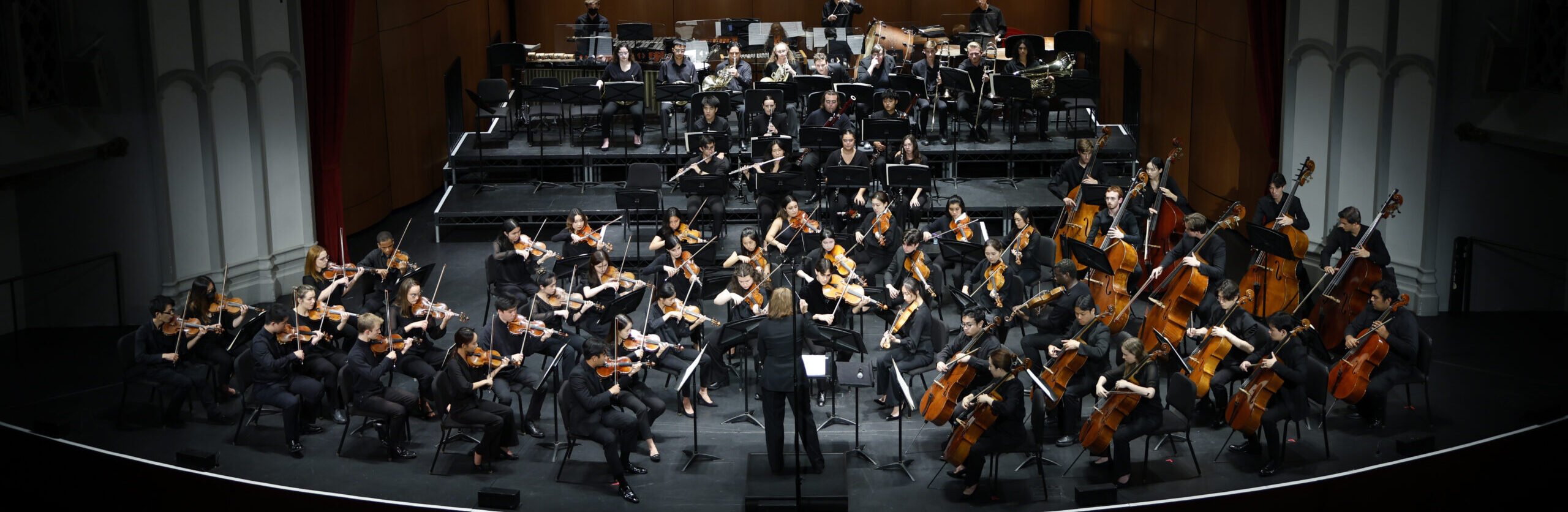
USC Thornton Symphony
Thornton Symphony Orchestra
Friday January 30th, 7:30 PM, Bovard Auditorium
Carl St.Clair, Conductor
Olivia Marckx, Cello
Solomon Leonard, Viola

Program
Ask Your Mama: 12 Moods for Jazz
Langston Hughes (1901-1967)
Music by Ron McCurdy, Eli Breuggemann, & David Spear
Ron McCurdy, narrator/trumpet
Joo Won Chae, mezzo-soprano
Sal Lozano, woodwinds
Julian Najah, piano
Edwin Livingston, bass
Reggie Quinerly, drums
Intermission
Don Quixote; Fantastiche Variationen über ein Thema ritterlichen Charakters, TrV 184, op. 35
Richard Strauss (1864-1949)
Olivia Marckx, cello
Solomon Leonard, viola
Program Notes
Program Description
Langston Hughes: Words, Jazz, and Justice is a multimedia concert performance of Langston Hughes’ kaleidoscopic jazz-poem suite featuring a jazz quartet, spoken-word, and images from the Harlem Renaissance. “Ask Your Mama” is Hughes’ homage in verse and music to the struggle for artistic and social freedom at home and abroad at the beginning of the 1960s. It is a twelve-part epic poem that Hughes scored with musical cues drawn from blues and Dixieland, gospel songs, boogie woogie, bebop and progressive jazz, Latin “cha cha” and Afro-Cuban mambo music, German lieder, Jewish liturgy, West Indian calypso, and African drumming – a creative masterwork left unperformed at his death.
Jazz was a cosmopolitan metaphor for Langston Hughes, a force for cultural convergence beyond the reach of words or the limits of any one language. It called up visual analogues for him as well, most pointedly the surrealistic techniques of painterly collage and of the film editing developed in this country in the 1930s and 40s, which condensed time and space, conveyed to the viewer a great array of information in short compass, and offered the possibility of suggesting expanded states of consciousness, chaotic remembrances of past events or dreams – through montage. “To me,” Hughes wrote, “jazz is a montage of a dream deferred. A great big dream – yet to come – and always yet to become ultimately and finally true.” By way of videography, this concert performance links the words and music of Hughes’ poetry to topical images of people, places, and events, and to the works of the visual artists Hughes admired or collaborated with most closely over the course of his career – the African-inspired mural designs and cubist geometries of Aaron Douglas, the blues- and jazz-inspired collages of Romare Bearden, the macabre grotesques of Meta Warrick Fuller and the rhythmic sculptural figurines and heads and bas reliefs of Richmond Barthe, the color blocked cityscapes and black history series of Palmer Hayden and Jacob Lawrence. Together, the words, sounds, and images recreate a magical moment in our cultural history, which bridges the Harlem Renaissance, the post-World War II Beat writers’ coffeehouse jazz poetry world, and the looming Black Arts performance explosion of the 1960s. “Ask Your Mama” was dedicated to Louis Armstrong, “the greatest horn blower of them all,” and to those of whatever hue or culture of origin who welcomed being immersed in the mysteries, rituals, names, and nuances of black life not just in America but in the Caribbean, in Latin America, in Europe and Africa during the years of anti-colonial upheaval abroad and the rising Freedom Movement here at home. Not only the youthful Martin Luther King Jr. but the independence leaders of Guinea and Nigeria and Ghana and Kenya, and the Congo fill the chants and refrains of Hughes’s epic poem. Originally, Langston Hughes created “Ask Your Mama” in the aftermath of his participation as an official for the five-day Newport Jazz Festival of July 1960, where he shared the stage with such luminaries as Louis Armstrong, Dizzy Gillespie, Horace Silver, Dakota Staton, Oscar Peterson, Lambert, Hendricks & Ross, Otis Spann, Ray Charles, and Muddy Waters. The musical scoring of the poem was designed to serve not as mere background for the words but to forge a conversation and a commentary with the music. Though Hughes originally intended to collaborate with Charles Mingus and then Randy Weston on the full performance of his masterwork, it remained only in the planning stages when Hughes died in 1967. Its recovery now in word, music, and image provides a galvanizing experience for audiences everywhere.
PROGRAM NOTES
Music by Ron McCurdy, Eli Breuggemann, & David Spear
Hesitation Blues – WC Handy
Mood 1- C U L T U R A L E X C H A N G E
In Negro sections of the South where doors have no resistance to violence, danger always whispers harshly. Klansmen cavort, and havoc may come at any time. Negroes often live either by the river or the railroad, and for most there is not much chance of going anywhere else. Yet always one of them has been away and has come home. The door has opened to admit something strange and foreign, yet tied by destiny to a regional past nourished by a way of life in common–in this case collard greens.
A State Department visitor from Africa comes, wishing to meet Negroes. He is baffled by the “two sides to every question” way of looking at things in the South. Although he finds that in the American social supermarket blacks for sale range from intellectuals to entertainers, to the African all cellophane signs point to ideas of change–in an IBM land that pays more attention to Moscow than to Mississippi. What–wonders the African–is really happening in the shadow of world events, past and present–and of world problems, old and new–to an America that seems to understand so little about its black citizens?
Afronato (Interlude) – Ron McCurdy/Eli Brueggemann
Mood 2- R I D E, R E D, R I D E
In the restless Caribbean there are the same shadows as in Mississippi, where, according to Time, Leontyne comes in the back door. Yet some persons in high places in Washington consider it subversive for ordinary people to be concerned with problems such as back doors anywhere–even suspecting those citizens of color who legitimately use the ballot in the North to elect representatives to front doors. But in spite of all, some Negroes occasionally do manage–for a moment–to get a brief ride in somebody’s American chariot.
Mood 3- S H A D E S O F P I G M E A T
Oppression by any other name is just about the same, casts a long shadow, adds a dash of bitters to each song, makes of almost every answer a question, and of men of every race or religion questioners.
Ya Think – Ron McCurdy
Mood 6- H O R N O F P L E N T Y
Certainly there are some who make money–and others who folks think make money. It takes money to buy gas to commute to the suburbs and keep one’s lawns sheared like one’s white neighbors who wonder how on earth a Negro got a lawn mower in the face of so many ways of keeping him from getting a lawn.
Meet Me at Congo Square – Ron McCurdy/Eli Brueggemann
**
Don Quixote; Fantastische Variationen über ein Thema ritterlichen Charakters, TrV 184, op.35
Richard Strauss (1897)
With inspiration from Miguel de Cervantes’ 17th-century novel Don Quixote de la Mancha, Richard Strauss composed Don Quixote, Op. 35 in Munich, 1897. This tone poem is scored at around 45 minutes long, with each instrument vividly emulating a fantasy of challenges, love, nobility, and turmoil.
Strauss (1864-1949) was a German composer and conductor, widely known and regarded as one of the leading figures of the late-Romantic and early-Modern era of music. A successor to Richard Wagner and Franz Liszt, he included keen orchestration and complex harmonic styles within his tone poems and operas. A few notable works of his include Don Juan, his first tone poem that achieved global acclaim, as well as the renowned Also sprach Zarathustra and Eine Alpensinfonie. Don Quixote’s opening premier was given in March of 1898 by Cologne’s Gürzenich Orchestra under Franz Wüllner.
Purely instrumental music that was inspired by a literary text, such as this, was often referred to as program music. This music became popular, although strikingly controversial to many, in the mid-19th century, with composers evoking profound emotions, feelings, ideas, and even characters through their symphonic poems based on literary texts. These ideas were voiced and amplified solely through the instruments and their extended techniques, and often went so far as to illustrate vivid images through sound. Strauss incorporates storytelling into this symphony with his dreamlike imagination, blurring reality through his sonic imagery of battles and death.
In this story, the cello represents the idealistic and noble knight Don Quixote, with tenor tuba and bass clarinet introducing the solo viola to depict Sancho Panza, his squire as they progress through constant themes and variations depicting a lively and dynamic portrayal of their journey. The wind machine and use of extensive string technique encapsulates scenes such as the famous windmill battle, while animal sounds are replicated by bleating woodwinds and spright movement in the brass.
Daya Asokan (BM Harp ’28)
Ensemble
Violin I
Yifei Mo, concertmaster
Anna Renton
Dahae Shin
Maia Law
Ayman Amerin
Sarah Yoo
Abigail Park
Isaiah Iny-Woods
Sara Yamada
Violin II
Maya Masaoka, principal
Maya Lambright
Hyojeong Kim
Ariana O’Connell
Chloe Hong
Dominic Guevara
Ashlee Sung
Viola
Solomon Leonard, Principal
John Czekanski
Gloria Choi
Cecile McNeill
Matthew Pakola
Jay Maldonado
Poppy Yu
Lilien Foldhazi
Cello
Miles Reed, Principal
William Harris
Amy Jong
Nathan Choe
Madelynn Bolin
Ernie Carbajal
Cheyoon Lee
Samuel Guevara
Bass
Josia Sulaiman, Principal
Julien Henry
Abigail Koehler
Jai Ahuja
Micah Sommons
Harp
Zoe O’Shaughnessy
*=Principal on McCurdy
+=Principal on Strauss
Flute
Ellen Cheng+
Tony Lin*
Dennis Papazyan
Piccolo
Dennis Papazyan
Oboe
Karen Hernandez+
Ricky Arellano
Jingming Zhao*
Connor Feyen
English Horn
Connor Feyen
Clarinet
Ashrey Shah+
Yoomin Sung
Mauricio Castillo
Jane Pankhurst*
Yoomin Sung
Dario Scalabrini
Eb Clarinet
Yoomin Sung
Bass Clarinet
Dario Scalabrini
Mauricio Castillo
Bassoon
Ethan Ault*
Chris Lee
Anjali Pillai+
Mio Yamauchi
Chris Lee
Contrabassoon
Ethan Ault
Horn
Lauren Goff+
Xinrae Cardozo
Evelyn Webber
Alan Schlesinger
Jean Smith*
Engelberth Meija
Neven Basener
Trumpet
Remy Ohara+
Derek Gong*
EJ Miranda
Trombone
Terry Cowley+
Alicia Miller
Joe Chilopoulos*
Sean Cooney
Bass Trombone
Harrison Chiang
Tenor Tuba
Logan Westerviller
Tuba
Stephanie Magera
Timpani
Marcos Salgado
Percussion
Luciano Valdes+
Sabrina Lai