| IMPORTANT UPDATE The spring 2026 administration of the MGEEs will take place on January 5, 6, and 7, 2026. Some exams are administered online via the Auralia platform. Other exams are administered in-person or via an online submission process. Please review the exam schedule below for the specific time and dates for each exam. More information for each exam is available in the “Music Graduate Entrance Exam” course in Brightspace. |
About the MGEEs
All incoming graduate students to the USC Thornton School of Music are required to complete the Music Graduate Entrance Exams (MGEE) to determine appropriate placement in classes. This site is designed to help you prepare by allowing you to determine which exams you will need to take, and in the case of Music Theory/Analysis, Aural Skills, and Orchestration, actually take practice versions of the exams. Although these are not the actual exams you will take, they are quite similar and should give you a good idea of how you will do taking the exams. Please note: successful completion of these online exams is not a guarantee of success in the actual MGEEs. As you complete each of the practice exams on this site, not only will you receive a score of how well you did, you will also be given further information on areas of study related to the questions you missed. We strongly encourage you to follow those suggestions for reading and study before taking the actual exams.
Exceptions: Graduate Students in Music Industry, Arts Leadership, and Screen Scoring do not need to take the MGEEs. Graduate students who have previously completed a degree at USC Thornton are exempt from any exam covering a subject area in which they previously completed coursework at USC Thornton or previously passed a MGEE at USC Thornton.
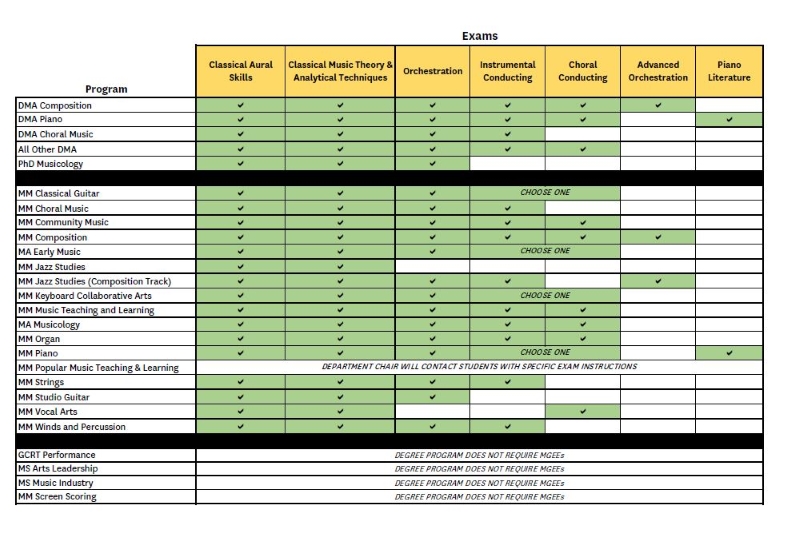
Each degree has a different set of exam requirements. See below to determine which exams you are required to take, and then refer to the schedule for the exam times and locations.
REQUIRED EXAMS FOR INCOMING GRADUATE STUDENTS
Click on the image of the chart (PDF) below to see the exams required for your degree program.
Graduate Entrance Exams Retake Policy/Review Courses
Entering students must take all required exams at the scheduled exam time prior to the beginning of their first semester in the program. If any given exam is not passed on the first attempt, that exam can be retaken at the scheduled exam time prior to the beginning of the second semester in that program. If the exam is not passed on the second attempt, the corresponding review course must be successfully completed with a grade of B-minus or better before the beginning of the third semester in the program, regardless of whether the exam has previously been attempted. If students complete any MGEE after their second semester in the program, the score earned on said exam will be invalid. Failure to fulfill all MGEE requirements by the beginning of the third semester-either through exams or review courses-may delay permission to fulfill degree requirements such as recitals, qualifying examinations, thesis projects, and dissertations, and could have a negative effect on financial aid eligibility.
EXAMINATION SCHEDULE AND ADMINISTRATION DETAILS
(all dates and times are in PST unless otherwise indicated)
| Spring 2026 Graduate Examination Schedule |
Time
|
Location
|
| Orchestration |
January 5
5-6:00 PM or
January 6 10-11:00 AM
|
Online via Brightspace
|
| Classical Aural Skills* |
January 5-6*
|
Online via Auralia & Musition
|
| Classical Music Theory and Analytical Techniques* |
January 5-6*
|
Online via Auralia & Musition
|
| Advanced Orchestration (Composition and Jazz Studies Composition Track majors only)** |
N/A
|
No Spring 2026 Administration
|
| Piano Literature (Piano majors only) |
January 7
1-2:30 PM |
BMH 100 (Ramo Recital Hall)
|
| Choral Conducting |
January 7
2-5:00pm |
MUS 105
Sign up details on Brightspace |
| Instrumental Conducting*** |
Due January 7
1:00 PM |
Online (material on Brightspace) |
* This exam administration is based upon your local time, beginning at 12:00 AM on January 5 and ending at 11:59 PM on January 6.
** This is a two-part exam with one portion being advanced orchestration. For that portion, students must orchestrate a short piano excerpt.
*** For this exam please be prepared to conduct the following excerpt: Beethoven’s Symphony No. 1, Movement IV (beginning to letter B; resume at m. 226 to letter F). Excerpt, audio file, and exam submission details are detailed in Brightspace.
ADMINISTRATION DETAILS (all dates and times are in PST unless otherwise indicated)
Orchestration: This exam is administered via digital submission in Brightspace. Once you have access to Brightspace, you will see that this exam has two administration windows on either January 5 (5-6:00 PM PST) or January 6 (10-11:00 AM PST). You will only be able to access the exam materials in Brightspace within either of those two windows. You will only need to complete the exam once, so please select a window that works best in your schedule. You may find this time-zone conversion tool helpful.
Classical Aural Skills and Theory and Analysis: This exam will be administered online through an exam platform called Auralia & Musition. You should be able to use your login credentials from the fall administration and both exams will be available for you to take starting January 5. The exams will be available starting at 12:00 AM January 5 through 11:59 PM on January 6 based upon your local time. You will need to complete both exams within this two day time period, and you will have 60 minutes (1 hour) to complete each exam once you open it.
Advanced Orchestration (only for Composition and Jazz Studies Composition Track majors): This exam is administered via digital submission with detailed instructions to be provided in Brightspace. There is no administration of this exam for Spring 2026.
Piano Literature: This exam will be administered in-person on the USC University Park campus in BMH 100 (Ramo Recital Hall) (map) on Wednesday, January 7 from 1:00 PM to 2:30 PM. The exam will be administered to all students at that time, so be sure to arrive at least 15 minutes before the exam begins at 1 PM. You must contact Kyle Shafiee to sign up for the exam via email at shafiee@usc.edu.
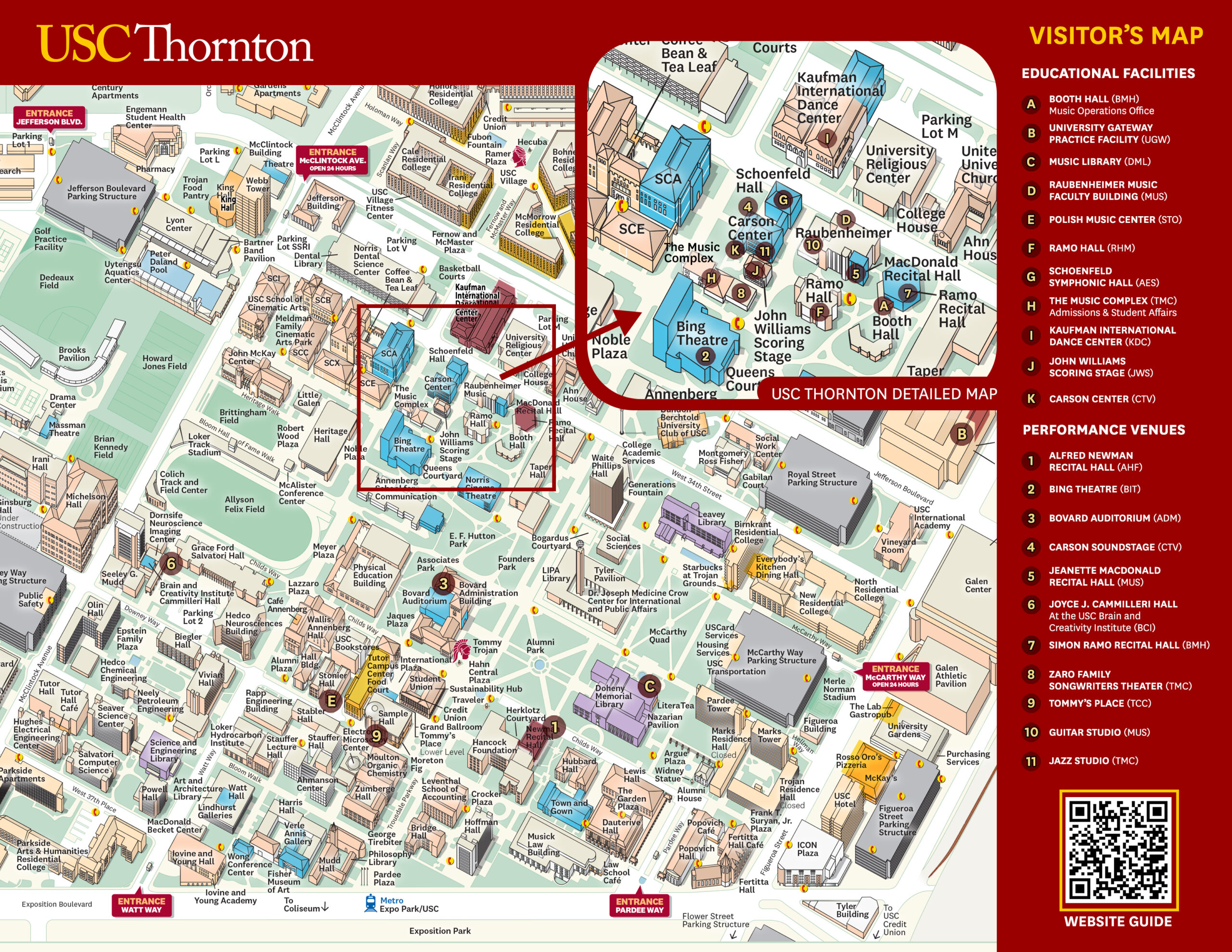
Choral Conducting: This exam will be administered in-person at the USC University Park campus in MUS 105 (map) on Wednesday, January 7 from 2:00 PM – 5:00 PM. You must sign up for this exam- the sign up link will be available here and in Brightspace. For more information, please contact the Department of Choral and Sacred Music at uschoral@usc.edu. Students taking the Piano Literature MGEE: Be sure to sign up for an exam time that does not conflict with the Piano Literature exam that is also administered that day.
Instrumental Conducting: This exam involves an online submission via YouTube of you conducting a specific excerpt (described in further detail in “The Examinations” section below). The link to this video submission must be submitted to the exam administrators via email by 1:00 PM (PST) on January 7. The excerpt and submission details are included in Brightspace.
The Examinations (Brief Descriptions and Suggestions for Review)
Choral Conducting: based on materials covered in Choral Conducting I (MUCD 340) at the USC Thornton School of Music. The exam tests familiarity with standard conducting patterns (1-12, simple, compound, and mixed meters) and ability to conduct from choral scores in four parts in modern clefs. Left hand independence is expected. You will be asked to conduct a short chorale, which will include execution of fermatas. Review Suggestions: Green, Modern Conductor; McElheran, Conducting Techniques for Beginners and Professionals; and Willetts, Upbeat Downbeat: Basic Conducting Patterns and Techniques.
Classical Theory/Analysis/Aural Skills: based on materials covered in four semesters of undergraduate Music Theory (MUCO 133ab, 233ab) and four semesters of Aural Skills (MUCO 132ab, 232ab) at the USC Thornton School of Music. Includes harmony (including chromatic harmonies and possibly modulations) and voice leading, realizing a figured bass with Roman numerals, form and analysis, and 20th century techniques; melodic and harmonic dictation (diatonic and chromatic possibly with modulation), and dictation of atonal fragments. Review Suggestions: Turek & McCarthy, Theory for Today’s Musician, 3rd edition; Kostka, Materials and Techniques of 20th Century Music; Green, Form in Tonal Music; Benjamin, Horvit & Nelson, Music for Sight Singing; Sample Theory/Analysis Exam, Sample Aural Skills Exam
Counterpoint: based on material covered in three semesters of Counterpoint for composition majors (MUCO 135 and 235) at the USC Thornton School of Music and included identification and writing of such contrapuntal forms as motet, canon, invention, chorale-variation, and fugue. Review Suggestions: Benjamin, The Craft of Tonal Counterpoint, textbook for both modal and tonal counterpoint.
Orchestration: This exam is based on material covered in one semester of Orchestration (MUCO 338x) at the USC Thornton School of Music and includes questions on ranges, clefs and transpositions of orchestral instruments, score comprehension and literacy, and short arranging problems. Review Suggestions: Kennan, The Technique of Orchestration and Adler, The Study of Orchestration. Sample Orchestration Exam
Instrumental Conducting: The instrumental conducting examination is designed to place students in either Instrumental Conducting I or Instrumental Conducting II. (Most undergraduate programs only require Instrumental Conducting I.) The examination is based on material covered in Instrumental Conducting (MUCD 343), and tests familiarity with standard conducting patterns, including sub-divided meters. Students must be prepared to conduct the following excerpt: Beethoven’s Symphony No. 1, Movement IV (beginning to letter B; resume at m. 226 to letter F). Students must have a working knowledge of basic orchestral transpositions and clefs. They will also be asked to ‘sight-conduct’ a short rhythmic excerpt which may include execution of fermatas. Conducting with a baton is highly encouraged, although not required. Review Suggestions: Green, Modern Conductor; McElheran, Conducting Techniques for Beginners and Professionals; and Willetts, Upbeat Downbeat: Basic Conducting Patterns and Techniques.
Piano Literature: The piano literature examination is based on material ordinarily covered in a two-semester, upper-division undergraduate keyboard literature course (MPKS 472ab in the Thornton School of Music section of the USC catalogue). Although such courses cover the entire history of this literature, special emphasis is placed on the solo literature of the 18th, 19th, and 20th centuries that frequently appears on piano recitals. Review Suggestions: Gillespie, Five Centuries of Keyboard Music; Gordon, A History of Keyboard Literature; and Kirby, Music for Piano: a Short History.
Technical Requirements
The sample exams (Theory and Analysis, Aural Skills, and Orchestration) are designed to work on any modern Windows PC or Macintosh computer. For the audio examples, you will need some sort of mp3 player software (RealPlayer, Windows Media Player, Quicktime, iTunes, etc.) and the free Adobe Reader software for the pdf format printed examples. Clicking the “Reveal Answer” button in each of the exams creates a new window. If these fail to open, turn off the Pop-Up Window Blocker function in your web browser.