2026 USC Thornton Outstanding Graduates
By Allison Engel
This year, we celebrate five outstanding graduates whose achievements stretch far beyond the scope of typical music degrees.
Celine Chen – Bachelor of Music, Piano Performance and Flute Performance
Pianist Celine Chen has played not once but twice on NPR’s prestigious showcase for young classical musicians, From the Top, drawing raves from host Peter Dugan. He declared he was “beyond impressed” by her rendition of one of the most difficult pieces in the repertoire, the fourth movement of Samuel Barber’s Piano Sonata. Compliments poured from him: “You brought out so much nuance…so well thought out …the clarity of the voices in the fugue …your octaves are the envy of any pianist.”

That level of virtuosity takes work, and Chen, who is the Bachelor of Music Outstanding Graduate recipient this year, routinely spends four hours a day practicing piano and more hours studying with her primary teacher, USC Thornton Keyboard Studies faculty member Bernadene Blaha. But Chen also is a double major in flute performance, and adds additional practice hours – sometimes up to three hours per day – “getting my chops in shape” on the flute. Her flute professor is Thornton Winds & Percussion faculty member Catherine Karoly.
Particularly before her recent flute recital, Chen said she was focused on making sure she could find time to practice both instruments. “Sometimes there are just not enough hours in the day,” she lamented. Still, it was the ability to major in both instruments – and take psychology classes – that drew her to Thornton.
“I chose USC because I met this girl who was a piano major as well as a business major and was taking flute lessons,” said Chen. “I thought – that’s just like me! No other school offered that flexibility. USC seemed very interdisciplinary, and I liked that.” While here, Chen also was a research assistant at the Brain and Creativity Institute, looking at how music therapy could provide focus for those with learning differences.
Chen lived in Surabaya, on the island of Java in Indonesia, until she was seven, when her family moved to Valencia, CA. She started first grade not knowing a word of English. By then, she had already been playing piano for three years. “I asked my parents if I could play when I was just three, but my fingers were not developed enough,” she said. “I had to wait until I was four.”
Flute entered her life in junior high, when she wanted to join the band and discovered that neither piano nor violin were part of the band. She started flute, “and I stuck with it. I really liked the timbre of it.”
In high school, her “very, very inspiring” piano teacher was Nobuyo Nishizaka, who lived in Pasadena. Chen’s flute lessons were at the Colburn School downtown Los Angeles.
Her parents, dad Jemmy Soetanto and mom Erly Ngoe, would make the one-hour drive from Valencia for her lessons after school and on every weekend. “Plus I have two other siblings and they play violin,” said Chen. “That was even more driving for my parents. And then I would have extra lessons when competitions were coming up. My parents get the gold star for sure.”
Also in high school, she was part of a chamber music trio that won prizes nationally, such as the Fischoff National Chamber Music Competition at the University of Notre Dame. The trio represented Junior Chamber Music as Debut Artists, performing in multiple European cities. “We were all from the same high school (West Ranch High School in Stevenson Ranch, CA), and all super passionate about music,” said Chen. “The violinist is now at Juilliard. The cellist is my cousin and he’s at Northwestern. We’re all still doing music, just separately.”
“We were a really close trio. It was really fun learning how string instruments work and how piano fits in with them.”
As a soloist, Chen has received major recognitions and prizes, including the 2022 Grand Prize at the Young Musicians Inspiring Change International Competition, being one of six instrumentalists invited to play a concert at Carnegie Hall, and awards from the Colburn School and William Grant Still Arts Center.
After graduation, Chen is headed to the San Francisco Conservatory of Music for her Master’s in Piano. Her long-range plans? “I love solo performing and that’s where I feel the most alive. My goal, my hope, is that I get to participate in a lot of competitions in the next couple of years, get my name out there, hopefully get signed, and start touring.”
“But I also love chamber music. That’s also definitely going to be part of my future. We’ll see how flute plays into my future. I’m not quite sure how.”
Chen says she will miss the USC campus and the friends and connections she has made here. “I’ll miss the K-Town cafes, going every weekend to see my piano professor perform with the L.A. Phil, so many things. There’s always so much going on in L.A. It’s such an amazing experience to live here.
“I’ve made such a very special community, like a family here away from home. But we’ll all have different paths and we’ll all meet up again, I’m sure.”
Benjamin Beckman – Master of Music, Composition
Musicians who play two or more instruments are sometimes known as double or triple threats. A rare few are like USC Thornton’s Benjamin Beckman, this year’s Master of Music Outstanding Graduate. At 25 years old, he is a true quintuple threat. He’s a composer, a conductor, a pianist (and former French horn player), an opera and chamber choir singer, and an artistic director of an opera company starting its third season.

His master’s degree is in composition, taught by luminary USC Thornton faculty members Donald Crockett and Andrew Norman. Beckman, who began composing as a child before he could read music, called composition the most valuable musical foundation.
“The degree is really a degree in thinking about music,” he explained. “So much of what the faculty guides us towards is thinking critically about the art we are creating, how it fits into the broader ecosystem of contemporary music, and how we are picking up threads that other composers, other theorists and other academics have been interested in for a long time.”
“The school has been unbelievably supportive in my hopes and dreams to pursue a multidisciplinary career within music,” Beckman continued. Last fall, he had a gig as assistant conductor of a Philip Glass opera at the Atlanta Opera, which necessitated missing classes for two weeks. At Thornton, these types of career expanding opportunities are encouraged, where students’ burgeoning professional careers can thrive alongside the pursuit of their degree. “The faculty were just excited and supportive,” said Beckman.
During his studies, he took conducting classes from Larry Livingston, and saw his composing efforts get full productions. His latest work, Ripple Infinity, was part of the USC Thornton Symphony’s “New Music for Orchestra” concert in February. He noted that Thornton was unique in giving its composers public premieres and supplying them with professional audio and video recordings of the performances.
Beckman, who grew up in Los Angeles, started piano lessons at age 5 ½, after banging nonstop on an upright in his home. He credits his piano interest to his grandmother, Elaine Strickstein, who would play Great American Songbook tunes by ear around her grandson.
Beckman wasn’t serious about his lessons or music until a friend in fourth grade gave a presentation on Interlochen Center for the Arts, and mentioned you could play Capture the Flag in the woods there. “As a city kid, I was absolutely smitten with the idea,” Beckman recalled. At Interlochen, (where he did get to play Capture the Flag), “I saw all these kids that were better at piano than me, and that lit a spark. With it came the realization that if you practice, you get better. If you get better, you can play better music. If you play better music, it’s harder. If it’s harder, you have to practice more. That’s the vicious cycle.”
Back home, in addition to piano lessons, he also took theory lessons from a neighbor and pianist who helped define Beckman’s expanding musicianship. “I got theory and ear training like intervals and the basics of high school or early collegiate music theory education when I was like 12. I think a lot of my general musicianship is due to that early training at that age, which was a huge gift.”
His undergraduate work was done at the Yale School of Music, where he sang (bass) with a select chamber choir, conducted for the school’s undergraduate chamber orchestra and student opera groups, played principal French horn in the symphony orchestra, and won a handful of academic awards.
After graduation, he worked for several opera companies. The reason? “One day, when I write a grand opera, it will be valuable to see how an opera company works.” In 2024, he and two friends from Yale decided to get first-hand knowledge. They founded their own company, the nonprofit Park City Opera in Utah. It does year-round programming with large productions in the summers. Beckman is the company’s artistic director and conductor.
This summer the company is doing Aaron Copland’s The Tender Land and Charles Gounod’s Roméo et Juliette. The latter will be the opera’s largest production to date, with nearly 80 artists involved.
“As ambitious and crazy as it sounds, I’m definitely aspiring for an international career as a conductor and composer,” Beckman said. “In the short to medium term, I’m looking to pursue more dedicated study in conducting for a few years, for both opera and orchestra.”
Shortly before Beckman started at USC, his grandmother moved out of the home in Encino where she had lived for 45 years. The last thing left in the house was her piano, a baby grand Wurlitzer. Beckman moved into his apartment downtown a week before the house sold, and was able to take her piano. So in a full-circle nod to the person who introduced him to music, “all my work as a student at USC, all of the composing, all of the practicing has been on her piano.”
Kaitlin Miller – DMA, Harp Performance
Kaitlin Miller’s fascination with harp began at age three when watching an animated Barbie version of Swan Lake. The video included interviews with musicians on the soundtrack, and the segment with the harpist absolutely captivated the toddler. Miller wanted to start playing right then, but began seven years later, thanks to the pure generosity of friends of her grandparents, who heard about her very specific musical desire. The friends, who lived in Kansas, researched harp teachers in Miller’s hometown of Greeley, Colorado, and paid for half of her lessons.
A few years later, Miller received a second stroke of unselfish generosity.

Her harp teacher, Dr. Kathy Moore, founder of the harp department at Northern Colorado University, was renting Miller an instrument she owned, a vintage 1930s Lyon & Healy Style 22 pedal harp. Moore said Miller could own the harp outright when she graduated from high school. However, Moore knew she had cancer, and said she would will her harp to her student if she died before Miller’s graduation. After teaching Miller for four years, Moore died when Miller was 14. True to her word, Moore had willed Miller her harp.
“My harp is a very special instrument for so many reasons,” said Miller. “It’s the harp I have in my apartment in Los Angeles and the one I take with me everywhere I perform. It has a really warm sound that feels one of a kind.” Miller said her musical story is definitely one about very generous people. It is fitting, then, that her new dream is to make harp more accessible to beginners.
“The hardest thing for new students is securing an instrument,” said Miller. “I would love to create a program to make harp accessible to youth in L.A.”
Her DMA training is going to help make that dream a reality. Miller took music teaching and learning for her major track at USC Thornton under esteemed “first-call” harp professor and faculty member JoAnn Turovsky. For her electives, she chose Arts Leadership and Jazz Studies. Jazz helped diversify her playing, which will be valuable for building a career in Los Angeles’ vibrant music scene, she said. Arts Leadership helped supply examples and contacts at arts nonprofits, which will be valuable as she explores setting up a program to help young harpists.
She is encouraged by the recent establishment of the Harp Center Los Angeles in West Los Angeles, a combination of harp studios and performance space started by USC alum Xochitl Derycz. Miller is developing a teaching studio there, and thinks it would be the perfect place to start a nonprofit dedicated to harp studies. “At USC I already started building up relationships with professors who I think could help me actually pursue this.”
For the next two or three years, Miller will be staying in the city to earn an Artist Diploma at the Colburn School of Music. It’s a performance degree, with no outside academic classes.
Friends wondered why she was continuing with school, after five years at USC earning both a master’s and doctorate, but Miller is looking forward to having several years devoted to dedicated practice. She also hopes to spend the time figuring out how to use the variety of skills she learned at Thornton.
“I got so much out of the doctorate,” she said, especially expanding her understanding of how versatile a musician she could become. “You diversify your skill set so much.” Miller said she is still open to an orchestra position, but realizes it is also possible to create a more varied harp career in Los Angeles.
“There are so many things I want to do,” Miller said. “The doctorate made me rethink what’s possible as a music career, and that’s really inspiring.”
She said she is going to take the summer off, but it doesn’t sound like it. In June, she will compete at the Grandjany Awards, a competition in honor of the late composer Marcel Grandjany. If Miller had to pick a favorite piece, she said it would be Grandjany’s “Rhapsodie,” which is part of the required repertoire for the upcoming competition. “It’s a legendary piece that as a student you dream about one day being able to play,” she said. It also was one of the pieces she played in the first competition she ever won, several years ago.
But beyond that, it holds even greater meaning for her. Her early teacher, Dr. Moore, had written her dissertation on “Rhapsodie.” “She talked about it frequently, and I knew it was special to her,” said Miller.
So Miller will be playing that special piece on the instrument that was one of two selfless gifts that began her musical journey.
Ayaka Miura – Graduate Certificate, Trumpet Performance
Three years ago, trumpet player Ayaka Miura had a big choice to make.
She was partway through a certificate program in Zurich after having spent several years earning a master’s at a conservatory near Paris. While in Zurich, she began working via Zoom with a mentor, Christopher Still, who plays second trumpet at the L.A. Phil.
When Miura took a break from Switzerland to return home to Akita, Japan, Still suggested she consider coming to USC Thornton for her graduate certificate. It was a big decision, but Miura had a feeling that USC might be the better environment for her to study. She took a leap of faith, and made the switch.
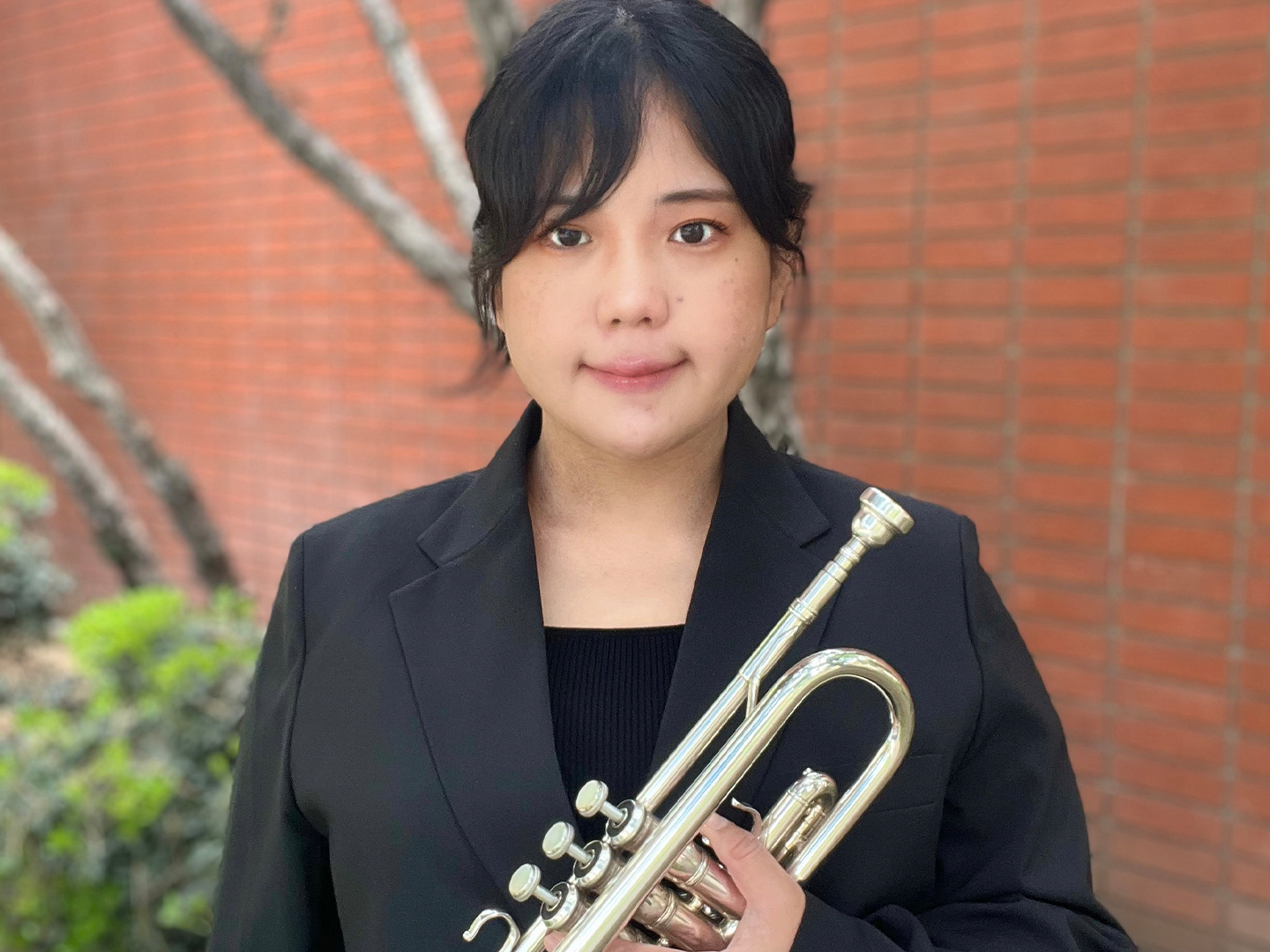
“It turned out to be the best decision ever of my life,” she said. This year, Miura is the recipient of the Outstanding Thornton Graduate among Graduate Certificate students.
Miura’s teachers are Thornton faculty members Thomas Hooten, the principal trumpet player at the L.A. Phil, and Jennifer Marotta, who performs regularly with the L.A. Phil and other major orchestras. Miura credits Hooten with hiring her to play on a tour the L.A. Phil made in Asia last October. Under the baton of Gustavo Dudamel, Miura was able to play four concerts at Walt Disney Concert Hall, two in Korea, two in Taipei, and one in Tokyo. Her parents, mom Taeko and dad Kazuhiro, were in the audience of Suntory Hall in Tokyo, seeing their daughter play, among other pieces, Mahler’s Symphony No. 2, with one of the world’s great orchestras.
“They were very moved to see me there,” said Miura.
She also was hired twice as a substitute at L.A. Phil concerts conducted by Esa Pekka Salonen. “It’s been like a dream,” she said, of the chance to play with the orchestra in Disney Hall.
Miura started playing trumpet at age 16, which she considers “a bit late.” Before that, she played French horn, which she began at age 10. When she started high school at a school with a very competitive band, she discovered there were many other students her age who played French horn. Those students had come from urban junior high schools and had more experience than she had in her more rural school. So she changed to trumpet.
Her transition to study at Thornton was helped by close bonds she developed with her teachers and trumpet studio mates.
Teacher Jennifer Marotta described Miura as: “a phenomenal trumpet player, musician, and person. Her incredible work ethic has shown tremendous growth in just two years, which is paying off in her audition successes.”
Miura’s career goal is to earn a position in a major orchestra. To that end, she’s embarking upon the experience of auditioning around the country. It’s a challenging process. Musicians send tapes of themselves playing pieces from a standard preliminary list. If the tapes pass muster, they may be invited to travel to the orchestra’s home city and play in person, albeit anonymously behind a screen, in order for the decision-makers to focus on the music and not the individual. The applicant may then advance to being a finalist, and be asked to travel back for a second in-person audition.
An example of a piece she might be asked to play for an audition is the opening trumpet solo of Maurice Ravel’s arrangement of Mussorgsky’s Pictures at an Exhibition. “Musically it’s not very difficult, but mentally it is difficult. The audition process is weird, always,” Miura admitted.
She is currently on the tenure track for the Boise Philharmonic, so she has at least one for-sure position after graduation. “I don’t know where exactly I’m going in the future, but I wish I could come back to L.A.,” she said. “It’s a special place. The L.A. Phil was so close and I went as much as I could on my student card. And if I was in L.A. I could keep in touch with my teachers.”
Whether Miura is in the city or not, her teachers will be keeping up with her progress. Said Marotta: “We look forward to seeing where Ayaka goes in her career and life, and we’ll miss her tremendously in our trumpet studio and are very proud of her!”
Arisa Abe – Artist Diploma, Euphonium Performance
It’s hard to imagine a more engaging, enthusiastic ambassador for the euphonium than Arisa Abe, this year’s USC Thornton Outstanding Graduate Artist Diploma awardee.

The euphonium, a brass instrument that looks like a small tuba, sounds like a trombone, but uses valves like a trumpet. Not as well-known as other brass instruments, possibly because it dates only to 1843, well after much orchestral work was written, for that reason, it is played in brass and wind ensembles, not orchestras.
But if Abe has her way, the world will become better acquainted with her instrument of choice. “The sound is so special,” she explained. “The sound is so round, so warm. The range is really wide, and it’s good for solo pieces. I feel the euphonium is special and unlike any other brass instrument.”
Her favorite piece to play is Pantomine by Philip Sparke, which she played as a soloist two years ago with the USC Thornton Wind Ensemble. “That piece shows the beauty of the euphonium,” she said. “The first part is a slow section that shows off the euphonium’s sound and beautiful phrases. And then there’s a fast section, which is really exciting. O.K., this instrument is just fantastic.”
To improve the instrument’s visibility, Abe is passionate about commissioning new pieces. For a recital she played in Spain last year, she commissioned three works by female composers.
One composer was Maria Newman, part of the famed Newman dynasty of composers. Abe met her through her Thornton performance professor, Doug Tornquist. (Abe also studied with longtime professor, the late Jim Self, before his retirement.) The second composer, Yasna Vismale, a USC Thornton Screen Scoring alum (MM ’24), also connected with Abe through the dynamic USC community: “Yasna first reached out to me to perform her film score. I loved her music, so I later reached out to her to write an original piece for euphonium and piano for the conference.” The third composer, Natsuko Shinkawa, lives in Japan and is an alum of Kunitachi College of Music, where Abe did her undergraduate work. Shinkawa had originally written a piece for Abe’s euphonium quartet, OrigAmi, for the International Tuba Euphonium Conference in 2023 – a piece that has only since grown in popularity. “The sense of melody and harmony is just stunning,” said Abe.
“I’d like to keep commissioning pieces, maybe from famous film composers, and I’d like to get recordings of those pieces,” said Abe. “My dream is spreading the word about euphonium.”
Doug Tornquist said that Abe “has entered the winner’s circle of the best euphonium players in the world,” bringing “a much needed fresh perspective to her instrument and the world of brass playing.”He said she should rise above whatever obstacles she encounters, thanks to her playing prowess, her commissions and repertoire additions, and her “warm and engaging charisma.“We are so lucky to have her with us.”
Abe, who grew up in Tokyo, played trumpet in elementary school. At age 13, when auditioning for her junior high school’s “fantastic” marching band that was a regular in national competitions, she thought about switching to low brass, either trombone or tuba. “I was a little tired of playing melodies and thought I would like to play middle harmonies.” The problem was too many other students had the same idea. “There were so many candidates that I just gave up. I pointed at the euphonium.”
That lucky accident took her through high school to music college, and then a decade of musical freelancing in Japan. She came to Thornton to earn a graduate certificate in 2022, which she received in 2024. Then, after a competitive audition process involving a wide range of instrumentalists, she was chosen for a full ride scholarship towards an Artist Diploma. Only one candidate is selected each year. The program is designed for students who want to become soloists, and musicians are required to give four recitals in two years.
“I came to USC to find community and make connections, and I found even more than I expected,” Abe said. “For example, I couldn’t imagine I could meet Maria Newman. I feel I can meet legends like that so easily, more than being in Tokyo.”
However, her home country is providing an unexpected boost to her campaign to promote the euphonium. There is a Japanese anime series of novels, short stories, TV shows and animated films called Sound! Euphonium that has charmed audiences since the first novel came out in 2013.
“I think more people are playing the euphonium because of that anime,” said Abe. “It’s really, really popular.”
***
All photos by Mallory Snyder except Ayaka Miura and Kaitlin Miller, courtesy of the artists.